“Something Really New: Three Simple Steps to Creating Truly Innovative Products” — Nir Eyal Innovation Copy Share Image
“If you’re skeptical that Google is habit-forming (and you are a frequent Google user), just try using Bing.” — Nir Eyal Internet Copy Share Image
“Building habit-forming products is an iterative process and requires user behavior analysis and continuous experimentation.” — Nir Eyal Habits Copy Share Image
“people’s “declared preferences” — what they say they want — are far different from their “revealed preferences” — what they actually do.” — Nir Eyal Preferences Actually Copy Share Image
Products with higher user engagement have the potential to grow faster than their rivals. — Nir Eyal Engagement Copy Share Image
“a product can decrease in perceived value if it starts off as scarce and becomes abundant.” — Nir Eyal Scarce Abundant Copy Share Image
“These and countless others use the voyeuristic promise of pleasure to capture attention and motivate action. Figure 4” — Nir Eyal Focus Copy Share Image
“The company revealed that 18 percent of readers report using the Bible app in the bathroom.” — Nir Eyal Books Copy Share Image
“The most important factor to increasing growth is ... Viral Cycle Time.”[xxv] Viral Cycle Time is the amount of time it takes… — Nir Eyal Growth Copy Share Image
“A 2010 study found that some habits can be formed in a matter of weeks while others can take more than five… — Nir Eyal Education Copy Share Image
“As we step into the character’s shoes we experience his or her motivations — including the search for rewards of the tribe,… — Nir Eyal Character Copy Share Image
“Without variability, we figure out what will happen next and become less excited by the experience. The same rules that apply to… — Nir Eyal Animal Copy Share Image
“I owe a particular debt of gratitude to the following people. This book truly would not have been possible without them. Michelle… — Nir Eyal Book Copy Share Image
“What would your user want to achieve by using your solution? Where and when will they use it? What emotions influence their… — Nir Eyal User Copy Share Image
Fogg states that all humans are motivated to seek pleasure and avoid pain; to seek hope and avoid fear; and finally, to… — Nir Eyal Acceptance Copy Share Image
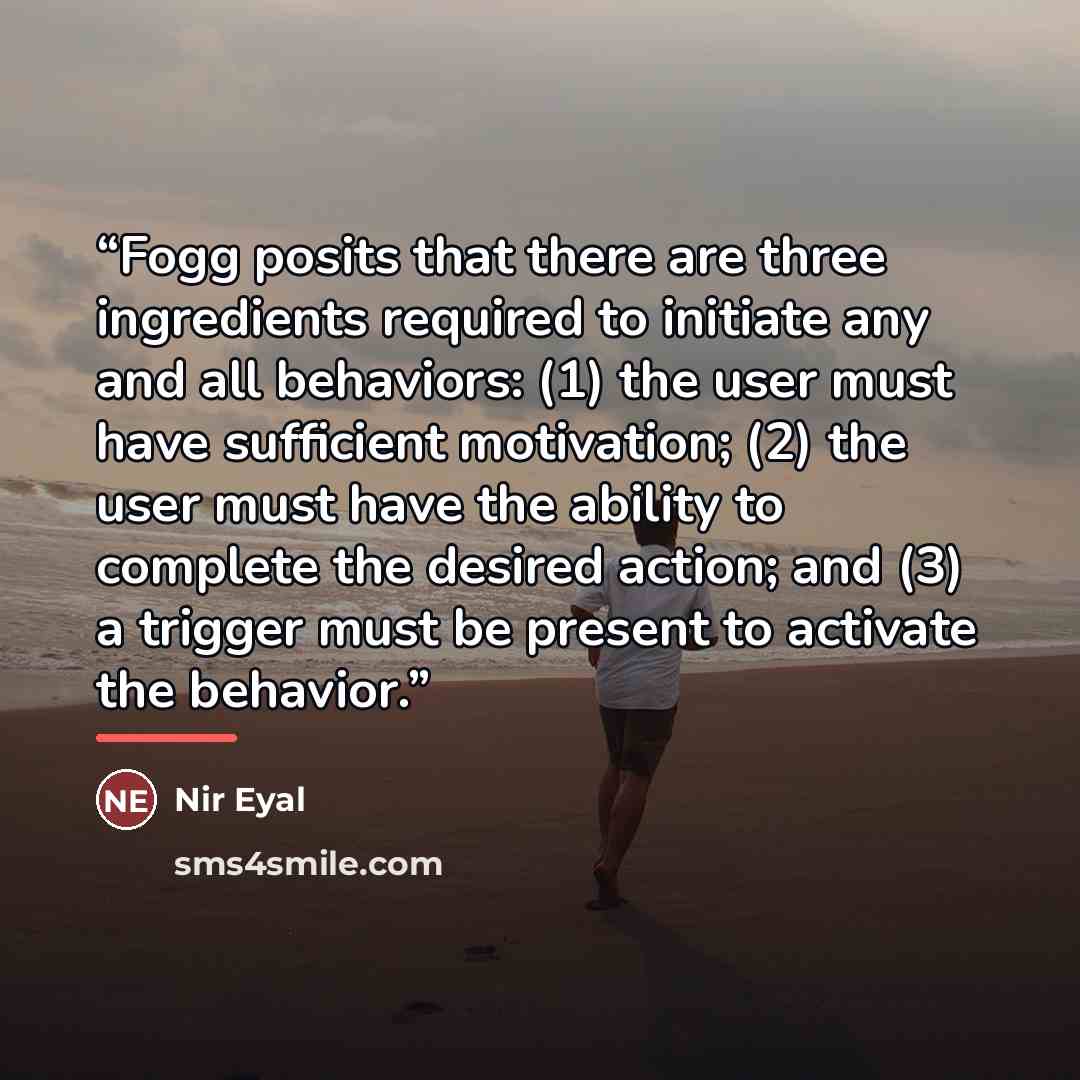
“Fogg posits that there are three ingredients required to initiate any and all behaviors: (1) the user must have sufficient motivation; (2)… — Nir Eyal Behaviors Copy Share Image
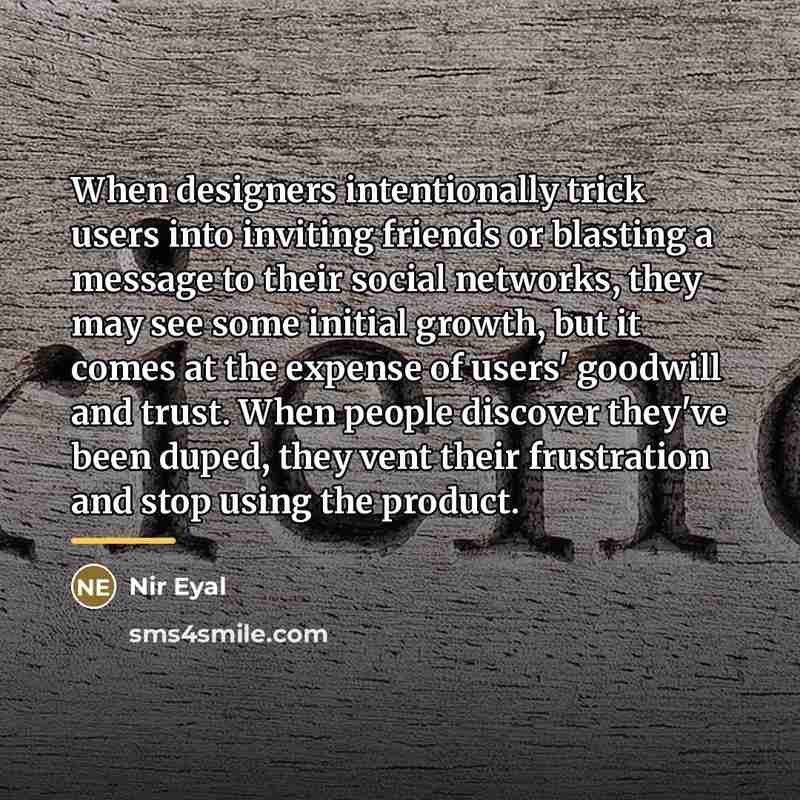
When designers intentionally trick users into inviting friends or blasting a message to their social networks, they may see some initial growth,… — Nir Eyal Designer Copy Share Image
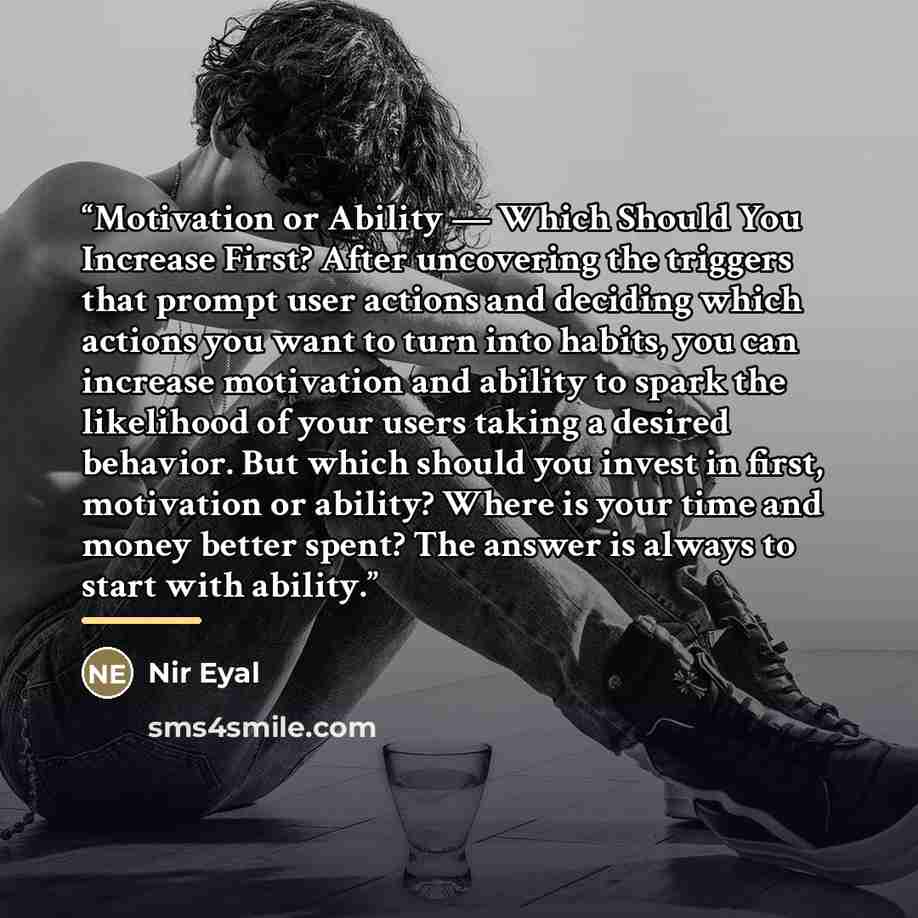
“Motivation or Ability — Which Should You Increase First? After uncovering the triggers that prompt user actions and deciding which actions you… — Nir Eyal Habits Copy Share Image
“Stephen Anderson, author of Seductive Interaction Design, created a tool called Mental Notes to help designers build better products through heuristics.[lxviii] Each… — Nir Eyal Books Copy Share Image
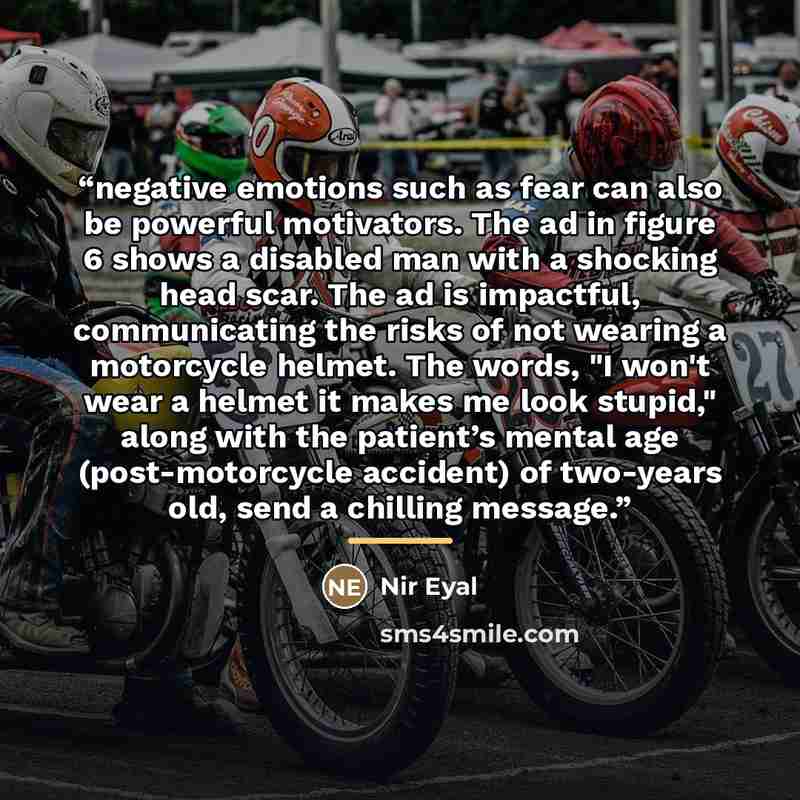
“negative emotions such as fear can also be powerful motivators. The ad in figure 6 shows a disabled man with a shocking… — Nir Eyal Fear Copy Share Image
“Pinterest users never know what they will find on the site. To keep them searching and scrolling, the company employs an unusual… — Nir Eyal Business Copy Share Image
“A company can begin to determine its product’s habit-forming potential by plotting two factors: frequency (how often the behavior occurs) and perceived… — Nir Eyal Business Copy Share Image
“Do This Now If you are building a habit-forming product, write down the answers to these questions: - What habits does your… — Nir Eyal Business Copy Share Image
“The need to acquire physical objects, such as food and other supplies that aid our survival, is part of our brain’s operating… — Nir Eyal Modern society Copy Share Image
“With every post, tweet, or pin, users anticipate social validation. Rewards of the tribe keep users coming back, wanting more. Sites that… — Nir Eyal Role models Copy Share Image
“You are now equipped to use the Hook Model to ask yourself these five fundamental questions for building effective hooks: 1. … — Nir Eyal Ask yourself Copy Share Image
“identified your habitual users, the next step is to codify the steps they took using your product to understand what hooked them.… — Nir Eyal Different ways Copy Share Image
“Email, for example, utilizes all three variable reward types. What subconsciously compels us to check our email? First, there is uncertainty surrounding… — Nir Eyal Material possessions Copy Share Image
“League of Legends has become well known for at least two things: proving the power of the free-to-play model in the West… — Nir Eyal Well known Copy Share Image
“Remember and Share - The Investment Phase is the fourth step in the Hook Model. - Unlike the Action Phase, which delivers… — Nir Eyal Cognitive dissonance Copy Share Image
“According to the Fogg Behavior Model, ability is the capacity to do a particular behavior. *** Fogg describes six “elements of… — Nir Eyal Ability Copy Share Image
“identify what the user is missing. What is making it difficult for the user to accomplish the desired action? Is the user… — Nir Eyal Habits Copy Share Image
As fleeting commitments, diets often fail. Thinking of dietary choices as part of who you are...can give them real staying power — Nir Eyal Choices Copy Share Image
“User habits are hard to break and confer powerful competitive advantages to any company fortunate enough to successfully create them.” — Nir Eyal Business Copy Share Image
“Habit-forming products often start as nice-to-haves (vitamins) but once the habit is formed, they become must-haves (painkillers).” — Nir Eyal Habit Copy Share Image
“Instead of asking ‘what problem should I solve?’ ask ‘what problem do I wish someone else would solve for me?’”[cxxxi]” — Nir Eyal Problem solving Copy Share Image
“Over time, Barbra associates Facebook with her need for social connection.” — Nir Eyal Social Copy Share Image
“According to a study by a mobile analytics firm, 26 percent of mobile apps in 2010 were downloaded and used only once.” — Nir Eyal Education Copy Share Image
For an infrequent action to become a habit, the user must perceive a high degree of utility, either from gaining pleasure or… — Nir Eyal Action Copy Share Image
“what draws us to act is not the sensation we receive from the reward itself, but the need to alleviate the craving… — Nir Eyal Craving Copy Share Image

![“The most important factor to increasing growth is ... Viral Cycle Time.”[xxv] Viral Cycle Time is the amount of time it takes a user to invite another user, and it can have a massive impact. “For example, after 20 days with a cycle time of two days, you will have 20,470 users,” quote by Nir Eyal](https://sms4smile.com/quotes/img-quotes/2c3/nir-eyal-1258_time_the-most-important-factor-to-increasing_1416967.jpg)
![“A 2010 study found that some habits can be formed in a matter of weeks while others can take more than five months.[xxxix] The researchers also found that the complexity of the behavior and how important the habit was to the person greatly affected how quickly the routine was formed.” quote by Nir Eyal](https://sms4smile.com/quotes/img-quotes/f91/nir-eyal-1258_education_a-2010-study-found-that-some-habits-can_1944731.jpg)
![“Stephen Anderson, author of Seductive Interaction Design, created a tool called Mental Notes to help designers build better products through heuristics.[lxviii] Each of the cards in his deck of 50 contains a brief description of a cognitive bias and is intended to spark product team conversations…” quote by Nir Eyal](https://sms4smile.com/quotes/img-quotes/b19/nir-eyal-1258_books_stephen-anderson-author-of-seductive-int_336893.jpg)
![“With every post, tweet, or pin, users anticipate social validation. Rewards of the tribe keep users coming back, wanting more. Sites that leverage tribal rewards benefit from what psychologist Albert Bandura called “social learning theory.”[lxxvi] Bandura studied the power of modeling and ascribed…” quote by Nir Eyal](https://sms4smile.com/quotes/img-quotes/48d/nir-eyal-1258_role-models_with-every-post-tweet-or-pin-users-antic_1305810.jpg)

![“League of Legends has become well known for at least two things: proving the power of the free-to-play model in the West and a vicious player community.”[lxxix] To combat the trolls, the game creators designed a reward system leveraging Bandura’s social learning theory, which they called Honor…” quote by Nir Eyal](https://sms4smile.com/quotes/img-quotes/771/nir-eyal-1258_well-known_league-of-legends-has-become-well-known_1266246.jpg)

![“According to the Fogg Behavior Model, ability is the capacity to do a particular behavior. *** Fogg describes six “elements of simplicity” — the factors that influence a task’s difficulty.[lxi] These are: - Time - How long it takes to complete an action. - Money - The fiscal cost of taking an…” quote by Nir Eyal](https://sms4smile.com/quotes/img-quotes/862/nir-eyal-1258_habits_according-to-the-fogg-behavior-model-abi_525627.jpg)

![“Instead of asking ‘what problem should I solve?’ ask ‘what problem do I wish someone else would solve for me?’”[cxxxi]” quote by Nir Eyal](https://sms4smile.com/quotes/img-quotes/805/nir-eyal-1258_problem-solving_instead-of-asking-what-problem-should-i_78727.jpg)