Regardless of our many differences, we all have the same needs. What differs is the strategy for fulfilling these needs. — Marshall B. Rosenberg Copy Share Image
Never connect yourself with the other person's pain. Just hear their need. Leave yourself out of the other person's feelings and needs. — Marshall B. Rosenberg Copy Share Image
We're not taught to think in terms of needs. We don't make nice dead people when we're in touch with needs. Domination… — Marshall B. Rosenberg Copy Share Image
The punitive use of force tends to generate hostility and to reinforce resistance to the very behavior we are seeking. — Marshall B. Rosenberg Copy Share Image
Not getting our needs fulfilled is painful - but it's a sweet pain, not suffering, which is what comes from life-alienated thinking… — Marshall B. Rosenberg Copy Share Image
Anger, depression, guilt, and shame are the product of the thinking that is at the base of violence on our planet. — Marshall B. Rosenberg Copy Share Image
NVC shows us a way of being very honest, but without any criticism, insults, or putdowns, and without any intellectual diagnosis implying… — Marshall B. Rosenberg Copy Share Image
If we want to make meetings productive, we need to keep track of those whose requests are on the table. — Marshall B. Rosenberg Copy Share Image
If we ask two questions, we will see that punishment never works. First: What do we want the other person to do?… — Marshall B. Rosenberg Copy Share Image
We are this divine energy. It's not something we have to attain. We just have to realize it, to be present to… — Marshall B. Rosenberg Copy Share Image
We can't win at somebody else's expense. We can only fully be satisfied when the other person's needs are fulfilled as well… — Marshall B. Rosenberg Copy Share Image
Miracles can happen when we can keep our consciousness away from analyzing and classifying one another. — Marshall B. Rosenberg Copy Share Image
Fear of corporal punishment obscures children's awareness of the compassion underlying the parent's demands. — Marshall B. Rosenberg Copy Share Image
Labeling and diagnosis is a catastrophic way to communicate. Telling other people what's wrong with them greatly reduces, almost to zero, the… — Marshall B. Rosenberg Copy Share Image
Nonviolent Communication shows us a way of being very honest, but without any criticism, without any insults, without any put-downs, without any… — Marshall B. Rosenberg Copy Share Image
NVC self-forgiveness: connecting with the need we were trying to meet when we took the action that we now regret. — Marshall B. Rosenberg Copy Share Image
My need is for safety, fun and to have distribution of resources, a sustainable life on the planet. NVC is a strategy… — Marshall B. Rosenberg Copy Share Image
My ultimate goal is to spend as many of my moments in life as I can in that world that the poet… — Marshall B. Rosenberg Copy Share Image
When our communication supports compassionate giving and receiving, happiness replaces violence and grieving. — Marshall B. Rosenberg Copy Share Image
We know the speaker has received adequate empathy when a. we sense a release of tension, or b. the flow of words… — Marshall B. Rosenberg Copy Share Image
When people hear needs, it provokes compassion. When people hear diagnoses, it provokes defensiveness and attack. — Marshall B. Rosenberg Copy Share Image
When it comes to giving advice, never do so unless you've first received a request in writing, signed by a lawyer. — Marshall B. Rosenberg Copy Share Image
Two things distinguish nonviolent actions from violent actions. First, you don't see an enemy and second, your intention is not to make… — Marshall B. Rosenberg Copy Share Image
The spirituality that we need to develop for social change is one that mobilizes us for social change. — Marshall B. Rosenberg Copy Share Image
Unless we as social change agents come from a certain kind of spirituality, we're likely to create more harm than good. — Marshall B. Rosenberg Copy Share Image
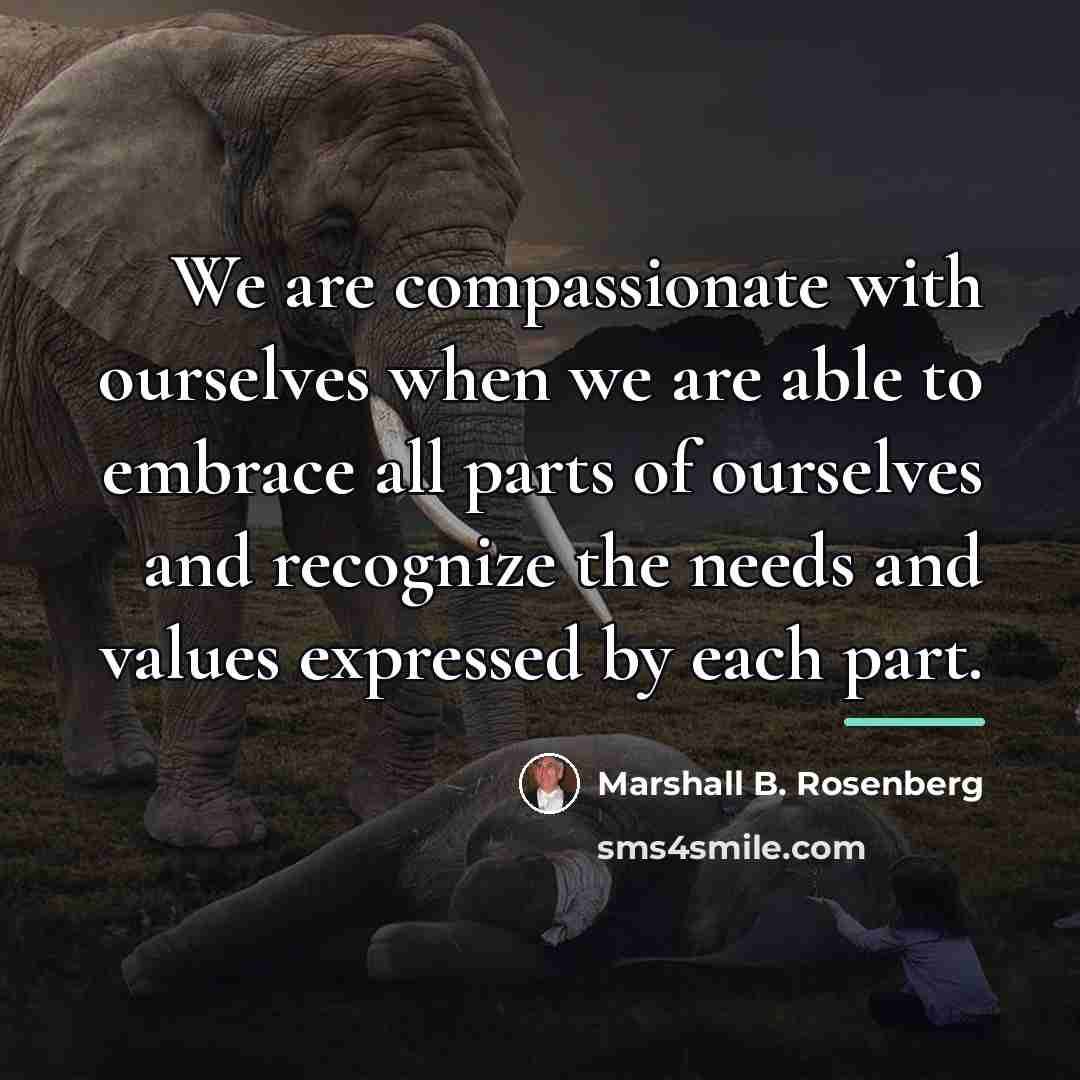
We are compassionate with ourselves when we are able to embrace all parts of ourselves and recognize the needs and values expressed… — Marshall B. Rosenberg Copy Share Image
We do not look for compromise; rather, we seek to resolve the conflict to everyone's complete satisfaction. — Marshall B. Rosenberg Copy Share Image
How I choose to look at any situation will greatly affect whether I have the power to change it or make matters… — Marshall B. Rosenberg Copy Share Image
I believe that the most joyful and intrinsic motivation human beings have for taking any action is the desire to meet our… — Marshall B. Rosenberg Copy Share Image
Also, think about your intentionality - are you getting lost in the method? or coming from the intentionality, the purpose? You don't… — Marshall B. Rosenberg Copy Share Image
All people ever say is: THANK YOU (a celebration of life) and PLEASE (an opportunity to make life more wonderful). — Marshall B. Rosenberg Copy Share Image
Fix-it jackals can't wait to fix it, because they don't know how to enjoy pain. And until you learn how to enjoy… — Marshall B. Rosenberg Copy Share Image
NVC is founded on language and communication skills that strengthen our ability to remain human, even under trying conditions. — Marshall B. Rosenberg Copy Share Image
However impressed we may be with NVC concepts, it is only through practice and application that our lives are transformed. — Marshall B. Rosenberg Copy Share Image
Understanding the other persons' needs does not mean you have to give up on your own needs. — Marshall B. Rosenberg Copy Share Image
Plans to exact retribution are never going to make us safer. — Marshall B. Rosenberg Copy Share Image
NVC gives us tools and understanding to create a more peaceful state of mind. — Marshall B. Rosenberg Copy Share Image
What I want in my life is compassion a flow between myself and others based on mutual giving from the heart. — Marshall B. Rosenberg Copy Share Image
Analyses of others are actually expressions of our own needs and values — Marshall B. Rosenberg Copy Share Image
Staying with empathy we allow speakers to touch deeper levels of themselves. — Marshall B. Rosenberg Copy Share Image
Often, instead of offering empathy, we have a strong urge to give advice or reassurance and to explain our own position or feeling. — Marshall B. Rosenberg Copy Share Image
NVC is founded on language and communication skills that strengthen our ability to remain human, even under trying conditions. — Marshall B. Rosenberg Copy Share Image
If you think ahead to what to say next - like how to fix it or make the person feel better - BOOM! Off… — Marshall B. Rosenberg Copy Share Image
Two questions help us see why we are unlikely to get what we want by using punishment... The first question is: What do I… — Marshall B. Rosenberg Copy Share Image
Praise and reward create a system of extrinsic motivations for behavior. Children (and adults) end up taking action in order to receive the praise… — Marshall B. Rosenberg Copy Share Image
Everything we do is in service of our needs. When this one concept is applied to our view of others, we'll see that we… — Marshall B. Rosenberg Copy Share Image