Evil is a source of moral intelligence in the sense that we need to learn from our shadow, from our dark side,… — John Bradshaw Be good Copy Share Image
“Shyness can become a serious problem when it is rooted in toxic shame.” — John Bradshaw Shame Copy Share Image
The more we know about how we lost our spontaneous wonder and creativity, the more we can find ways to get them… — John Bradshaw Creativity Copy Share Image
The foundation for our self-image is grounded in the first three years of life. It comes from our major caretaker's mirroring. — John Bradshaw Caretakers Copy Share Image
Children are natural Zen masters; their world is brand new in each and every moment. — John Bradshaw Children Copy Share Image
“Love-that which biologists, nervous about being misunderstood call "attachment"-fuels the bond between dog and master or mistress.” — John Bradshaw Animal Copy Share Image
Chronically dysfunctioning families are also delusional. Delusion is sincere denial. — John Bradshaw Delusion Copy Share Image
“A racket is a family-authorized feeling used to replace an unacceptable and shameful feeling.” — John Bradshaw Feeling Copy Share Image
“With the child already shame-based, the feeling of discouragement takes over the whole personality. As the shame-based child forms her primitive conscience,… — John Bradshaw Children Copy Share Image
“We humans are finite, “perfectly imperfect.” Limitation is our essential nature. Grave problems result from refusing to accept our limits. Healthy shame… — John Bradshaw Guilt Copy Share Image
Many self-help books give you these neat, tidy formulas that are really illusions. They dupe people into thinking, 'Well if I can… — John Bradshaw Books Copy Share Image
“In fact, the most paradoxical aspect of neurotic shame is that it is the core motivator of the superachieved and the underachieved,… — John Bradshaw Aspect Copy Share Image
“Toxically shamed people tend to become more and more stagnant as life goes on. They live in a guarded, secretive and defensive… — John Bradshaw Guilt Copy Share Image
Recovery begins with embracing our pain and taking the risk to share it with others. We do this by joining a group… — John Bradshaw Groups Copy Share Image
True love heals and affects spiritual growth. If we do not grow because of someone else’s love, it’s generally because it is… — John Bradshaw Counterfeit Copy Share Image
“CHIEF COMPONENT The chief component in the family system is the marriage. If the marriage is healthy and functional, the family will… — John Bradshaw Family Copy Share Image
The feeling of righteousness is the core mood alteration among religious addicts. Religious addiction is a massive problem in our society. It… — John Bradshaw Addict Copy Share Image
“Because the exposure of self to self lies at the heart of neurotic shame, escape from the self is necessary. The escape… — John Bradshaw Authentic self Copy Share Image
“Being abandoned through the neglect of our developmental dependency needs is the major factor in becoming an adult child. We grow up;… — John Bradshaw Becoming an adult Copy Share Image
“PERFECTIONISM Perfectionism is a family system rule and a core culprit in creating toxic shame. We see it also in both the… — John Bradshaw Family Copy Share Image
“To be severed and alienated within oneself also creates a sense of unreality. One may have an all-pervasive sense of never quite… — John Bradshaw Authentic self Copy Share Image
“A child can only experience his feelings when there is someone there who fully accepts them, names them and supports them. Another… — John Bradshaw Abandonment Copy Share Image
“When our e-motions are not mirrored and named, we lose contact with one of our vital human powers. Parents who are out… — John Bradshaw Child Copy Share Image
“This means that shame monitors excitement and pleasure. Nature has made the sexual experience the most exciting and pleasurable of all our… — John Bradshaw Hand in hand Copy Share Image
“Another dynamic aspect of the sexual conversion of basic needs is the pleasure of sexual orgasm itself. When one is shamed through… — John Bradshaw Communication Copy Share Image
“Alice Miller writes: There are large numbers of people who suffer from narcissistic disorders, who often had sensitive and caring parents from… — John Bradshaw Gifts and talents Copy Share Image
“3. Blame. Whenever things don’t turn out as planned, blame yourself or others. Blame is another defensive cover-up for shame. Blame maintains… — John Bradshaw Blame Copy Share Image
“Family secrets can go back for generations. They can be about suicides, homicides, incest, abortions, addictions, public loss of face, financial disaster,… — John Bradshaw Family Copy Share Image
“In the face of it, we are powerless. All recovering persons come to a turning point in their lives precipitated by the… — John Bradshaw Addiction Copy Share Image
“SOCIETY AS COMPULSIVE AND ADDICTED Our society is highly addictive. We have sixty million sexual abuse victims. Possibly seventy-five million lives are… — John Bradshaw Addiction Copy Share Image
“There is no way you can share your inner self because you are an object of contempt to yourself. When you are… — John Bradshaw Identity Copy Share Image
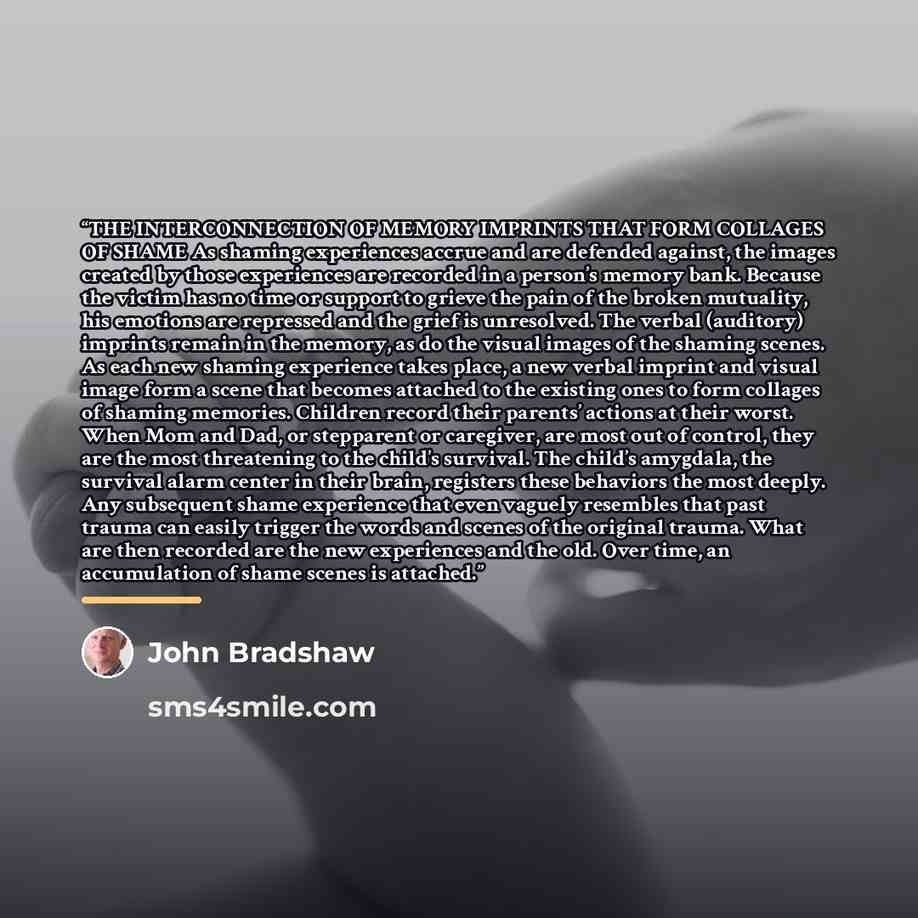
“THE INTERCONNECTION OF MEMORY IMPRINTS THAT FORM COLLAGES OF SHAME As shaming experiences accrue and are defended against, the images created by… — John Bradshaw Grief Copy Share Image
“Perhaps nothing so accurately characterizes dysfunctional families as denial.” — John Bradshaw Abuse-survivors Copy Share Image
I know from my own clinical work that when people are beaten and hurt, they numb out so that they cant feel… — John Bradshaw Beaten Copy Share Image
Growing up means leaving home and becoming a self supporting adult. I think this the hardest task any human being hast to… — John Bradshaw Adults Copy Share Image
“Giving and receiving unconditional love is the most effective and powerful way to personal wholeness and happiness.” — John Bradshaw Giving and receiving Copy Share Image
“The shared secret and the shared denial are the most horrible aspects of incest.” — John Bradshaw Abusive father Copy Share Image
Hell, in my opinion, is never finding your true self and never living your own life or knowing who you are. — John Bradshaw Findings Copy Share Image