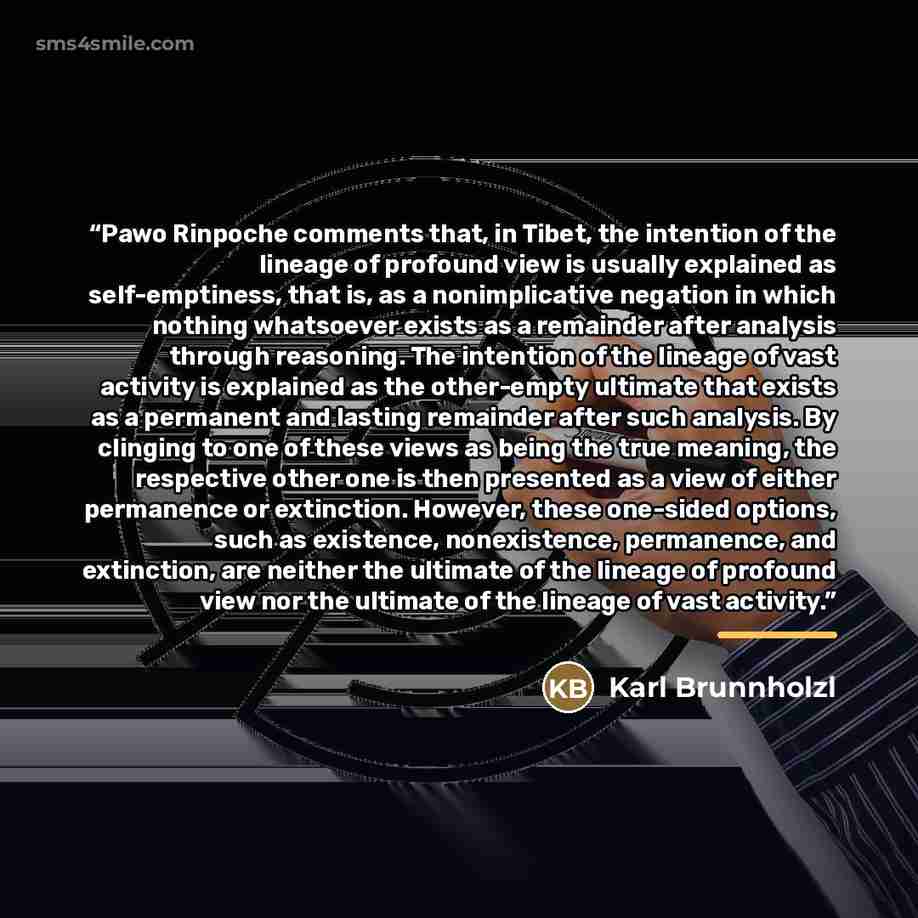
““He underlines the distinction between mental nonengagement and the absence of mental engagement. The first is understood as the fundamental noninvolvement in dualistic appearances while sustaining fresh wakefulness, once discriminating knowledge has determined that there are no dualistic phenomena whatsoever. This can also be understood as mental disengagement in the sense of not interfering with the nature of the mind as it is. On the other hand, absence of mental engagement describes the mere absence of any mental activity, such as in a faint, deep sleep, or mental stupor, which does not lead to any realization or liberation at all. Thus, Kamalasila emphasizes that the first is a crucial factor in meditation, while the latter is obviously to be avoided.””
![“Its meaning is to rest one-pointedly on the focal object [of meditation], without being distracted by other thoughts. If this [one-pointed resting] were stopped, all meditative concentrations would stop. Therefore, in general, "mental nonengagement" has the meaning of not mentally engaging in any…” quote by Karl Brunnholzl](https://sms4smile.com/quotes/img-quotes/604/karl-brunnholzl-4600_focus_its-meaning-is-to-rest-one-pointedly-on_1635099.jpg)


![“Hence, [emptiness] is also not an object of [something like the] cognition of Buddhas, because they do not have [such a thing as] cognition.” quote by Karl Brunnholzl](https://sms4smile.com/quotes/img-quotes/c69/karl-brunnholzl-4600_psychology_hence-emptiness-is-also-not-an-object-of_55069.jpg)
![“Here, master Bhavya states [this as] the main argument, and then he formulates four autonomous reasons as the means to prove the subject property. The venerable and fearless Candrakirti presents this by labeling the mere refutation of arising from the four extremes a "position." He teaches the…” quote by Karl Brunnholzl](https://sms4smile.com/quotes/img-quotes/cb7/karl-brunnholzl-4600_logic_here-master-bhavya-states-this-as-the-ma_140001.jpg)
![“Therefore, everything is the illusory magical display of one's own mind. It is appearing yet delusive, and delusive while appearing. Thus, all of it is contained in the body, and the [body] is again contained in the mind. As for the mind, it has no color and no shape. It is natural luminosity that…” quote by Karl Brunnholzl](https://sms4smile.com/quotes/img-quotes/8f8/karl-brunnholzl-4600_psychology_therefore-everything-is-the-illusory-mag_189022.jpg)
![“Not only can nobody deny the appearance of mere consciousness whose nature is other-dependent and not affected by the flaw of conceptions of a body with form and so on, but those who make any such [denial] only invalidate themselves by perception and such.” quote by Karl Brunnholzl](https://sms4smile.com/quotes/img-quotes/52d/karl-brunnholzl-4600_nature_not-only-can-nobody-deny-the-appearance_199293.jpg)




![“...even though [my psychiatrist] understood mor than anyone how much I felt I was losing--in energy, vivacity, and originality--by taking medication, he never was seduced into losing sight of the overall perspective of how costly, damaging, and life threatening my illness was. He was at ease with…” quote by Kay Redfield Jamison](https://sms4smile.com/quotes/img-quotes/57f/kay-redfield-jamison-1826_life_even-though-my-psychiatrist-understood-m_3399.jpg)