Censoring Quote by Robert B. Cialdini
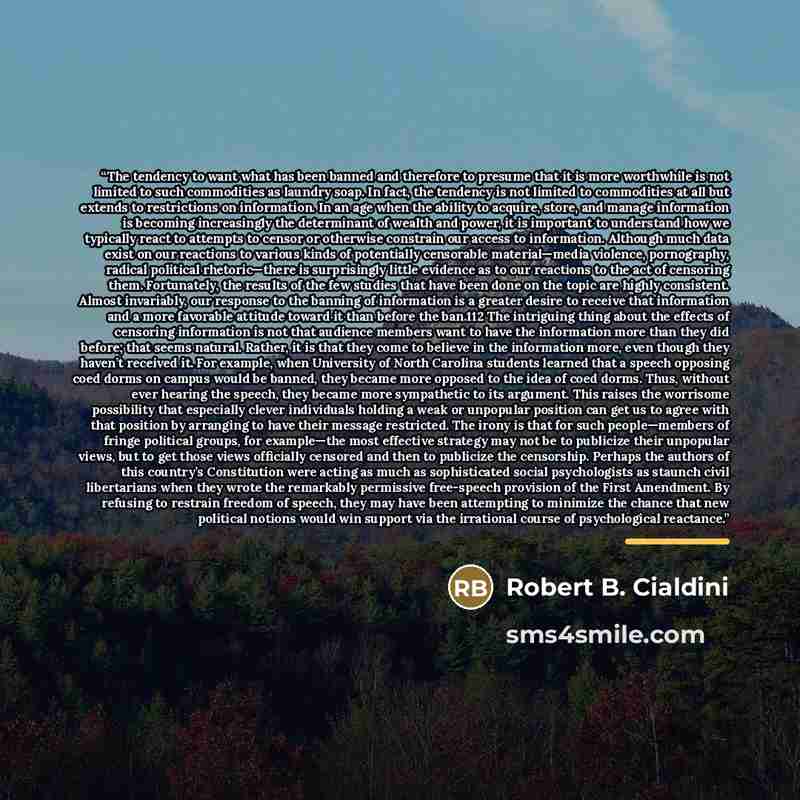
““The tendency to want what has been banned and therefore to presume that it is more worthwhile is not limited to such commodities as laundry soap. In fact, the tendency is not limited to commodities at all but extends to restrictions on information. In an age when the ability to acquire, store, and manage information is becoming increasingly the determinant of wealth and power, it is important to understand how we typically react to attempts to censor or otherwise constrain our access to information. Although much data exist on our reactions to various kinds of potentially censorable material—media violence, pornography, radical political rhetoric—there is surprisingly little evidence as to our reactions to the act of censoring them. Fortunately, the results of the few studies that have been done on the topic are highly consistent. Almost invariably, our response to the banning of information is a greater desire to receive that information and a more favorable attitude toward it than before the ban.112 The intriguing thing about the effects of censoring information is not that audience members want to have the information more than they did before; that seems natural. Rather, it is that they come to believe in the information more, even though they haven’t received it. For example, when University of North Carolina students learned that a speech opposing coed dorms on campus would be banned, they became more opposed to the idea of coed dorms. Thus, without ever hearing the speech, they became more sympathetic to its argument. This raises the worrisome possibility that especially clever individuals holding a weak or unpopular position can get us to agree with that position by arranging to have their message restricted. The irony is that for such people—members of fringe political groups, for example—the most effective strategy may not be to publicize their unpopular views, but to get those views officially censored and then to publicize the censorship. Perhaps the authors of this country’s Constitution were acting as much as sophisticated social psychologists as staunch civil libertarians when they wrote the remarkably permissive free-speech provision of the First Amendment. By refusing to restrain freedom of speech, they may have been attempting to minimize the chance that new political notions would win support via the irrational course of psychological reactance.””
About This Quote
Censorship paradoxically heightens desire and perceived credibility of the prohibited information, even without exposure.
In simple terms: Forbidden info becomes more attractive and trusted.
Key Takeaway
Banning can backfire, boosting belief in the censored message.
Themes
psychology of restriction
information scarcity
censorship effects
belief formation
social influence
reactance
Mood
intrigue
caution
critical
Type
analytical
observational
When to use this quote
- political campaigns
- academic debates
- media regulation
- activist messaging
- online platforms
Key Concepts
reactance theory
confirmation bias
information asymmetry
fringe persuasion
Practical Applications
- designing communication strategies
- policy evaluation
Questions to Reflect On
- How might a ban alter public perception of a controversial idea?
- What safeguards could mitigate the backfire effect of censorship?
A Different Perspective
Some may argue that bans deter exposure, but evidence shows the opposite for many audiences.
![“[Censoring] knowledge, telling people what they must think and what ideas are impermissible, which lines of evidence may not be pursued, is the aperture to thought police, foolish and incompetent decision-making, and long-term decline.” quote by Carl Sagan](https://sms4smile.com/quotes/img-quotes/d65/carl-sagan-160_censorship_censoring-knowledge-telling-people-what_2215659.jpg)
![“In the past, censorship worked by blocking the flow of information. In the twenty-first century, censorship works by flooding people with irrelevant information. [...] In ancient times having power meant having access to data. Today having power means knowing what to ignore.” quote by Yuval Noah Harari](https://sms4smile.com/quotes/img-quotes/35b/yuval-noah-harari-100_power_in-the-past-censorship-worked-by-blockin_2786788.jpg)