Business Quote by Brian de Haaff

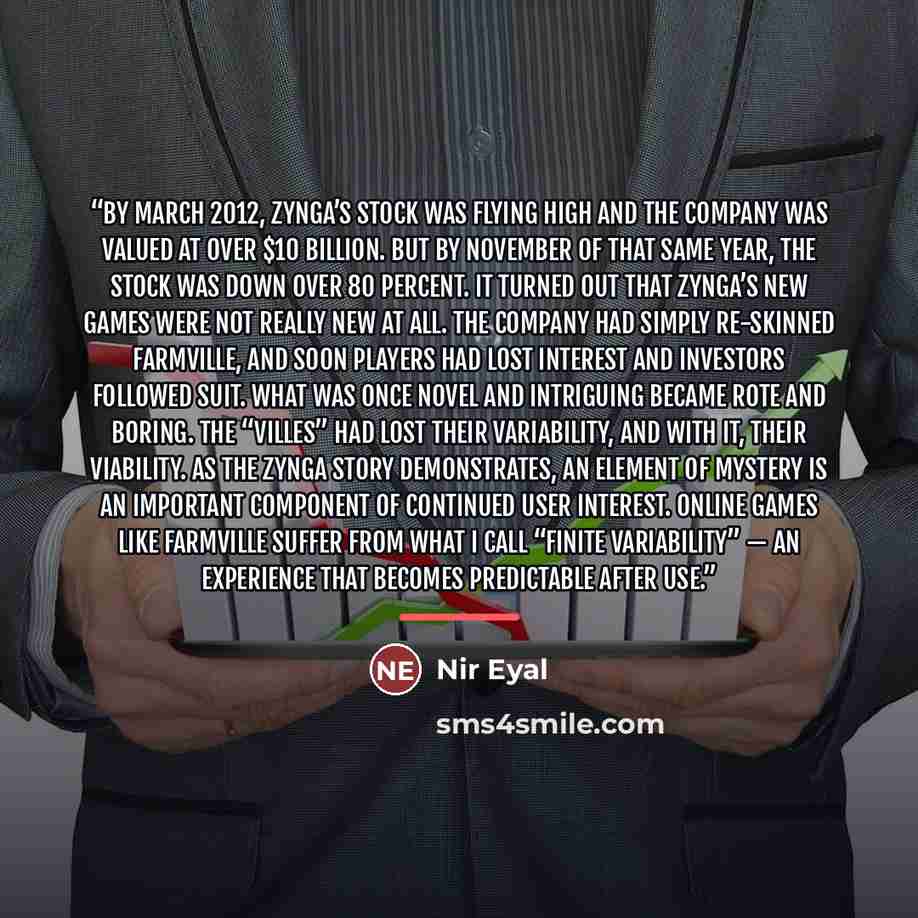
““Persson did not create Minecraft because he wanted to create a billion-dollar company; he loved video games and kept his day job while developing it. When the game soared in popularity, he started a company, Mojang, with some of the profits, but kept it small, with just 12 employees. Even with zero dollars spent on marketing and no user instructions, Minecraft grew exponentially, flying past the 100 million registered user mark in 2014 based largely on word of mouth.2 Players shared user-generated extras like modifications (“mods”) and custom maps with each other, and the game caught on not only with children but their parents and even educators. Still, Persson avoided the valuation game, refusing an investment offer from former Facebook president Sean Parker. Finally, he and his co-founders sold Mojang to Microsoft for $2.5 billion, a fortune built on one man’s focus on creating something that people loved.3 On the other end of the spectrum is Zynga, one of the fastest startups ever to reach a $1 billion valuation.4 The social game developer had its first hit in 2009 with FarmVille. Next came Zynga’s partnership with Facebook that turned into a growth engine. The company began trading on the NASDAQ in December 2011 and had 253 million active users per month as late as the first quarter of 2013.5 Then the relationship with Facebook ended and the wheels started coming off. Flush with IPO cash, Zynga started exhibiting all the symptoms of ego-driven, grow-at-any-cost syndrome. They moved into a $228 million headquarters in San Francisco. They began hastily acquiring companies like NaturalMotion, Newtoy, and Area/Code. They infuriated customers by launching new games without sufficient testing and filling them with scripts that signed players up for unwanted subscriptions and services. When customer outrage went viral, instead of focusing on building better products, Zynga hired a behavioral psychologist to try to trick customers into loving its games.6 In a 2009 speech at Startup@Berkeley, CEO Mark Pincus said, “I funded [Zynga] myself but I did every horrible thing in the book to just get revenues right away. I mean, we gave our users poker chips if they downloaded this Zwinky toolbar, which . . . I downloaded it once — I couldn’t get rid of it. We did anything possible just to just get revenues so that we could grow and be a real business.”7 By the spring of 2016, Zynga had laid off about 18 percent of its workforce and its share price had declined from $14.50 in 2012 to about $2.50.””
About This Quote
The passage contrasts two tech company paths: Minecraft's organic growth via community and modest scale versus Zynga's rapid, investment‑driven expansion and subsequent decline, illustrating sustainable versus aggressive growth strategies.
In simple terms: Community‑driven growth can outlast aggressive scaling.
Key Takeaway
Prioritize product love and community over rapid valuation.
Themes
business
growth
sustainability
Mood
insightful
balanced
Type
business
motivational
When to use this quote
- entrepreneurship
- gaming industry
- company scaling
Key Concepts
startup strategy
product‑market fit
Questions to Reflect On
- What makes a product beloved?
- How can companies balance growth with quality?
A Different Perspective
Aggressive scaling can lead to quality loss and backlash.
















![“[S]ometimes, when you are a food person, the possible irrelevance of what you are doing doesn’t cross your mind until it’s too late. (Once, for example, when I was just starting out in the food business, I was hired by the caper people to develop a lot of recipes using capers, and it was weeks of…” quote by Nora Ephron](https://sms4smile.com/quotes/img-quotes/d79/nora-ephron-1217_business_s-ometimes-when-you-are-a-food-person-th_980.jpg)

![“If the State does not acquire supremacy over [vast private] enterprises, it becomes their puppet, and they become the real State.” quote by Bertrand Russell](https://sms4smile.com/quotes/img-quotes/bad/bertrand-russell-69_acquire_if-the-state-does-not-acquire-supremacy_1379.jpg)