Character is that which reveals moral purpose, exposing the class of things a man chooses and avoids. — Aristotle Copy Share Image
Justice is that virtue of the soul which is distributive according to desert. — Aristotle Copy Share Image
Virtue is the golden mean between two vices, the one of excess and the other of deficiency. — Aristotle Copy Share Image
The honors and rewards fall to those who show their good qualities in action. — Aristotle Copy Share Image
Emotions of any kind can be evoked by melody and rhythm; therefore music has the power to form character. — Aristotle Copy Share Image
The good citizen need not of necessity possess the virtue which makes a good man. — Aristotle Copy Share Image
A good character carries with it the highest power of causing a thing to be believed. — Aristotle Copy Share Image
Virtue is more clearly shown in the performance of fine ACTIONS than in the non-performance of base ones. — Aristotle Copy Share Image
“Virtue lies in our power, and similarly so does vice; because where it is in our power to act, it is also… — Aristotle Copy Share Image
Some vices miss what is right because they are deficient, others because they are excessive, in feelings or in actions, while virtue… — Aristotle Copy Share Image
A state of the soul is either (1) an emotion, (2) a capacity, or (3) a disposition; virtue therefore must be one… — Aristotle Copy Share Image
Music has a power of forming the character, and should therefore be introduced into the education of the young. — Aristotle Copy Share Image
“Hence while in respect of its substance and the definition that states what it really is in essence virtue is the observance… — Aristotle Copy Share Image
To enjoy the things we ought and to hate the things we ought has the greatest bearing on excellence of character. — Aristotle Copy Share Image
It is their character indeed that makes people who they are. But it is by reason of their actions that they are… — Aristotle Copy Share Image
“Virtue is a greater good than honour; and one might perhaps accordingly suppose that virtue rather than honour is the end of… — Aristotle Copy Share Image
Of means of persuading by speaking there are three species: some consist in the character of the speaker; others in the disposing… — Aristotle Copy Share Image
“good character is the indispensable condition and chief determinant of happiness, itself the goal of all human doing. The end of all… — Aristotle Copy Share Image
“To feel these feelings at the right time, on the right occasion, towards the right people, for the right purpose and in… — Aristotle Copy Share Image
Persuasion is achieved by the speaker's personal character when the speech is so spoken as to make us think him credible. We… — Aristotle Copy Share Image
“Now if you have proofs to bring forward, bring them forward, and your moral discourse as well; if you have no enthymemes,… — Aristotle Copy Share Image
There are, then, three states of mind ... two vices--that of excess, and that of defect; and one virtue--the mean; and all… — Aristotle Copy Share Image
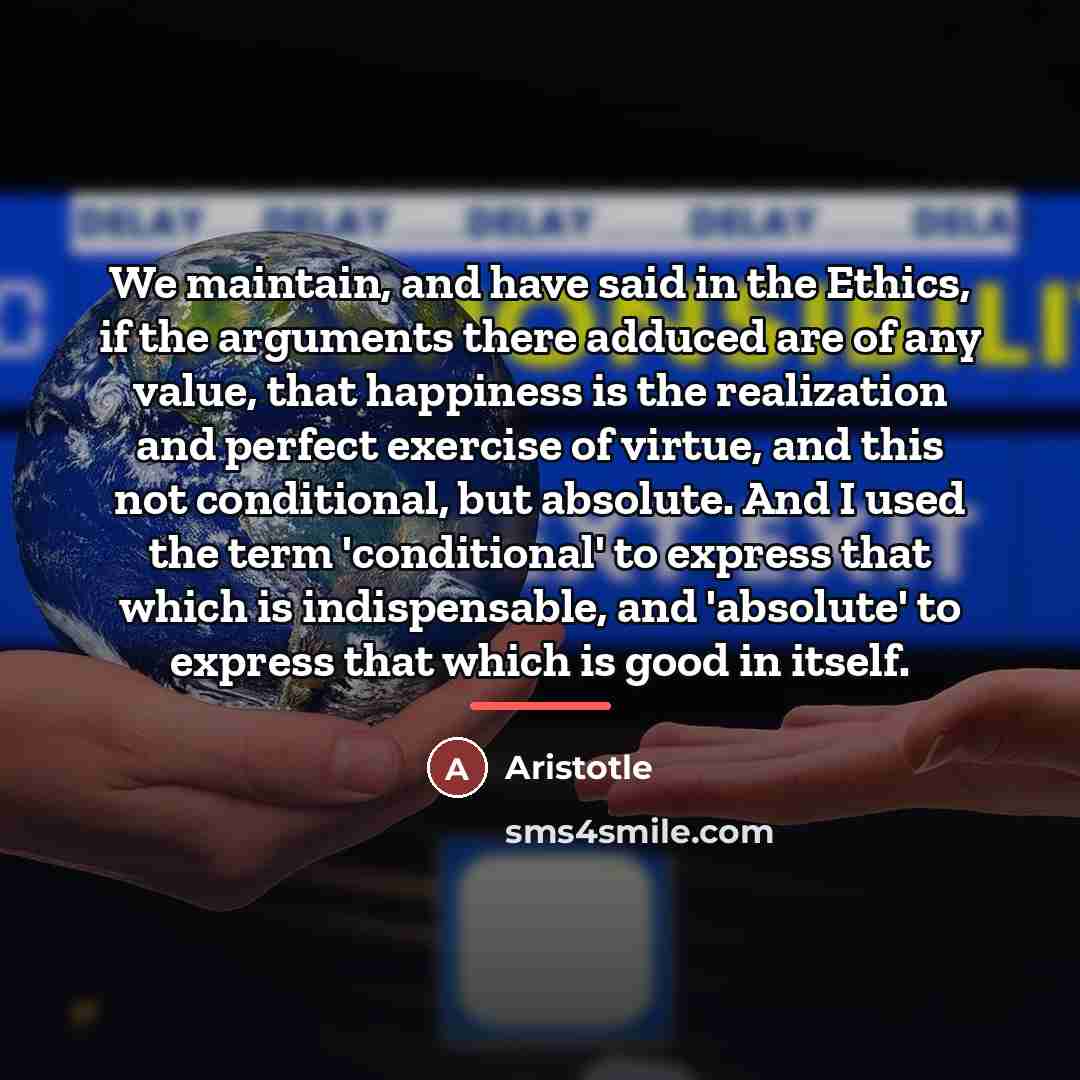
We maintain, and have said in the Ethics, if the arguments there adduced are of any value, that happiness is the realization… — Aristotle Copy Share Image
If then, as we say, good craftsmen look to the mean as they work, and if virtue, like nature, is more accurate… — Aristotle Copy Share Image
“Courage is the first of human virtues because it makes all others possible.” — Aristotle Copy Share Image
Character gives us qualities, but it is in our actions — what we do — that we are happy or the reverse. — Aristotle Copy Share Image
Moral qualities are so constituted as to be destroyed by excess and by deficiency . . . — Aristotle Copy Share Image
“None of the moral virtues is engendered in us by nature, for no natural property can be altered by habit.” — Aristotle Copy Share Image
Virtue makes us aim at the right end, and practical wisdom makes us take the right means. — Aristotle Copy Share Image
“Moral experience—the actual possession and exercise of good character—is necessary truly to understand moral principles and profitably to apply them.” — Aristotle Copy Share Image
Since music has so much to do with the molding of character, it is necessary that we teach it to our children. — Aristotle Copy Share Image
Good moral character is not something that we can achieve on our own. We need a culture that supports the conditions under… — Aristotle Copy Share Image
“The virtues therefore are engendered in us neither by nature nor yet in violation of nature; nature gives us the capacity to… — Aristotle Copy Share Image
True happiness flows from the possession of wisdom and virtue and not from the possession of external goods. — Aristotle Copy Share Image
The Good of man is the active exercise of his soul's faculties in conformity with excellence or virtue, or if there be… — Aristotle Copy Share Image
The knowledge of the soul admittedly contributes greatly to the advance of truth in general, and, above all, to our understanding of Nature, for… — Aristotle Copy Share Image
Young men have strong passions and tend to gratify them indiscriminately. Of the bodily desires, it is the sexual by which they are most… — Aristotle Copy Share Image
The body is at its best between the ages of thirty and thirty-five; the mind is at its best about the age of forty-nine. — Aristotle Copy Share Image
The ensouled is distinguished from the unsouled by its being alive. Now since being alive is spoken of in many ways, even if only… — Aristotle Copy Share Image
Although it may be difficult in theory to know what is just and equal, the practical difficulty of inducing those to forbear who can,… — Aristotle Copy Share Image
The true forms of government, therefore, are those in which the one, or the few, or the many, govern with a view to the… — Aristotle Copy Share Image
All persons ought to endeavor to follow what is right, and not what is established. — Aristotle Copy Share Image
Give a man a fish, you feed him for a day. Give a man a poisoned fish, you feed him for the rest of… — Aristotle Copy Share Image
The man who confers a favour would rather not be repaid in the same coin. — Aristotle Copy Share Image
Obstinate people can be divided into the opinionated, the ignorant, and the boorish. — Aristotle Copy Share Image
Happiness does not consist in pastimes and amusements but in virtuous activities. — Aristotle Copy Share Image
To learn is a natural pleasure, not confined to philosophers, but common to all men. — Aristotle Copy Share Image
![“If then, as we say, good craftsmen look to the mean as they work, and if virtue, like nature, is more accurate and better than any form of art, it will follow that virtue has the quality of hitting the mean. I refer to moral virtue [not intellectual], for this is concerned with emotions and…” quote by Aristotle](https://sms4smile.com/quotes/img-quotes/796/aristotle-78_accurate_if-then-as-we-say-good-craftsmen-look-to_695282.jpg)