The knowledge of the soul admittedly contributes greatly to the advance of truth in general, and, above all, to our understanding of… — Aristotle Copy Share Image
The ensouled is distinguished from the unsouled by its being alive. Now since being alive is spoken of in many ways, even… — Aristotle Copy Share Image
The End is included among goods of the soul, and not among external goods. — Aristotle Copy Share Image
In [the soul] one part naturally rules, and the other is subject, and the virtue of the ruler we maintain to be… — Aristotle Copy Share Image
A state of the soul is either (1) an emotion, (2) a capacity, or (3) a disposition; virtue therefore must be one… — Aristotle Copy Share Image
The heart is the perfection of the whole organism. Therefore the principles of the power of perception and the souls ability to… — Aristotle Copy Share Image
The soul has two parts, one rational and the other irrational. Let us now similarly divide the rational part, and let it… — Aristotle Copy Share Image
If a man of good natural disposition acquires Intelligence [as a whole], then he excels in conduct, and the disposition which previously… — Aristotle Copy Share Image
Music imitates (represents) the passions or states of the soul, such as gentleness, anger, courage, temperance, and their opposites. — Aristotle Copy Share Image
The good of man is the active exercise of his soul's faculties. This exercise must occupy a complete lifetime. One swallow does… — Aristotle Copy Share Image
That in the soul which is called the mind is, before it thinks, not actually any real thing. — Aristotle Copy Share Image
To the query, ''What is a friend?'' his reply was ''A single soul dwelling in two bodies.'' — Aristotle Copy Share Image
These virtues are formed in man by his doing the actions ... The good of man is a working of the soul… — Aristotle Copy Share Image
Whether if soul did not exist time would exist or not, is a question that may fairly be asked; for if there… — Aristotle Copy Share Image
This body is not a home, but an inn; and that only for a short time. Seneca Friendship is composed of a… — Aristotle Copy Share Image
In bad or corrupted natures the body will often appear to rule over the soul, because they are in an evil and… — Aristotle Copy Share Image
While the faculty of sensation is dependent upon the body, mind is separable from it — Aristotle Copy Share Image
We have divided the Virtues of the Soul into two groups, the Virtues of the Character and the Virtues of the Intellect. — Aristotle Copy Share Image
There also appears to be another element in the soul, which, though irrational, yet in a manner participates in rational principle. — Aristotle Copy Share Image
If thinking is like perceiving, it must be either a process in which the soul is acted upon by what is capable… — Aristotle Copy Share Image
Of actions some aim at what is necessary and useful, and some at what is honorable. And the preference given to one… — Aristotle Copy Share Image
The knowledge of the soul admittedly contributes greatly to the advance of truth in general, and, above all, to our understanding of Nature, for… — Aristotle Copy Share Image
Young men have strong passions and tend to gratify them indiscriminately. Of the bodily desires, it is the sexual by which they are most… — Aristotle Copy Share Image
The body is at its best between the ages of thirty and thirty-five; the mind is at its best about the age of forty-nine. — Aristotle Copy Share Image
The ensouled is distinguished from the unsouled by its being alive. Now since being alive is spoken of in many ways, even if only… — Aristotle Copy Share Image
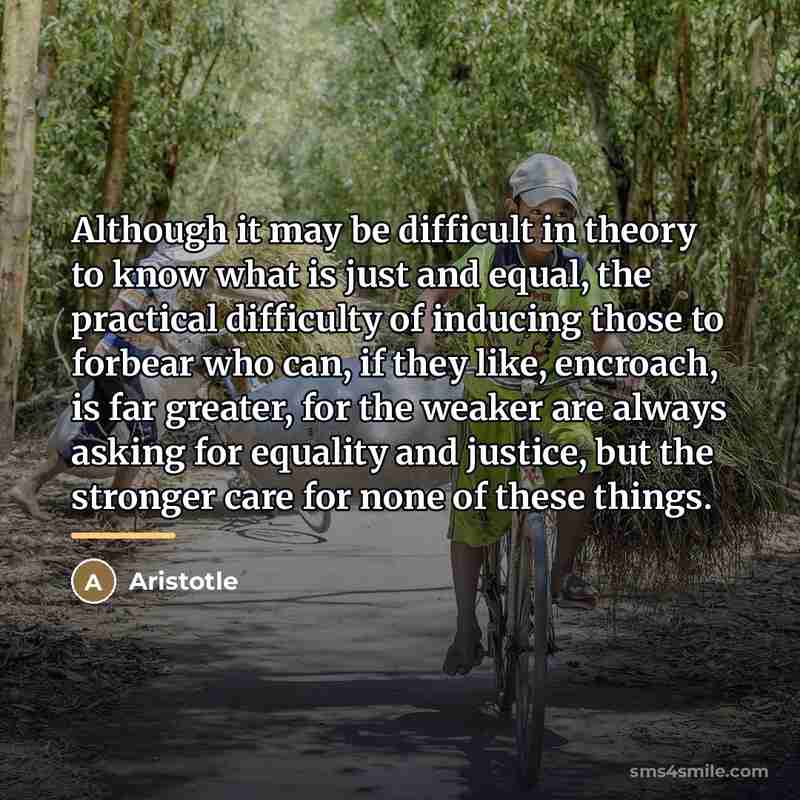
Although it may be difficult in theory to know what is just and equal, the practical difficulty of inducing those to forbear who can,… — Aristotle Copy Share Image
The true forms of government, therefore, are those in which the one, or the few, or the many, govern with a view to the… — Aristotle Copy Share Image
All persons ought to endeavor to follow what is right, and not what is established. — Aristotle Copy Share Image
Give a man a fish, you feed him for a day. Give a man a poisoned fish, you feed him for the rest of… — Aristotle Copy Share Image
The man who confers a favour would rather not be repaid in the same coin. — Aristotle Copy Share Image
Obstinate people can be divided into the opinionated, the ignorant, and the boorish. — Aristotle Copy Share Image