He who sees things grow from the beginning will have the best view of them. — Aristotle Copy Share Image
... the science we are after is not about mathematicals either none of them, you see, is separable. — Aristotle Copy Share Image
Everything that depends on the action of nature is by nature as good as it can be. — Aristotle Copy Share Image
It is no part of a physician's business to use either persuasion or compulsion upon the patients. — Aristotle Copy Share Image
The high-minded man must care more for the truth than for what people think. — Aristotle Copy Share Image
Every science and every inquiry, and similarly every activity and pursuit, is thought to aim at some good. — Aristotle Copy Share Image
It is evidently equally foolish to accept probable reasoning from a mathematician and to demand from a rhetorician demonstrative proofs. — Aristotle Copy Share Image
It is clear that there is some difference between ends: some ends are energeia [energy], while others are products which are additional… — Aristotle Copy Share Image
The mathematical sciences particularly exhibit order symmetry and limitations; and these are the greatest forms of the beautiful. — Aristotle Copy Share Image
Nature does nothing without a purpose. In children may be observed the traces and seeds of what will one day be settled… — Aristotle Copy Share Image
For it is owing to their wonder that men both now begin and at first began to philosophize... They were pursuing science… — Aristotle Copy Share Image
“Hence anyone who is to listen intelligently to lectures about what is noble and just and, generally, about the subjects of political… — Aristotle Copy Share Image
Our account does not rob the mathematicians of their science... In point of fact they do not need the infinite and do… — Aristotle Copy Share Image
Conscientious and careful physicians allocate causes of disease to natural laws, while the ablest scientists go back to medicine for their first… — Aristotle Copy Share Image
In the case of some people, not even if we had the most accurate scientific knowledge, would it be easy to persuade… — Aristotle Copy Share Image
For any two portions of fire, small or great, will exhibit the same ratio of solid to void; but the upward movement… — Aristotle Copy Share Image
Anaximenes and Anaxagoras and Democritus say that its [the earth's] flatness is responsible for it staying still: for it does not cut… — Aristotle Copy Share Image
“Every art, and every science reduced to a teachable form, and in like manner every action and moral choice, aims, it is… — Aristotle Copy Share Image
Those who assert that the mathematical sciences say nothing of the beautiful or the good are in error. For these sciences say… — Aristotle Copy Share Image
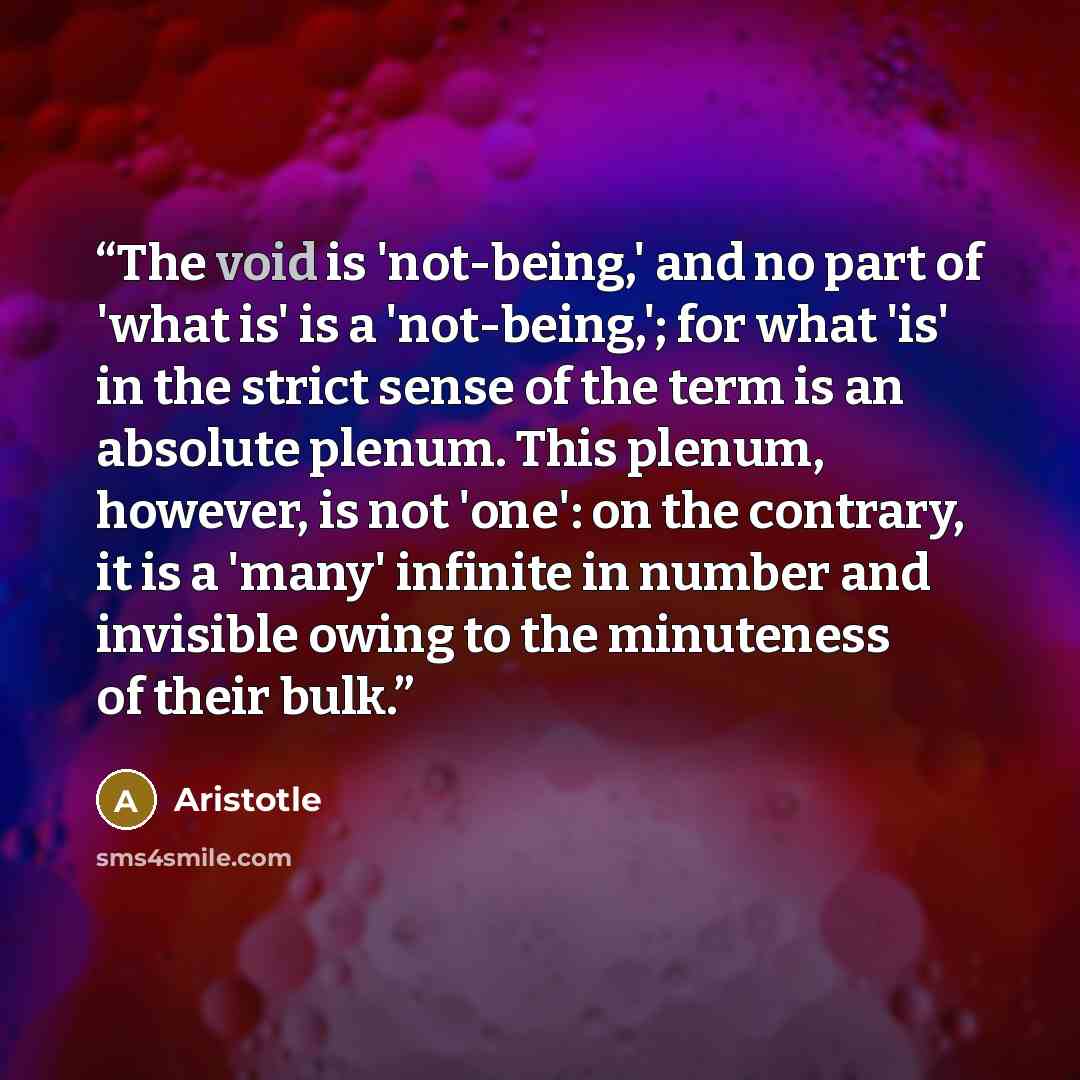
“The void is 'not-being,' and no part of 'what is' is a 'not-being,'; for what 'is' in the strict sense of the… — Aristotle Copy Share Image
Now that practical skills have developed enough to provide adequately for material needs, one of these sciences which are not devoted to… — Aristotle Copy Share Image
...we are all inclined to ... direct our inquiry not by the matter itself, but by the views of our opponents; and,… — Aristotle Copy Share Image
At first he who invented any art that went beyond the common perceptions of man was naturally admired by men, not only… — Aristotle Copy Share Image
“If, then, there is some end of the things we do, which we desire for its own sake (everything else being desired… — Aristotle Copy Share Image
Hippocrates is an excellent geometer but a complete fool in everyday affairs. — Aristotle Copy Share Image
But nature flies from the infinite; for the infinite is imperfect, and nature always seeks an end. — Aristotle Copy Share Image
He who thus considers things in their first growth and origin ... will obtain the clearest view of them. — Aristotle Copy Share Image
We, on the other hand, must take for granted that the things that exist by nature are, either all or some of… — Aristotle Copy Share Image
Metaphysics is universal and is exclusively concerned with primary substance. ... And here we will have the science to study that which… — Aristotle Copy Share Image
Here and elsewhere we shall not obtain the best insight into things until we actually see them growing from the beginning. — Aristotle Copy Share Image
The knowledge of the soul admittedly contributes greatly to the advance of truth in general, and, above all, to our understanding of Nature, for… — Aristotle Copy Share Image
Young men have strong passions and tend to gratify them indiscriminately. Of the bodily desires, it is the sexual by which they are most… — Aristotle Copy Share Image
The body is at its best between the ages of thirty and thirty-five; the mind is at its best about the age of forty-nine. — Aristotle Copy Share Image
The ensouled is distinguished from the unsouled by its being alive. Now since being alive is spoken of in many ways, even if only… — Aristotle Copy Share Image
Although it may be difficult in theory to know what is just and equal, the practical difficulty of inducing those to forbear who can,… — Aristotle Copy Share Image
The true forms of government, therefore, are those in which the one, or the few, or the many, govern with a view to the… — Aristotle Copy Share Image
All persons ought to endeavor to follow what is right, and not what is established. — Aristotle Copy Share Image
Give a man a fish, you feed him for a day. Give a man a poisoned fish, you feed him for the rest of… — Aristotle Copy Share Image
The man who confers a favour would rather not be repaid in the same coin. — Aristotle Copy Share Image
Obstinate people can be divided into the opinionated, the ignorant, and the boorish. — Aristotle Copy Share Image
![“It is clear that there is some difference between ends: some ends are energeia [energy], while others are products which are additional to the energeia.” quote by Aristotle](https://sms4smile.com/quotes/img-quotes/540/aristotle-78_clear_it-is-clear-that-there-is-some-differenc_1071743.jpg)
![“Anaximenes and Anaxagoras and Democritus say that its [the earth's] flatness is responsible for it staying still: for it does not cut the air beneath but covers it like a lid, which flat bodies evidently do: for they are hard to move even for the winds, on account of their resistance.” quote by Aristotle](https://sms4smile.com/quotes/img-quotes/c55/aristotle-78_accounts_anaximenes-and-anaxagoras-and-democritus_1311623.jpg)
![“Now that practical skills have developed enough to provide adequately for material needs, one of these sciences which are not devoted to utilitarian ends [mathematics] has been able to arise in Egypt, the priestly caste there having the leisure necessary for disinterested research.” quote by Aristotle](https://sms4smile.com/quotes/img-quotes/2ee/aristotle-78_able_now-that-practical-skills-have-developed_114834.jpg)