Miracles have no claim whatever to the character of historical facts and are wholly invalid as evidence of any revelation. — John Stuart Mill Copy Share Image
In the long-run, the best proof of a good character is good actions. — John Stuart Mill Copy Share Image
That a thing is peculiar; is no argument for its being blamable; since the most criminal actions are to a being like… — John Stuart Mill Copy Share Image
Eccentricity has always abounded when and where strength of character had abounded; and the amount of eccentricity in a society has generally… — John Stuart Mill Copy Share Image
It is useful while mankind is imperfect that there should be different opinions, so that there should be different experiments of living,… — John Stuart Mill Copy Share Image
All action is for the sake of some end; and rules of action, it seems natural to suppose, must take their whole… — John Stuart Mill Copy Share Image
All women are brought up from the very earliest years in the belief that their ideal of character is the very opposite… — John Stuart Mill Copy Share Image
All social inequalities which have ceased to be considered expedient, assume the character not of simple inexpediency, but of injustice, and appear… — John Stuart Mill Copy Share Image
“Protection, therefore, against tyranny of the magistrate is not enough: there needs protection also against the tyranny of the prevailing opinion and… — John Stuart Mill Copy Share Image
“The creed which accepts as the foundation of morals, Utility, or the Greatest-Happiness Principle, holds that actions are right in proportion as… — John Stuart Mill Copy Share Image
A state of things in which a large portion of the most active and inquiring intellects find it advisable to keep the… — John Stuart Mill Copy Share Image
What little recognition the idea of obligation to the public obtains in modern morality, is derived from Greek and Roman sources, not… — John Stuart Mill Copy Share Image
The principle itself of dogmatic religion, dogmatic morality, dogmatic philosophy, is what requires to be rooted out; not any particular manifestation of… — John Stuart Mill Copy Share Image
Christian morality (so called) has all the characters of a reaction; it is, in great part, a protest against Paganism. Its ideal… — John Stuart Mill Copy Share Image
“His aversion to religion, in the sense usually attached to the term, was of the same kind with that of Lucretius: he… — John Stuart Mill Copy Share Image
“My father’s moral inculcations were at all times mainly those of the Socratici viri; justice, temperance (to which he gave a very… — John Stuart Mill Copy Share Image
In this age, the mere example of non-conformity, the mere refusal to bend the knee to custom, is itself a service. Precisely… — John Stuart Mill Copy Share Image
“It is a strange notion that the acknowledgment of a first principle is inconsistent with the admission of secondary ones. To inform… — John Stuart Mill Copy Share Image
The doctrine called Philosophical Necessity is simply this: that, given the motives which are present to an individual's mind, and given likewise… — John Stuart Mill Copy Share Image
Is there any moral enormity which might not be justified by imitation of such a Deity? — John Stuart Mill Copy Share Image
Customs are made for customary circumstances, and customary characters. — John Stuart Mill Copy Share Image
To do as one would be done by, and to love one's neighbour as oneself, constitute the ideal perfection of utilitarian morality — John Stuart Mill Copy Share Image
The great creative individual . . . is capable of more wisdom and virtue than collective man ever can be. — John Stuart Mill Copy Share Image
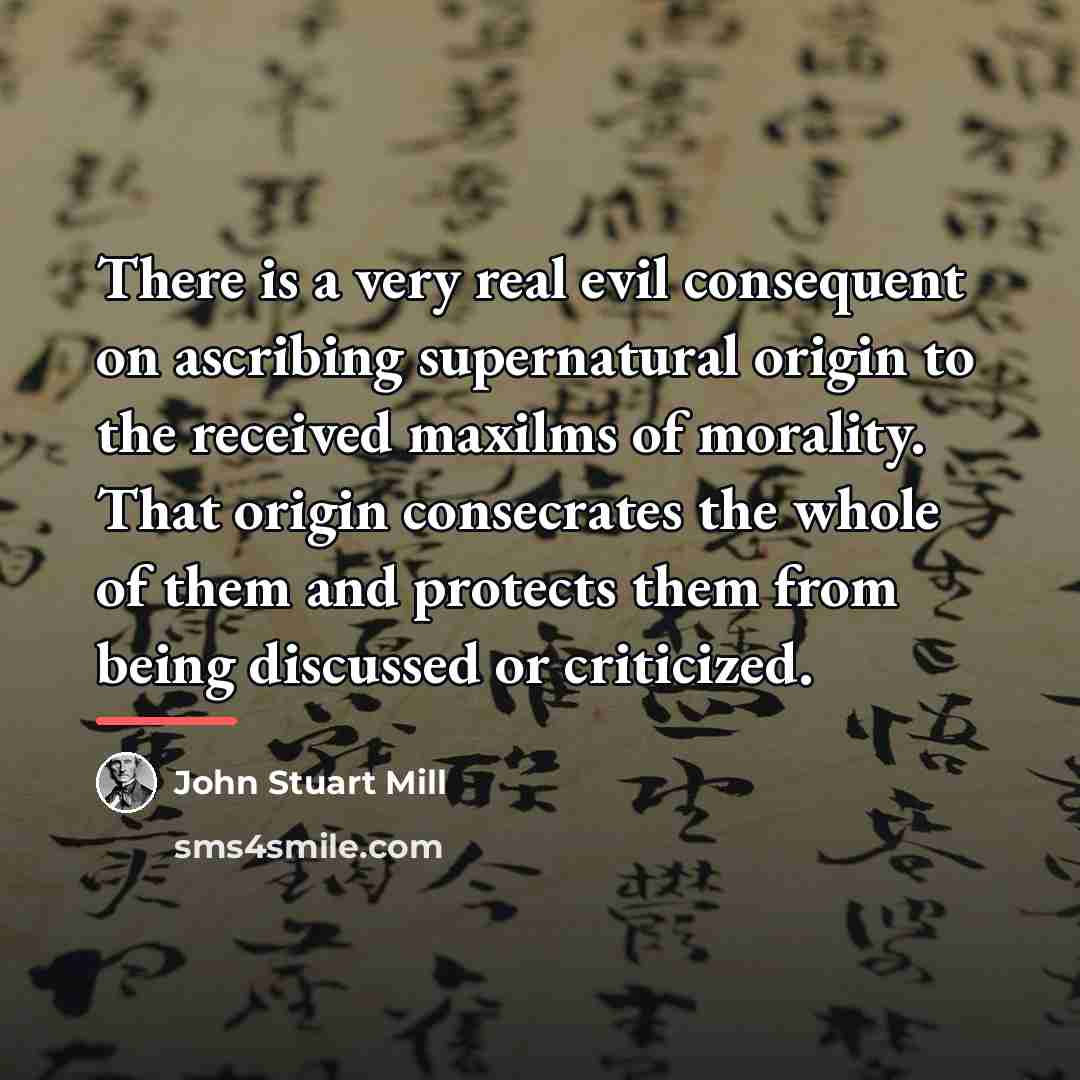
There is a very real evil consequent on ascribing supernatural origin to the received maxilms of morality. That origin consecrates the whole… — John Stuart Mill Copy Share Image
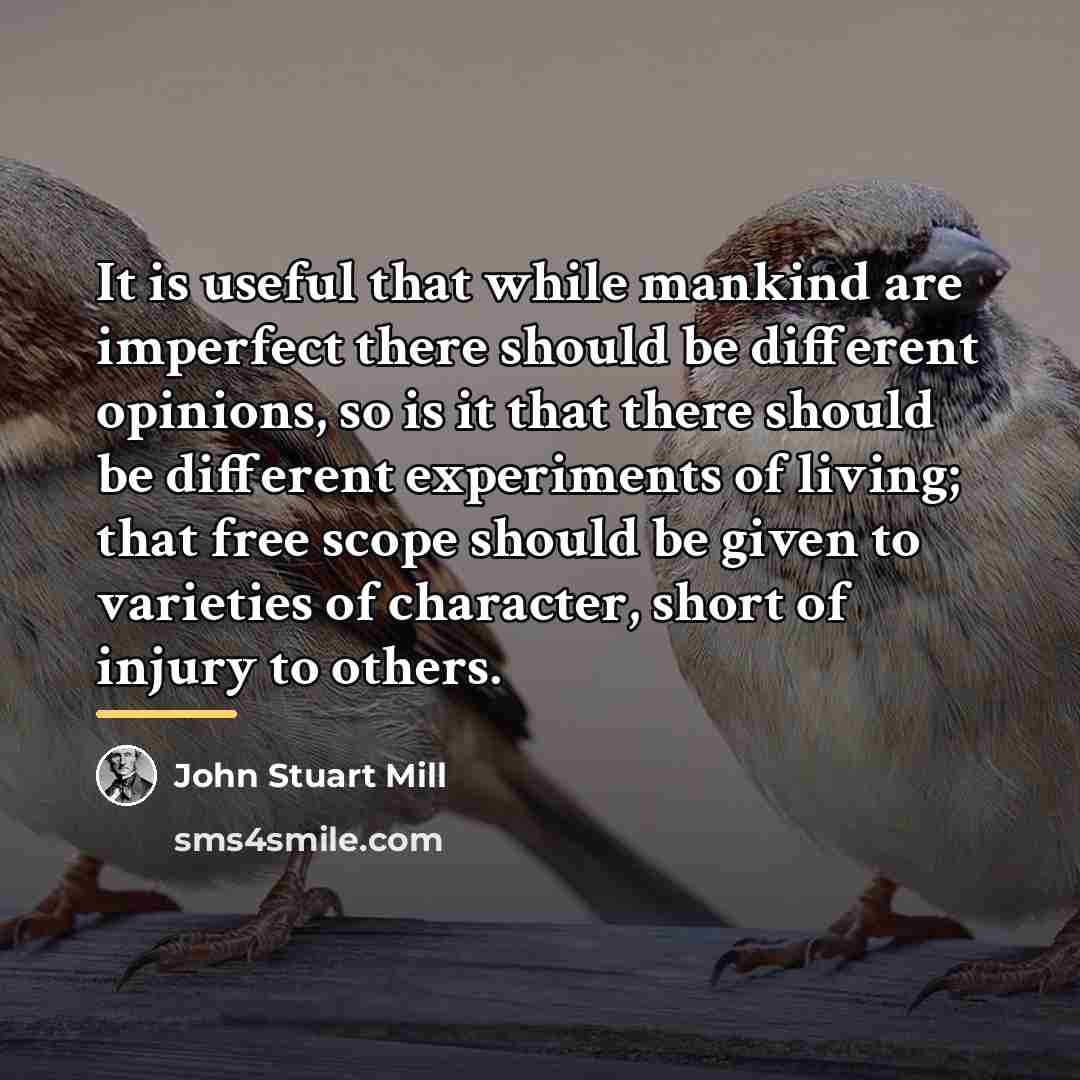
It is useful that while mankind are imperfect there should be different opinions, so is it that there should be different experiments… — John Stuart Mill Copy Share Image
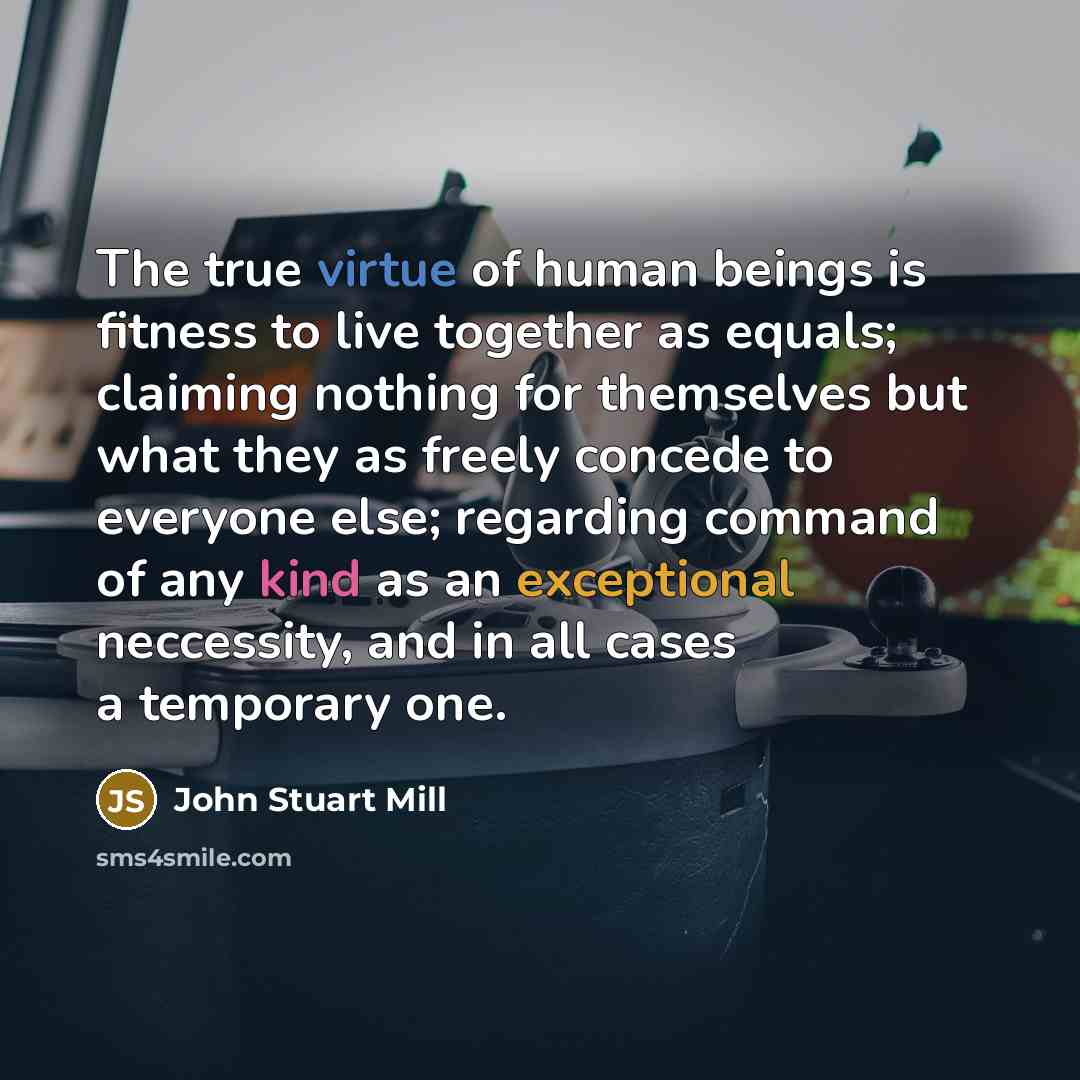
The true virtue of human beings is fitness to live together as equals; claiming nothing for themselves but what they as freely… — John Stuart Mill Copy Share Image
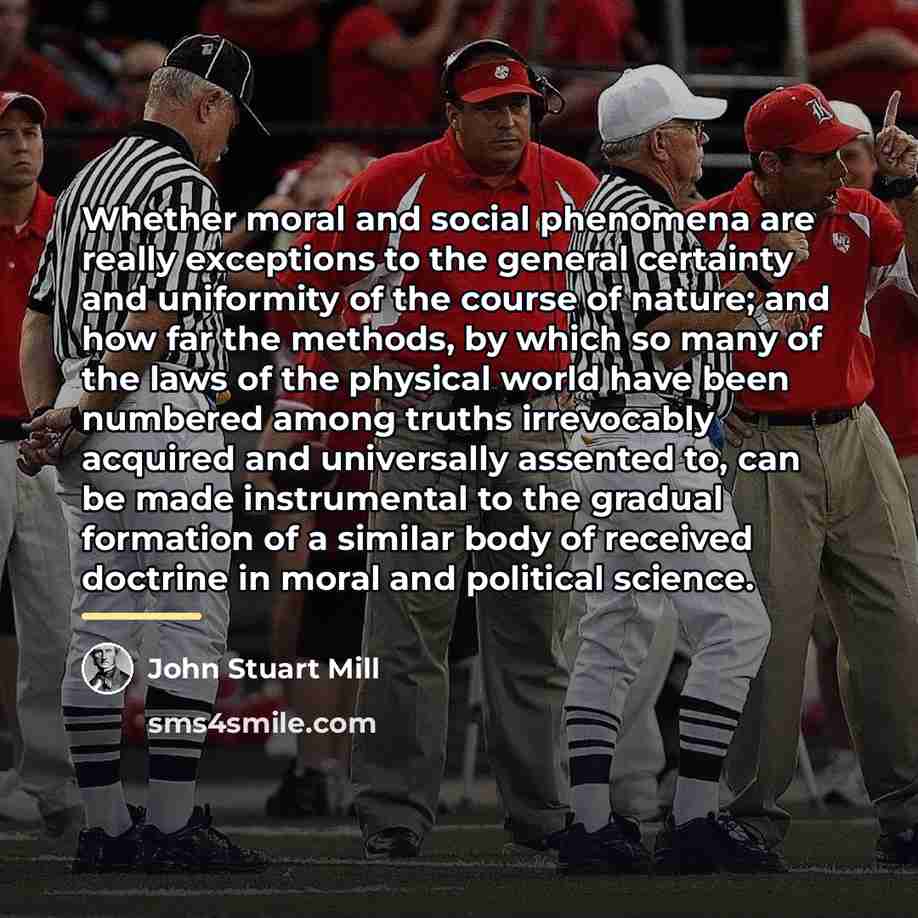
Whether moral and social phenomena are really exceptions to the general certainty and uniformity of the course of nature; and how far… — John Stuart Mill Copy Share Image
“Who can compute what the world loses in the multitude of promising intellects combined with timid characters, who dare not follow out… — John Stuart Mill Copy Share Image
The laws and conditions of the production of wealth partake of the character of physical truths. There is nothing optional or arbitrary… — John Stuart Mill Copy Share Image
The prevailing tendency to regard all the marked distinctions of human character as innate, and in the main indelible, and to ignore… — John Stuart Mill Copy Share Image
“Yet the same gradual decay to which, after a certain age, all the language of psychology seems liable, has been at work… — John Stuart Mill Copy Share Image
Persons of genius are, ex vi termini, more individual than any other people - less capable, consequently, of fitting themselves, without hurtful… — John Stuart Mill Copy Share Image
... what is really inspiriting and ennobling in the doctrine of freewill, is the conviction that we have real power over the… — John Stuart Mill Copy Share Image
the only way in which a human being can make some approach to knowing the whole of a subject, is by hearing… — John Stuart Mill Copy Share Image
Christian morality (so called) has all the characters of a reaction… In its horror of sensuality, it made an idol of asceticism,… — John Stuart Mill Copy Share Image
“It results from the preceding considerations, that there is in reality nothing desired except happiness. Whatever is desired otherwise than as a… — John Stuart Mill Copy Share Image
A person whose desires and impulses are his own—are the expression of his own nature, as it has been developed and modified… — John Stuart Mill Copy Share Image
Though it is only in a very imperfect state of the world's arrangements that anyone can best serve the happiness of others… — John Stuart Mill Copy Share Image
Belief, thus, in the supernatural, great as are the services which it rendered in the early stages of human development, cannot be… — John Stuart Mill Copy Share Image
The average condition of the people improving or deteriorating, depends upon whether population is advancing faster than improvement, or improvement than population. — John Stuart Mill Copy Share Image
Liberty lies in the rights of that person whose views you find most odious. — John Stuart Mill Copy Share Image
“No longer enslaved or made dependent by force of law, the great majority are so by force of poverty; they are still chained to… — John Stuart Mill Copy Share Image
All acts suppose certain dispositions, and habits of mind and heart, which may be in themselves states of enjoyment or of wretchedness, and which… — John Stuart Mill Copy Share Image
Unfortunately for the good sense of mankind, the fact of their fallibility is far from carrying the weight in their practical judgement, which is… — John Stuart Mill Copy Share Image
“In history, as in traveling, men usually see only what they already had in their own minds; and few learn much from history, who… — John Stuart Mill Copy Share Image
All errors which a man is likely to commit against advice are far outweighed by the evil of allowing others to constrain him for… — John Stuart Mill Copy Share Image
Every great movement must experience three stages: ridicule, discussion, adoption. — John Stuart Mill Copy Share Image
The successful conduct of an industrial enterprise requires two quite distinct qualifications: fidelity and zeal. — John Stuart Mill Copy Share Image
“[For people] to refuse a hearing to an opinion, because they are sure that it is false, is to assume that their certainty is… — John Stuart Mill Copy Share Image
This is what writers mean when they say that the notion of cause involves the idea of necessity. If there be any meaning which… — John Stuart Mill Copy Share Image


![“[For people] to refuse a hearing to an opinion, because they are sure that it is false, is to assume that their certainty is the same thing as absolute certainty. All silencing of discussion is an assumption of infallibility.” quote by John Stuart Mill](https://sms4smile.com/quotes/img-quotes/c53/john-stuart-mill-477_doubt_for-people-to-refuse-a-hearing-to-an-opi_63929.jpg)