Character Quote by John Stuart Mill
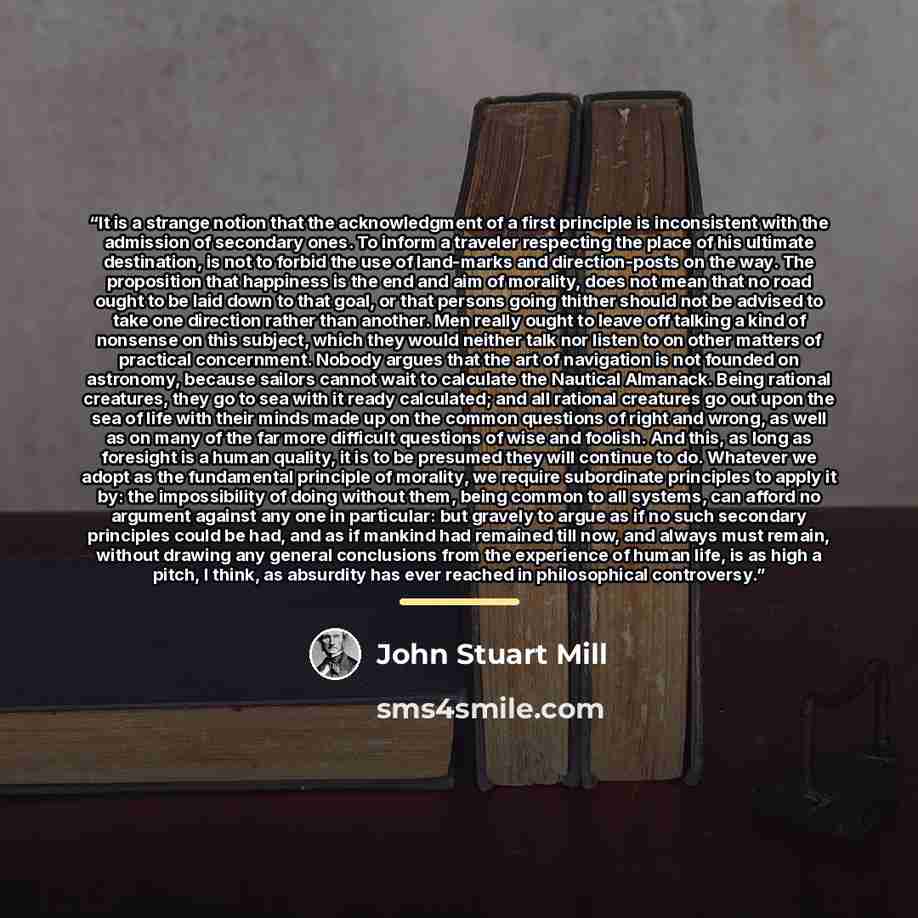
““It is a strange notion that the acknowledgment of a first principle is inconsistent with the admission of secondary ones. To inform a traveler respecting the place of his ultimate destination, is not to forbid the use of land-marks and direction-posts on the way. The proposition that happiness is the end and aim of morality, does not mean that no road ought to be laid down to that goal, or that persons going thither should not be advised to take one direction rather than another. Men really ought to leave off talking a kind of nonsense on this subject, which they would neither talk nor listen to on other matters of practical concernment. Nobody argues that the art of navigation is not founded on astronomy, because sailors cannot wait to calculate the Nautical Almanack. Being rational creatures, they go to sea with it ready calculated; and all rational creatures go out upon the sea of life with their minds made up on the common questions of right and wrong, as well as on many of the far more difficult questions of wise and foolish. And this, as long as foresight is a human quality, it is to be presumed they will continue to do. Whatever we adopt as the fundamental principle of morality, we require subordinate principles to apply it by: the impossibility of doing without them, being common to all systems, can afford no argument against any one in particular: but gravely to argue as if no such secondary principles could be had, and as if mankind had remained till now, and always must remain, without drawing any general conclusions from the experience of human life, is as high a pitch, I think, as absurdity has ever reached in philosophical controversy.””
About This Quote
Source Essay: Utilitarianism and Moral Philosophy, 1863
The passage argues that moral systems need primary principles plus secondary rules to guide actions, emphasizing practical guidance over abstract debate.
In simple terms: Moral foundations need supporting rules for practical use.
Key Takeaway
Apply core values while using detailed guidelines.
Themes
morality
principles
practicality
Mood
thoughtful
analytical
Type
philosophical
educational
When to use this quote
- making ethical decisions
- teaching philosophy
- policy formulation
Key Concepts
utilitarianism
ethical theory
navigation metaphor
Questions to Reflect On
- How do you balance core values with situational rules?
- What secondary principles guide your daily choices?
A Different Perspective
Neglecting secondary principles can cause moral ambiguity.












![“[For people] to refuse a hearing to an opinion, because they are sure that it is false, is to assume that their certainty is the same thing as absolute certainty. All silencing of discussion is an assumption of infallibility.” quote by John Stuart Mill](https://sms4smile.com/quotes/img-quotes/c53/john-stuart-mill-477_doubt_for-people-to-refuse-a-hearing-to-an-opi_63929.jpg)