Customer Quote by Michael Lewis
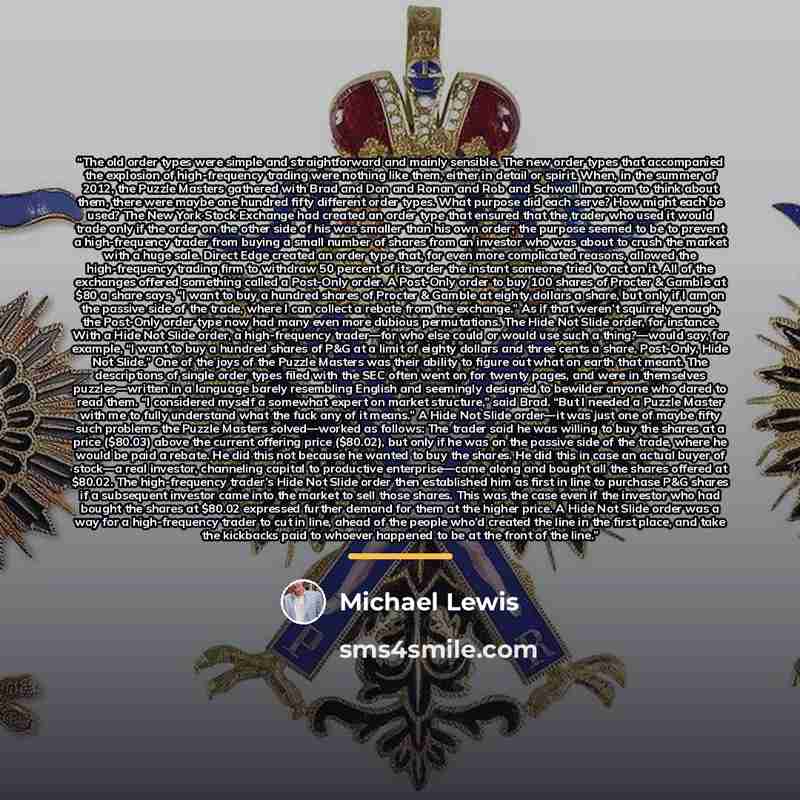
““The old order types were simple and straightforward and mainly sensible. The new order types that accompanied the explosion of high-frequency trading were nothing like them, either in detail or spirit. When, in the summer of 2012, the Puzzle Masters gathered with Brad and Don and Ronan and Rob and Schwall in a room to think about them, there were maybe one hundred fifty different order types. What purpose did each serve? How might each be used? The New York Stock Exchange had created an order type that ensured that the trader who used it would trade only if the order on the other side of his was smaller than his own order; the purpose seemed to be to prevent a high-frequency trader from buying a small number of shares from an investor who was about to crush the market with a huge sale. Direct Edge created an order type that, for even more complicated reasons, allowed the high-frequency trading firm to withdraw 50 percent of its order the instant someone tried to act on it. All of the exchanges offered something called a Post-Only order. A Post-Only order to buy 100 shares of Procter & Gamble at $80 a share says, “I want to buy a hundred shares of Procter & Gamble at eighty dollars a share, but only if I am on the passive side of the trade, where I can collect a rebate from the exchange.” As if that weren’t squirrely enough, the Post-Only order type now had many even more dubious permutations. The Hide Not Slide order, for instance. With a Hide Not Slide order, a high-frequency trader—for who else could or would use such a thing?—would say, for example, “I want to buy a hundred shares of P&G at a limit of eighty dollars and three cents a share, Post-Only, Hide Not Slide.” One of the joys of the Puzzle Masters was their ability to figure out what on earth that meant. The descriptions of single order types filed with the SEC often went on for twenty pages, and were in themselves puzzles—written in a language barely resembling English and seemingly designed to bewilder anyone who dared to read them. “I considered myself a somewhat expert on market structure,” said Brad. “But I needed a Puzzle Master with me to fully understand what the fuck any of it means.” A Hide Not Slide order—it was just one of maybe fifty such problems the Puzzle Masters solved—worked as follows: The trader said he was willing to buy the shares at a price ($80.03) above the current offering price ($80.02), but only if he was on the passive side of the trade, where he would be paid a rebate. He did this not because he wanted to buy the shares. He did this in case an actual buyer of stock—a real investor, channeling capital to productive enterprise—came along and bought all the shares offered at $80.02. The high-frequency trader’s Hide Not Slide order then established him as first in line to purchase P&G shares if a subsequent investor came into the market to sell those shares. This was the case even if the investor who had bought the shares at $80.02 expressed further demand for them at the higher price. A Hide Not Slide order was a way for a high-frequency trader to cut in line, ahead of the people who’d created the line in the first place, and take the kickbacks paid to whoever happened to be at the front of the line.””
About This Quote
Source Book: Flash Boys by Michael Lewis, 2014
High‑frequency trading created complex order types that obscure intent, raising concerns about market fairness and transparency.
In simple terms: Complex trading rules hide true motives.
Key Takeaway
Advocate for clearer market regulations.
Themes
finance
technology
transparency
Mood
critical
analytical
Type
explanatory
informative
When to use this quote
- trading strategies
- policy analysis
- investor education
Key Concepts
market structure
high‑frequency trading
regulation
Questions to Reflect On
- How do these order types affect ordinary investors?
- What reforms could simplify markets?
A Different Perspective
Complexity can increase systemic risk.

![“Crucial decisions are made, today as thousands of years ago, in terms of the intuitive guesses and preferences of a few men in positions of authority...[it is] quite likely that the fate of entire societies may be sealed by a series of avoidable mistakes committed by their leaders.” quote by Michael Lewis](https://sms4smile.com/quotes/img-quotes/a59/michael-lewis-705_decision-making_crucial-decisions-are-made-today-as-thou_16888.jpg)