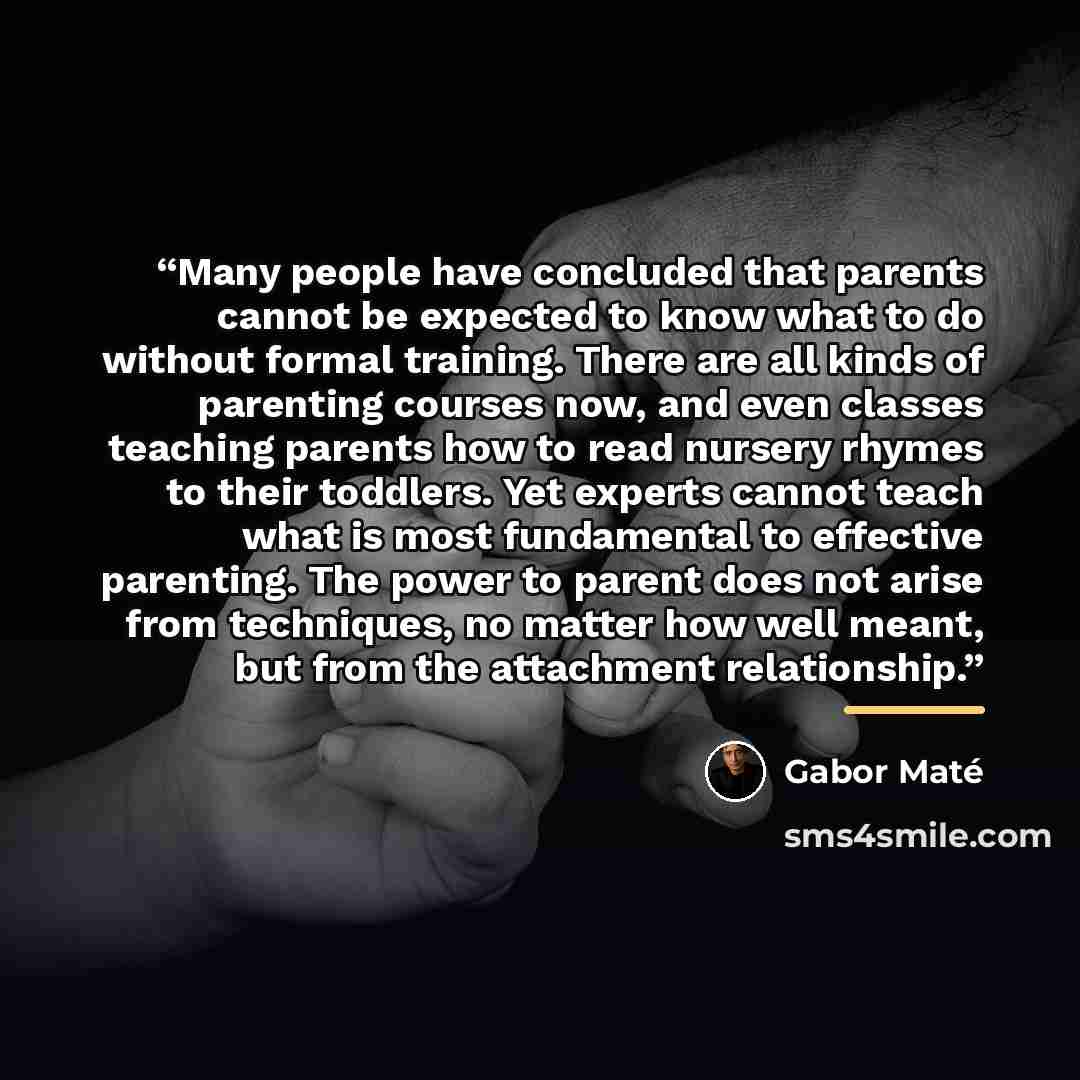
Child Quote by Gabor Maté

““Recognizing that parental responsibility is insufficient for successful child-rearing, but still not conscious of the role of attachment, many experts assume the problem must be in the parenting know-how. If parenting is not going well, it is because parents are not doing things right. According to this way of thinking, it is not enough to don the role; a parent needs some skill to be effective. The parental role has to be supplemented with all kinds of parenting techniques — or so many experts seem to believe. Many parents, too, reason something like this: if others can get their children to do what they want them to do but I can't, it must be because I lack the requisite skills. Their questions all presume a simple lack of knowledge, to be corrected by “how to” types of advice for every conceivable problem situation: How do I get my child to listen? How can I get my child to do his homework? What do I need to do to get my child to clean his room? What is the secret to getting a child to do her chores? How do I get my child to sit at the table? Our predecessors would probably have been embarrassed to ask such questions or, for that matter, to show their face in a parenting course. It seems much easier for parents today to confess incompetence rather than impotence, especially when our lack of skill can be conveniently blamed on a lack of training or a lack of appropriate models in our own childhood. The result has been a multibillion-dollar industry of parental advice-giving, from experts advocating timeouts or reward points on the fridge to all the how-to books on effective parenting. Child-rearing experts and the publishing industry give parents what they ask for instead of the insight they so desperately need. The sheer volume of the advice offered tends to reinforce the feelings of inadequacy and the sense of being unprepared for the job. The fact that these methodologies fail to work has not slowed the torrent of skill teaching. Once we perceive parenting as a set of skills to be learned, it is difficult for us to see the process any other way. Whenever trouble is encountered the assumption is that there must be another book to be read, another course to be taken, another skill to be mastered. Meanwhile, our supporting cast continues to assume that we have the power to do the job. Teachers act as if we can still get our children to do homework. Neighbors expect us to keep our children in line. Our own parents chide us to take a firmer stand. The experts assume that compliance is just another skill away. The courts hold us responsible for our child's behavior. Nobody seems to get the fact that our hold on our children is slipping. The reasoning behind parenting as a set of skills seemed logical enough, but in hindsight has been a dreadful mistake. It has led to an artificial reliance on experts, robbed parents of their natural confidence, and often leaves them feeling dumb and inadequate. We are quick to assume that our children don't listen because we don't know how to make them listen, that our children are not compliant because we have not yet learned the right tricks, that children are not respectful enough of authority because we, the parents, have not taught them to be respectful. We miss the essential point that what matters is not the skill of the parents but the relationship of the child to the adult who is assuming responsibility.””
About This Quote
Source Book: In the Realm of Hungry Ghosts, 2008
Parenting is often reduced to skill acquisition, ignoring deeper relational needs like attachment, leading to ineffective advice and parental insecurity.
In simple terms: Parenting advice focuses on techniques, not emotional connection.
Key Takeaway
Focus on building secure attachment, not just tactics.
Themes
parenting
attachment
expert advice
insecurity
skill vs. relationship
Mood
reflective
concerned
hopeful
Type
advisory
psychological
reflective
When to use this quote
- parent‑child bonding
- family therapy
- parenting workshops
- self‑reflection
- seeking mentorship
Key Concepts
attachment theory
parental self-efficacy
psychology of caregiving
Questions to Reflect On
- How can parents cultivate attachment beyond techniques?
- What relational needs are unmet by “how‑to” advice?
A Different Perspective
Techniques alone cannot replace the emotional bond needed for healthy development.