I mean, the radical contingency that is - that exists and the fact that I'm going into the streets and finding random… — Kehinde Wiley Copy Share Image
You'll find that street casting in America is a lot different than street casting in different nations. — Kehinde Wiley Copy Share Image
My peers at the time: you know, young black kids from off the streets of Harlem, having these conversations with me in… — Kehinde Wiley Copy Share Image
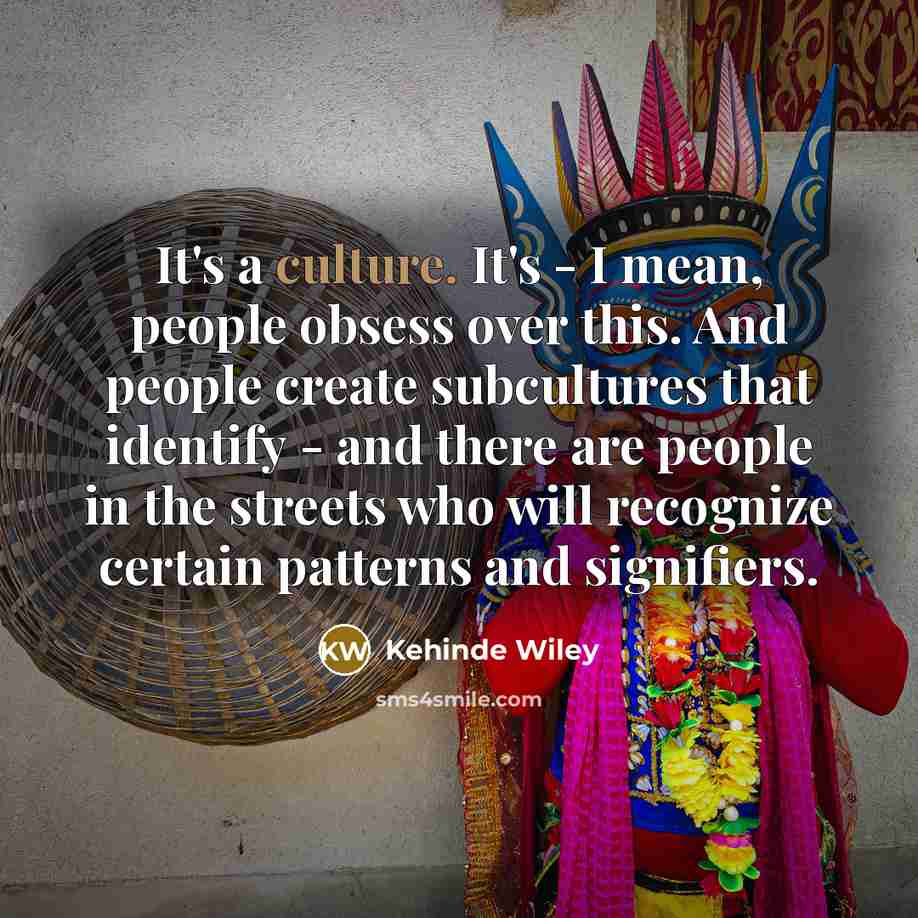
It's a culture. It's - I mean, people obsess over this. And people create subcultures that identify - and there are people… — Kehinde Wiley Copy Share Image
All the world's a stage. P.T. Barnum: It becomes a circus. But circuses or street pageants or parades have always been useful… — Kehinde Wiley Copy Share Image
While it may seem a little mundane, the material realities of realizing the painting actually have a lot to do with how… — Kehinde Wiley Copy Share Image
If I have the same plan to go into the streets, find random strangers, use art-historical referent from their - from the… — Kehinde Wiley Copy Share Image
In the Studio Museum in Harlem, when I was dealing with that community and dealing with my peers in the streets, it… — Kehinde Wiley Copy Share Image
Whereas I remember being in Dakar, in Senegal, where I have my third studio, and street casting, and I remember looking at… — Kehinde Wiley Copy Share Image
I think it was a matter of, like, I'm not going to have my kids in these wild streets. Both my twin… — Kehinde Wiley Copy Share Image
There's a team of filmmakers who follow me in the streets when I'm finding these models, to give me a sense of… — Kehinde Wiley Copy Share Image
I began working within the streets of Harlem, where, after graduating from Yale [University, New Haven, CT], I became the artist in… — Kehinde Wiley Copy Share Image
I was recently in Israel doing my work and casting for models in the streets of Haifa and Jerusalem and Tel Aviv,… — Kehinde Wiley Copy Share Image
That's what I think my job in the world has been, is to sort of try to sit silently a bit and… — Kehinde Wiley Copy Share Image
Much like teaching art to young art students age 10 to 15 or so on, you have to break it down into bite-sized pieces,… — Kehinde Wiley Copy Share Image
The erotic and the art historical imagination is something that gets very little play when people talk about my work, and when they rarely… — Kehinde Wiley Copy Share Image
One of the weirdest things that happened to artists and art criticism was this moment when everyone got cynical and stopped believing in the… — Kehinde Wiley Copy Share Image
At its best, what art does is, it points to who we as human beings and what we as human beings value. And if… — Kehinde Wiley Copy Share Image
My style is in the 21st century. If you look at the process, it goes from photography through Photoshop, where certain features are heightened,… — Kehinde Wiley Copy Share Image
I think the world that I grew up in was like being in this sort of magical artistic garden. — Kehinde Wiley Copy Share Image
It was something that came sort of matter-of-factually. Because there - it's like really - real honest engagement with the people around me and… — Kehinde Wiley Copy Share Image
We're wired to be empathetic and to care about the needs of others, but also to be curious about others. And I think that's… — Kehinde Wiley Copy Share Image
Painting is situational. And my particular situation exists within gender, race, class, sexuality, nation. — Kehinde Wiley Copy Share Image
There were certain expectations that were assumed of me as a young black American 20th-century - then 20th-century artist. — Kehinde Wiley Copy Share Image
I think, something that you might be able to locate in the work that I'm creating today: the ability to look at a black… — Kehinde Wiley Copy Share Image
I remember the first time I went to the Los Angeles County Museum of Art and saw a Kerry James Marshall painting with black… — Kehinde Wiley Copy Share Image
![“I began working within the streets of Harlem, where, after graduating from Yale [University, New Haven, CT], I became the artist in residence at the Studio Museum in Harlem [New York, NY]. I wanted to know what that was about. I would actually pull people from off of the streets and ask them to…” quote by Kehinde Wiley](https://sms4smile.com/quotes/img-quotes/dd2/kehinde-wiley-1194_art_i-began-working-within-the-streets-of-ha_2894302.jpg)
![“That's what I think my job in the world has been, is to sort of try to sit silently a bit and watch it all sort of move and see those small, quiet details, whether it be a small village outside of Colombo [country?] or the favelas of Brazil, where, again, resistance culture is something that you…” quote by Kehinde Wiley](https://sms4smile.com/quotes/img-quotes/aa7/kehinde-wiley-1194_bits_that-s-what-i-think-my-job-in-the-world_2937965.jpg)