What is portraiture? It's choice. It's the ability to position your body in the world for the world to celebrate you on… — Kehinde Wiley Copy Share Image
Painting is about the world that we live in. Black men live in the world. My choice is to include them. — Kehinde Wiley Copy Share Image
I create something that means something to me, to the world, and try to do my best. I can't fix everything. — Kehinde Wiley Copy Share Image
My mother introduced to me as a child the world of language: the way in which translation can be a system by… — Kehinde Wiley Copy Share Image
In America , there's a just-add-water reality TV world in which people expect to get their Warholian 15 minutes of fame. — Kehinde Wiley Copy Share Image
I think the world that I grew up in was like being in this sort of magical artistic garden. — Kehinde Wiley Copy Share Image
What you have in my work is one person's path as he travels through the world, and there is no limitation of… — Kehinde Wiley Copy Share Image
All the world's a stage. P.T. Barnum: It becomes a circus. But circuses or street pageants or parades have always been useful… — Kehinde Wiley Copy Share Image
It never really understood its own situational luxury. And I think that by and large the privilege of being Kehinde Wiley in… — Kehinde Wiley Copy Share Image
What's interesting about young black American artists within the twentieth century, and increasingly within the twenty-first as well, is that there's this… — Kehinde Wiley Copy Share Image
Just so [becoming a chef ] that I could support my art habit. You know? I mean, this is - this is… — Kehinde Wiley Copy Share Image
Being a kid with black skin in South Central Los Angeles, in a part of the world where opportunity didn't necessarily knock… — Kehinde Wiley Copy Share Image
The art world has become so insular. The rules have become so autodidactic that, in a sense, they lose track of what… — Kehinde Wiley Copy Share Image
When I look back at my paintings, they don't give me a sense of where I was when I first met that… — Kehinde Wiley Copy Share Image
What I love in art is that it takes known combinations and reorders them in a way that sheds light on something… — Kehinde Wiley Copy Share Image
I was trying. I was crawling. I was coming into myself. I was trying to in some ways get beyond - what… — Kehinde Wiley Copy Share Image
In high school I went to the Los Angeles County High School for the Arts. And this is like Fame. It's like… — Kehinde Wiley Copy Share Image
I think that once you're able to sort of get in line with who and how you relate to the world, you'll… — Kehinde Wiley Copy Share Image
I think what's really interesting and useful about this question is that ultimately all art is a type of self-portraiture. And so… — Kehinde Wiley Copy Share Image
I'm like a gypsy. I've got a place in Beijing, a place in New York, a place in west Africa; I'm working… — Kehinde Wiley Copy Share Image
One of the weirdest things that happened to artists and art criticism was this moment when everyone got cynical and stopped believing… — Kehinde Wiley Copy Share Image
So much of the hubris that surrounded conceptual art in the 1950s through '70s was that it had this arrogant presupposition that… — Kehinde Wiley Copy Share Image
Can I - do I have to be obsessed with it and proceed from that? Not always. But when I'm on top… — Kehinde Wiley Copy Share Image
I would imagine that what you try to do is to - is to be as sensitive to the environment that surrounds… — Kehinde Wiley Copy Share Image
The expectations of the viewer are what you're asking about. And the expectations of the viewer are manifold. However, they are very… — Kehinde Wiley Copy Share Image
By and large, most of the work that we see in the great museums throughout the world are populated with people who… — Kehinde Wiley Copy Share Image
I think my life has been transformed by the ability to take things that exist in the world and look at them… — Kehinde Wiley Copy Share Image
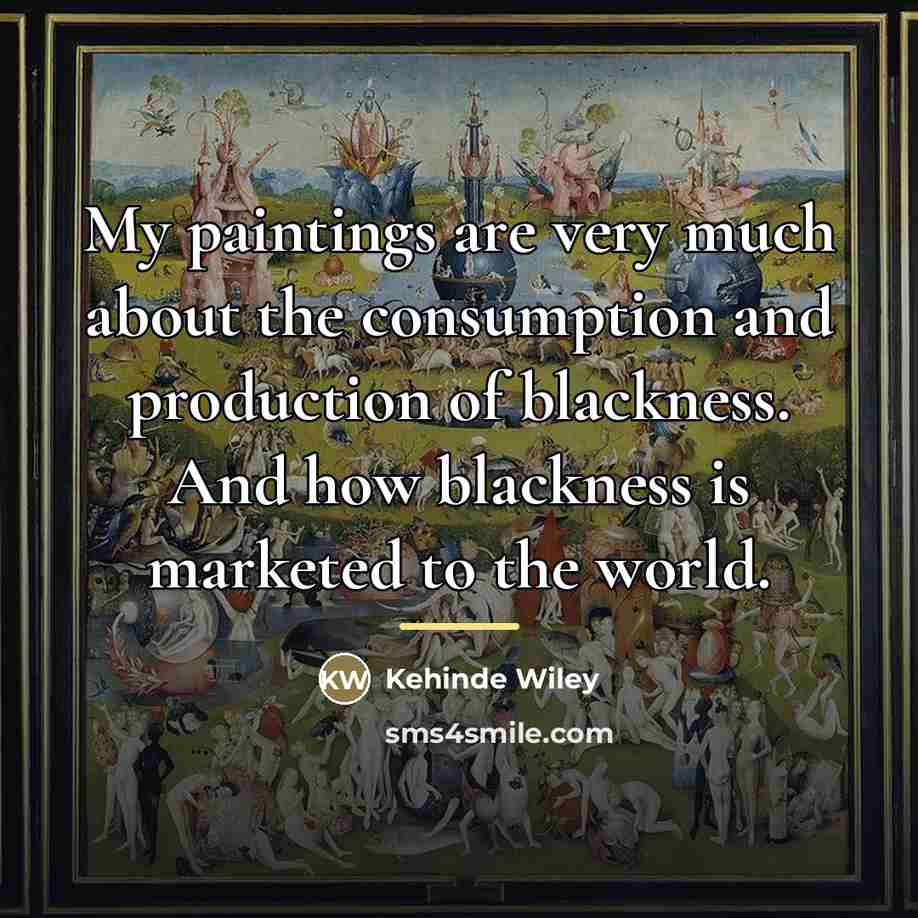
My paintings are very much about the consumption and production of blackness. And how blackness is marketed to the world. — Kehinde Wiley Copy Share Image
People who - and I think that's been a huge education for me. I think it's a - it's a privilege to… — Kehinde Wiley Copy Share Image
I understand blackness from the inside out. What my goal is, is to allow the world to see the humanity that I… — Kehinde Wiley Copy Share Image
What it is is a type of editorialization, you know? This is self-portraiture. This is what you think about the world we… — Kehinde Wiley Copy Share Image
In a sense, we are all victims of the misogyny and racism that exist in the world, no matter what our gender… — Kehinde Wiley Copy Share Image
Even the hubris or the desire to go out into the world and find patterns that reflect back to yourself is so… — Kehinde Wiley Copy Share Image
What we have now is a communication ability. We have the ability to see working ideas that are going on in the… — Kehinde Wiley Copy Share Image
I started making work that I assumed would be far too garish, far too decadent, far too black for the world to… — Kehinde Wiley Copy Share Image
That's what I think my job in the world has been, is to sort of try to sit silently a bit and… — Kehinde Wiley Copy Share Image
The reality of Barack Obama being the president of the United States - quite possibly the most powerful nation in the world… — Kehinde Wiley Copy Share Image
I love the of dealing with the homoerotic versus the idea of dealing with certain tropes with regards to black masculinity in… — Kehinde Wiley Copy Share Image
Much like teaching art to young art students age 10 to 15 or so on, you have to break it down into bite-sized pieces,… — Kehinde Wiley Copy Share Image
The erotic and the art historical imagination is something that gets very little play when people talk about my work, and when they rarely… — Kehinde Wiley Copy Share Image
One of the weirdest things that happened to artists and art criticism was this moment when everyone got cynical and stopped believing in the… — Kehinde Wiley Copy Share Image
At its best, what art does is, it points to who we as human beings and what we as human beings value. And if… — Kehinde Wiley Copy Share Image
My style is in the 21st century. If you look at the process, it goes from photography through Photoshop, where certain features are heightened,… — Kehinde Wiley Copy Share Image
I think the world that I grew up in was like being in this sort of magical artistic garden. — Kehinde Wiley Copy Share Image
It was something that came sort of matter-of-factually. Because there - it's like really - real honest engagement with the people around me and… — Kehinde Wiley Copy Share Image
We're wired to be empathetic and to care about the needs of others, but also to be curious about others. And I think that's… — Kehinde Wiley Copy Share Image
Painting is situational. And my particular situation exists within gender, race, class, sexuality, nation. — Kehinde Wiley Copy Share Image
There were certain expectations that were assumed of me as a young black American 20th-century - then 20th-century artist. — Kehinde Wiley Copy Share Image
I think, something that you might be able to locate in the work that I'm creating today: the ability to look at a black… — Kehinde Wiley Copy Share Image
I remember the first time I went to the Los Angeles County Museum of Art and saw a Kerry James Marshall painting with black… — Kehinde Wiley Copy Share Image
![“Just so [becoming a chef ] that I could support my art habit. You know? I mean, this is - this is something where you've been literally given an opportunity to put the world on pause for a second.” quote by Kehinde Wiley](https://sms4smile.com/quotes/img-quotes/ef0/kehinde-wiley-1194_art_just-so-becoming-a-chef-that-i-could-sup_2148704.jpg)
![“That's what I think my job in the world has been, is to sort of try to sit silently a bit and watch it all sort of move and see those small, quiet details, whether it be a small village outside of Colombo [country?] or the favelas of Brazil, where, again, resistance culture is something that you…” quote by Kehinde Wiley](https://sms4smile.com/quotes/img-quotes/aa7/kehinde-wiley-1194_bits_that-s-what-i-think-my-job-in-the-world_2937965.jpg)