I have been painting white people for much longer in my life than I have done for colored people. — Kehinde Wiley Copy Share Image
If people looked at me like I was a little different, I would maybe sit next to them, and I would draw. — Kehinde Wiley Copy Share Image
In America , there's a just-add-water reality TV world in which people expect to get their Warholian 15 minutes of fame. — Kehinde Wiley Copy Share Image
I taught myself to paint African-Americans, mostly people roughly my skin tone. — Kehinde Wiley Copy Share Image
I've met others [people] who simply responded to me, "You're Kehinde Wiley. I know your work. I saw it at the Brooklyn… — Kehinde Wiley Copy Share Image
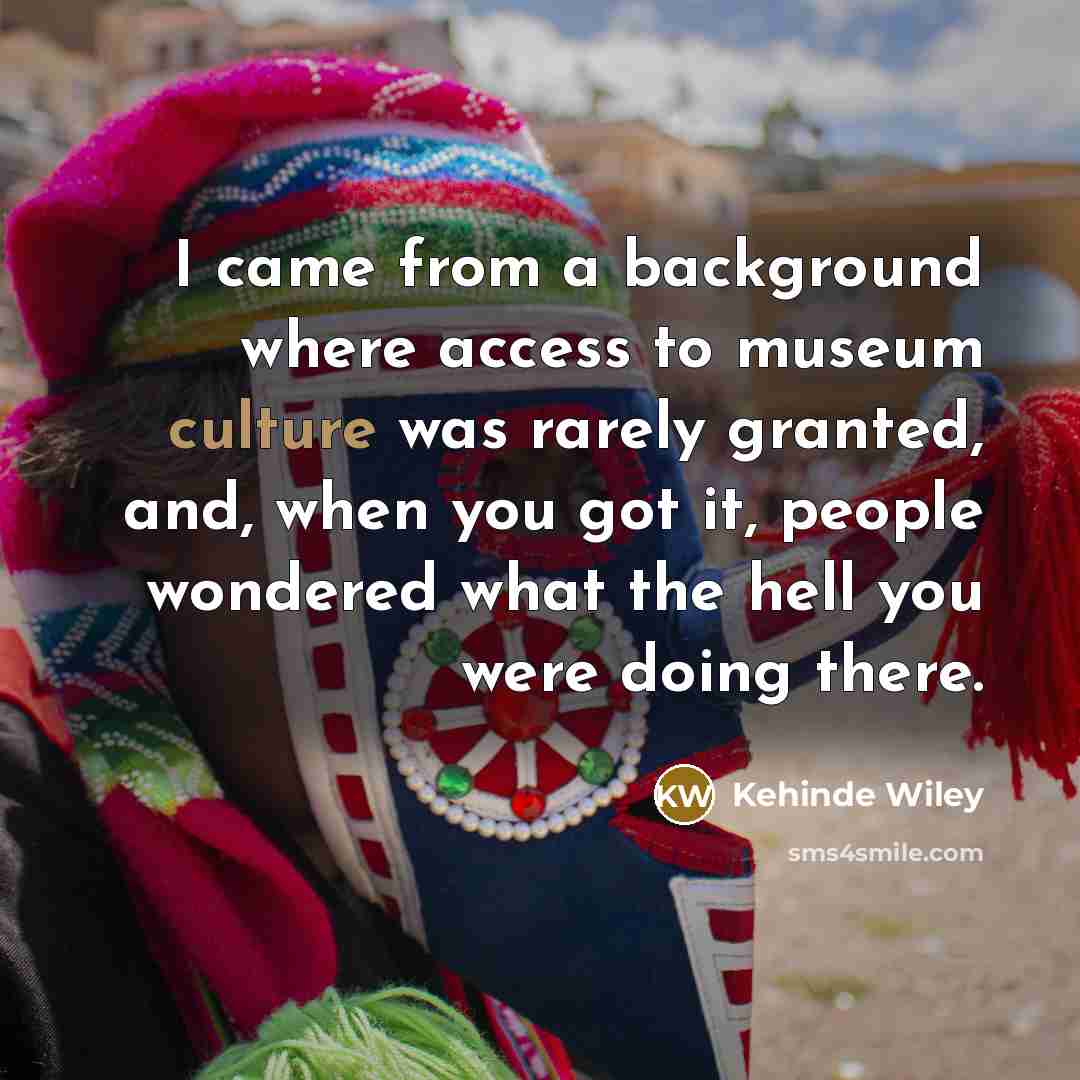
I came from a background where access to museum culture was rarely granted, and, when you got it, people wondered what the… — Kehinde Wiley Copy Share Image
I've had moments where I've met people who were complete, like, idiots, who could not understand visual culture to save their lives. — Kehinde Wiley Copy Share Image
The expectations of the viewer are what you're asking about. And the expectations of the viewer are manifold. However, they are very… — Kehinde Wiley Copy Share Image
It was something that came sort of matter-of-factually. Because there - it's like really - real honest engagement with the people around… — Kehinde Wiley Copy Share Image
That's the trouble with, I think, my - the contemporary read of my work. So many people just simply say, "These are… — Kehinde Wiley Copy Share Image
Most people say, "Hell, no. I don't know who you are. This scares me. Like, I'm not interested in this."Another way of… — Kehinde Wiley Copy Share Image
The art world has become so insular. The rules have become so autodidactic that, in a sense, they lose track of what… — Kehinde Wiley Copy Share Image
It never really understood its own situational luxury. And I think that by and large the privilege of being Kehinde Wiley in… — Kehinde Wiley Copy Share Image
I began working within the streets of Harlem, where, after graduating from Yale [University, New Haven, CT], I became the artist in… — Kehinde Wiley Copy Share Image
There are just so many different types of people that come into my studio, and secondarily, there's the idea of ideation, like,… — Kehinde Wiley Copy Share Image
The ability to look at certain patterns with regards to urban fashion, with regards to swagger, with regards to cultural hegemony, with… — Kehinde Wiley Copy Share Image
There is a political and racial context behind everything that I do. Not always because I design it that way, or because… — Kehinde Wiley Copy Share Image
So much of the hubris that surrounded conceptual art in the 1950s through '70s was that it had this arrogant presupposition that… — Kehinde Wiley Copy Share Image
I think what's really interesting and useful about this question is that ultimately all art is a type of self-portraiture. And so… — Kehinde Wiley Copy Share Image
It became a question of taste. I have a certain taste in art history. And that - I had a huge library… — Kehinde Wiley Copy Share Image
You have to be careful about over-politicizing the utterances of people of colour because, oftentimes, there's poetry that seeks to go beyond… — Kehinde Wiley Copy Share Image
What's interesting about the 21st century is how people deal with cultural history. We don't necessarily feel like there are discrete categories.… — Kehinde Wiley Copy Share Image
Artists are those people who sit at the intersection between the known and unknown, the rational and irrational, coming to terms with… — Kehinde Wiley Copy Share Image
I think that's kind of indicative of a type of self-confidence that people develop when they recognize their own ability to create. — Kehinde Wiley Copy Share Image
It's a culture. It's - I mean, people obsess over this. And people create subcultures that identify - and there are people… — Kehinde Wiley Copy Share Image
My paintings at their best take that vocabulary and attempt to transpose that into a form that gives respect not only to… — Kehinde Wiley Copy Share Image
Many people see my early work simply as portraits of black and brown people. Really, it's an investigation of how we see… — Kehinde Wiley Copy Share Image
So sometimes you have to play your hand and sort of push in a direction. And I think that masculinity is the… — Kehinde Wiley Copy Share Image
Much like teaching art to young art students age 10 to 15 or so on, you have to break it down into… — Kehinde Wiley Copy Share Image
By and large, most of the work that we see in the great museums throughout the world are populated with people who… — Kehinde Wiley Copy Share Image
People who - and I think that's been a huge education for me. I think it's a - it's a privilege to… — Kehinde Wiley Copy Share Image
I was recently in Israel doing my work and casting for models in the streets of Haifa and Jerusalem and Tel Aviv,… — Kehinde Wiley Copy Share Image
In our conversations, he [Michael Jackson] revealed a surprising understanding of art history. We were going through the finer points of the… — Kehinde Wiley Copy Share Image
Much like teaching art to young art students age 10 to 15 or so on, you have to break it down into bite-sized pieces,… — Kehinde Wiley Copy Share Image
The erotic and the art historical imagination is something that gets very little play when people talk about my work, and when they rarely… — Kehinde Wiley Copy Share Image
One of the weirdest things that happened to artists and art criticism was this moment when everyone got cynical and stopped believing in the… — Kehinde Wiley Copy Share Image
At its best, what art does is, it points to who we as human beings and what we as human beings value. And if… — Kehinde Wiley Copy Share Image
My style is in the 21st century. If you look at the process, it goes from photography through Photoshop, where certain features are heightened,… — Kehinde Wiley Copy Share Image
I think the world that I grew up in was like being in this sort of magical artistic garden. — Kehinde Wiley Copy Share Image
It was something that came sort of matter-of-factually. Because there - it's like really - real honest engagement with the people around me and… — Kehinde Wiley Copy Share Image
We're wired to be empathetic and to care about the needs of others, but also to be curious about others. And I think that's… — Kehinde Wiley Copy Share Image
Painting is situational. And my particular situation exists within gender, race, class, sexuality, nation. — Kehinde Wiley Copy Share Image
There were certain expectations that were assumed of me as a young black American 20th-century - then 20th-century artist. — Kehinde Wiley Copy Share Image
I think, something that you might be able to locate in the work that I'm creating today: the ability to look at a black… — Kehinde Wiley Copy Share Image
I remember the first time I went to the Los Angeles County Museum of Art and saw a Kerry James Marshall painting with black… — Kehinde Wiley Copy Share Image
![“I've met others [people] who simply responded to me, "You're Kehinde Wiley. I know your work. I saw it at the Brooklyn Museum [Brooklyn, NY] And I'd be honored to be in your work."” quote by Kehinde Wiley](https://sms4smile.com/quotes/img-quotes/700/kehinde-wiley-1194_brooklyn_i-ve-met-others-people-who-simply-respon_313513.jpg)
![“I began working within the streets of Harlem, where, after graduating from Yale [University, New Haven, CT], I became the artist in residence at the Studio Museum in Harlem [New York, NY]. I wanted to know what that was about. I would actually pull people from off of the streets and ask them to…” quote by Kehinde Wiley](https://sms4smile.com/quotes/img-quotes/dd2/kehinde-wiley-1194_art_i-began-working-within-the-streets-of-ha_2894302.jpg)
![“In our conversations, he [Michael Jackson] revealed a surprising understanding of art history. We were going through the finer points of the difference between one Italian sculptor to the next. You know, this - these are things that we don't necessarily assume of people in sanctified light.” quote by Kehinde Wiley](https://sms4smile.com/quotes/img-quotes/856/kehinde-wiley-1194_art_in-our-conversations-he-michael-jackson_3203876.jpg)