There was no image of the other biological half of myself. And as an artists, as a - as an - as… — Kehinde Wiley Copy Share Image
You know, one of my - one of my best and, I think, most enlightening moments was when I was contacted by… — Kehinde Wiley Copy Share Image
I use those expectations as a color on my palette, a certain temperature in the room. You can use those expectations for… — Kehinde Wiley Copy Share Image
My mother sent me to art classes at the age of 11. I began to have kids around me say, 'Will you… — Kehinde Wiley Copy Share Image
In some way they are all self-portraits, but I think I know what you mean by asking this - I would say,… — Kehinde Wiley Copy Share Image
My paintings are very much about the consumption and production of blackness. And how blackness is marketed to the world. — Kehinde Wiley Copy Share Image
Status and class and social anxiety and perhaps social code are all released when you look at paintings of powerful individuals from… — Kehinde Wiley Copy Share Image
I like to play with the conventions around what we expect of paintings historically. But I also like to play with the… — Kehinde Wiley Copy Share Image
Going back to that idea that painting sits still and that we give ourselves over to it over time. There's a difference… — Kehinde Wiley Copy Share Image
Like commercial stuff is sort of cheap and disposable and fun and can be sort of interesting in many ways. I love… — Kehinde Wiley Copy Share Image
When we talk about Orientalist painting, we're talking about painting generally from the seventeenth through the nineteenth century, and some would say… — Kehinde Wiley Copy Share Image
My style is in the 21st century. If you look at the process, it goes from photography through Photoshop, where certain features… — Kehinde Wiley Copy Share Image
Believing that navel-gazing in and of itself can transform itself into something that means something for society. I mean, we are communicative… — Kehinde Wiley Copy Share Image
I think that at its best, painting can be an act of juggling perceptions, a hall of mirrors. And it can be… — Kehinde Wiley Copy Share Image
Can I - do I have to be obsessed with it and proceed from that? Not always. But when I'm on top… — Kehinde Wiley Copy Share Image
I happen to be a twin. I grew up half of my life with someone who looks and sounds like me. And… — Kehinde Wiley Copy Share Image
There's nothing shocking inherently about that, given that so much of the way that artists are taught is by copying old master… — Kehinde Wiley Copy Share Image
My paintings at their best take that vocabulary and attempt to transpose that into a form that gives respect not only to… — Kehinde Wiley Copy Share Image
Painting from life is a completely different monster, which I like. But because I've been painting from photography for so long, I've… — Kehinde Wiley Copy Share Image
Many people see my early work simply as portraits of black and brown people. Really, it's an investigation of how we see… — Kehinde Wiley Copy Share Image
I have a fondness for making paintings that go beyond just having a conversation about art for art's sake or having a… — Kehinde Wiley Copy Share Image
I love the flexibility of saying, "Today we're making 50-foot paintings, and we're going to have to join hands and figure out… — Kehinde Wiley Copy Share Image
There's something really cool about taking oily coloured paste and pushing it around with these hairy sticks and making something that looks… — Kehinde Wiley Copy Share Image
He [Michael Jackson] would choose specific moments. They were art history books that I prefer. They were paintings that he prefers. It's… — Kehinde Wiley Copy Share Image
For example, in one of my last exhibitions I had a 50-foot massive painting with I think perhaps a hundred thousand hand-painted… — Kehinde Wiley Copy Share Image
There is something that always will be true about painting and sculpture - that in order to really get it, you have… — Kehinde Wiley Copy Share Image
You know, I'm incredibly blessed to be able to have this level of choice as an artist today. In this economy, it's… — Kehinde Wiley Copy Share Image
I'm like a gypsy. I've got a place in Beijing, a place in New York, a place in west Africa; I'm working… — Kehinde Wiley Copy Share Image
When I look back at my paintings, they don't give me a sense of where I was when I first met that… — Kehinde Wiley Copy Share Image
While it may seem a little mundane, the material realities of realizing the painting actually have a lot to do with how… — Kehinde Wiley Copy Share Image
Stained glass is unique from the outside, but as a painting insider, I know that oil painting's all about light. And it's… — Kehinde Wiley Copy Share Image
It became a question of taste. I have a certain taste in art history. And that - I had a huge library… — Kehinde Wiley Copy Share Image
I think that gave rise to the type of practice that I - that I do now. I think it was informed… — Kehinde Wiley Copy Share Image
What's great about it is that painting doesn't move. And so in the 21st century, when we're used to clicking and browsing… — Kehinde Wiley Copy Share Image
Let's talk about the artist's desire to go beyond the pictorial or the representational and the desire to create the abstract -… — Kehinde Wiley Copy Share Image
I suppose in the end what shift occurred - is that at Yale I began to become more materially and conceptually aware… — Kehinde Wiley Copy Share Image
For years, I've been painting black men as a way to respond to the reality of the streets. I've asked black men… — Kehinde Wiley Copy Share Image
There's quite obviously the desire to open the rule sets that allow for inclusion or disclusion. I think that my hope would… — Kehinde Wiley Copy Share Image
What came out of that was an intense obsession with status anxiety. So much of these portraits are about fashioning oneself into… — Kehinde Wiley Copy Share Image
Much like teaching art to young art students age 10 to 15 or so on, you have to break it down into bite-sized pieces,… — Kehinde Wiley Copy Share Image
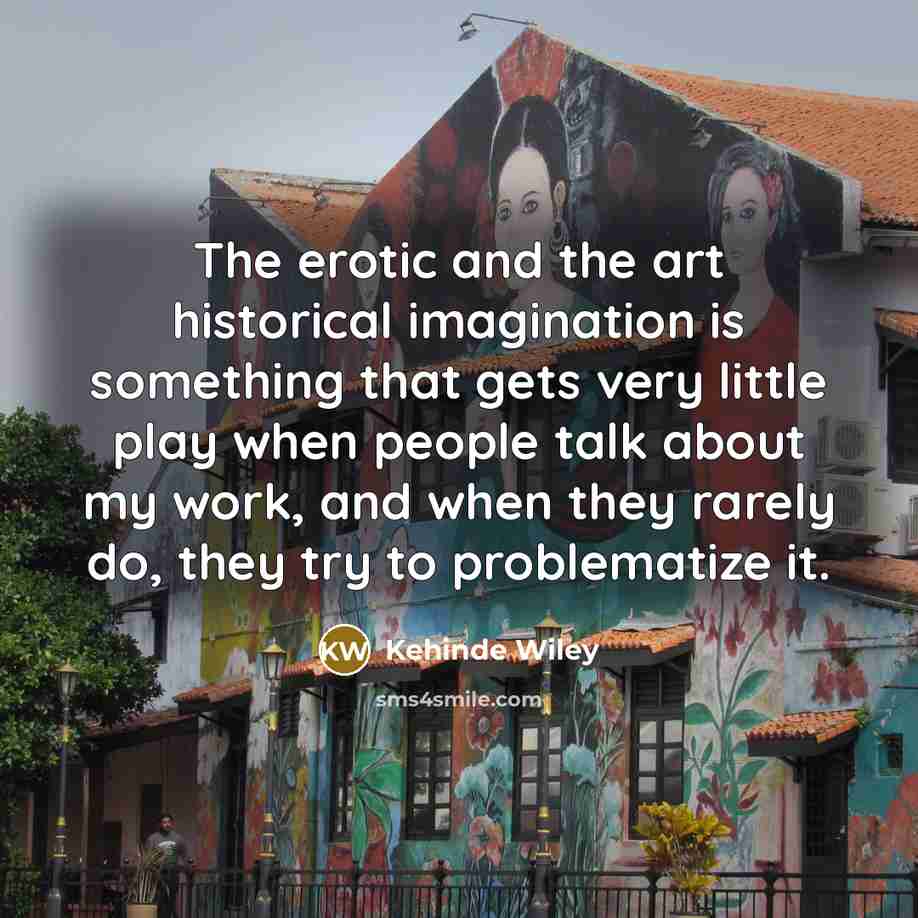
The erotic and the art historical imagination is something that gets very little play when people talk about my work, and when they rarely… — Kehinde Wiley Copy Share Image
One of the weirdest things that happened to artists and art criticism was this moment when everyone got cynical and stopped believing in the… — Kehinde Wiley Copy Share Image
At its best, what art does is, it points to who we as human beings and what we as human beings value. And if… — Kehinde Wiley Copy Share Image
My style is in the 21st century. If you look at the process, it goes from photography through Photoshop, where certain features are heightened,… — Kehinde Wiley Copy Share Image
I think the world that I grew up in was like being in this sort of magical artistic garden. — Kehinde Wiley Copy Share Image
It was something that came sort of matter-of-factually. Because there - it's like really - real honest engagement with the people around me and… — Kehinde Wiley Copy Share Image
We're wired to be empathetic and to care about the needs of others, but also to be curious about others. And I think that's… — Kehinde Wiley Copy Share Image
Painting is situational. And my particular situation exists within gender, race, class, sexuality, nation. — Kehinde Wiley Copy Share Image
There were certain expectations that were assumed of me as a young black American 20th-century - then 20th-century artist. — Kehinde Wiley Copy Share Image
I think, something that you might be able to locate in the work that I'm creating today: the ability to look at a black… — Kehinde Wiley Copy Share Image
I remember the first time I went to the Los Angeles County Museum of Art and saw a Kerry James Marshall painting with black… — Kehinde Wiley Copy Share Image
![“He [Michael Jackson] would choose specific moments. They were art history books that I prefer. They were paintings that he prefers. It's this dance back and forth. We were halfway through the dance. He died.” quote by Kehinde Wiley](https://sms4smile.com/quotes/img-quotes/70b/kehinde-wiley-1194_art_he-michael-jackson-would-choose-specific_2414757.jpg)
![“For example, in one of my last exhibitions I had a 50-foot massive painting with I think perhaps a hundred thousand hand-painted small flowers. This was the Christ painting [The Dead Christ in the Tomb, 2008] in my Down exhibition [2008]. Now, I simply can't spend eight hours a day painting small…” quote by Kehinde Wiley](https://sms4smile.com/quotes/img-quotes/f48/kehinde-wiley-1194_christ_for-example-in-one-of-my-last-exhibition_923224.jpg)