The erotic and the art historical imagination is something that gets very little play when people talk about my work, and when… — Kehinde Wiley Copy Share Image
The art world has become so insular. The rules have become so autodidactic that, in a sense, they lose track of what… — Kehinde Wiley Copy Share Image
I was surrounded by art by virtue of not only the educational opportunities that my mother's foresight availed me to. — Kehinde Wiley Copy Share Image
Questlove is an artist who I respect because he constantly shifts within the idiom, challenging perceptions of hip-hop and black American culture. — Kehinde Wiley Copy Share Image
This is something that, as artists, we constantly deal with-throwing away the past, slaying the father, and creating the new. This desire… — Kehinde Wiley Copy Share Image
There were certain expectations that were assumed of me as a young black American 20th-century - then 20th-century artist. — Kehinde Wiley Copy Share Image
What I try to do is defy expectations in terms of boundaries, whether it is high or low art, pop culture, or… — Kehinde Wiley Copy Share Image
The beauty of art is that it allows you to slow down, and for a moment, things that once seemed unfamiliar become… — Kehinde Wiley Copy Share Image
[My twin brother] he was the star artist of the family as we - as we were growing up. He eventually lost… — Kehinde Wiley Copy Share Image
There is a political and racial context behind everything that I do. Not always because I design it that way, or because… — Kehinde Wiley Copy Share Image
That's partly the success of my work-the ability to have a young black girl walk into the Brooklyn Museum and see paintings… — Kehinde Wiley Copy Share Image
I think what's really interesting and useful about this question is that ultimately all art is a type of self-portraiture. And so… — Kehinde Wiley Copy Share Image
Like, the smells and the sights and the sounds. As an artist, you want to sort of be able to engage that… — Kehinde Wiley Copy Share Image
You know, I'm incredibly blessed to be able to have this level of choice as an artist today. In this economy, it's… — Kehinde Wiley Copy Share Image
If I have the same plan to go into the streets, find random strangers, use art-historical referent from their - from the… — Kehinde Wiley Copy Share Image
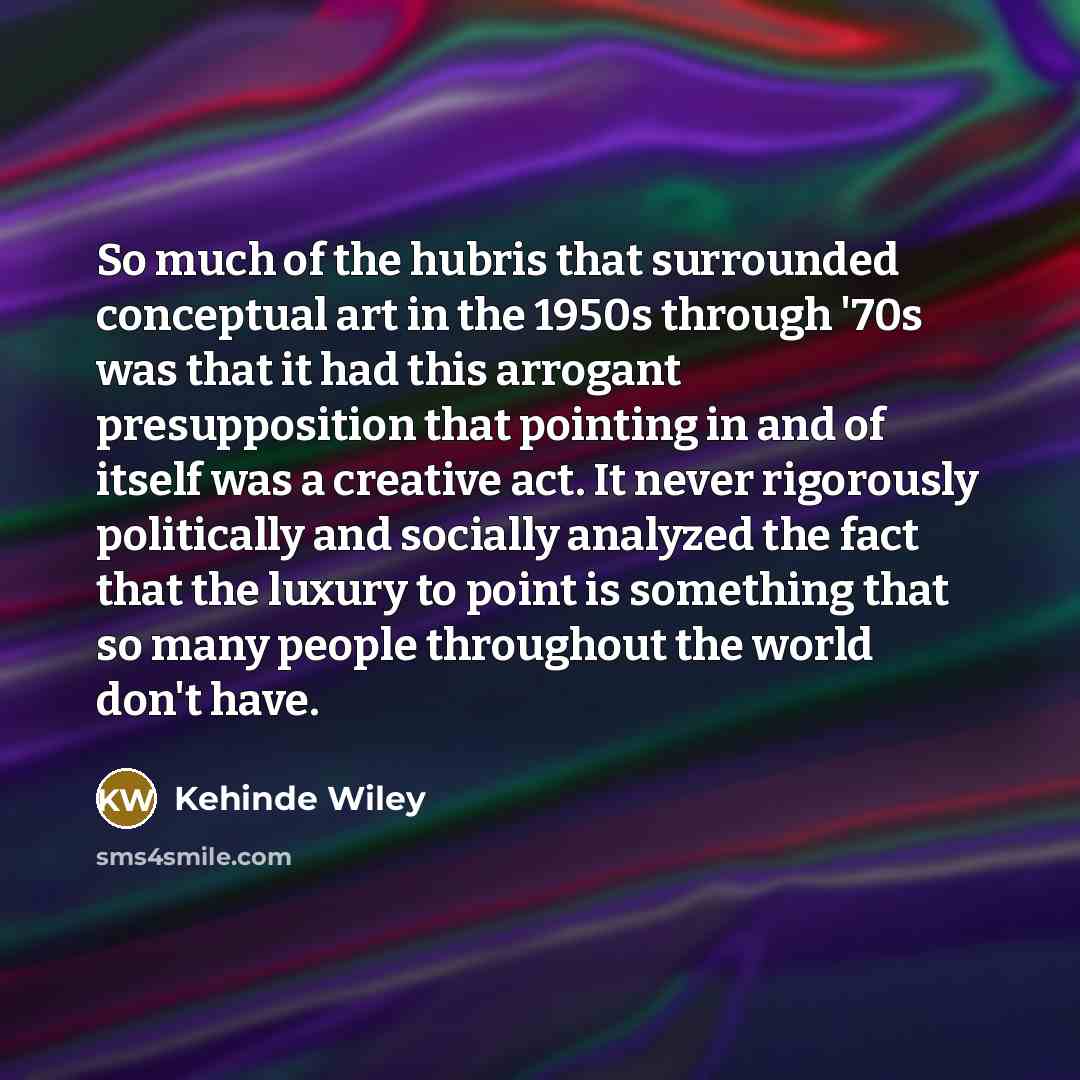
So much of the hubris that surrounded conceptual art in the 1950s through '70s was that it had this arrogant presupposition that… — Kehinde Wiley Copy Share Image
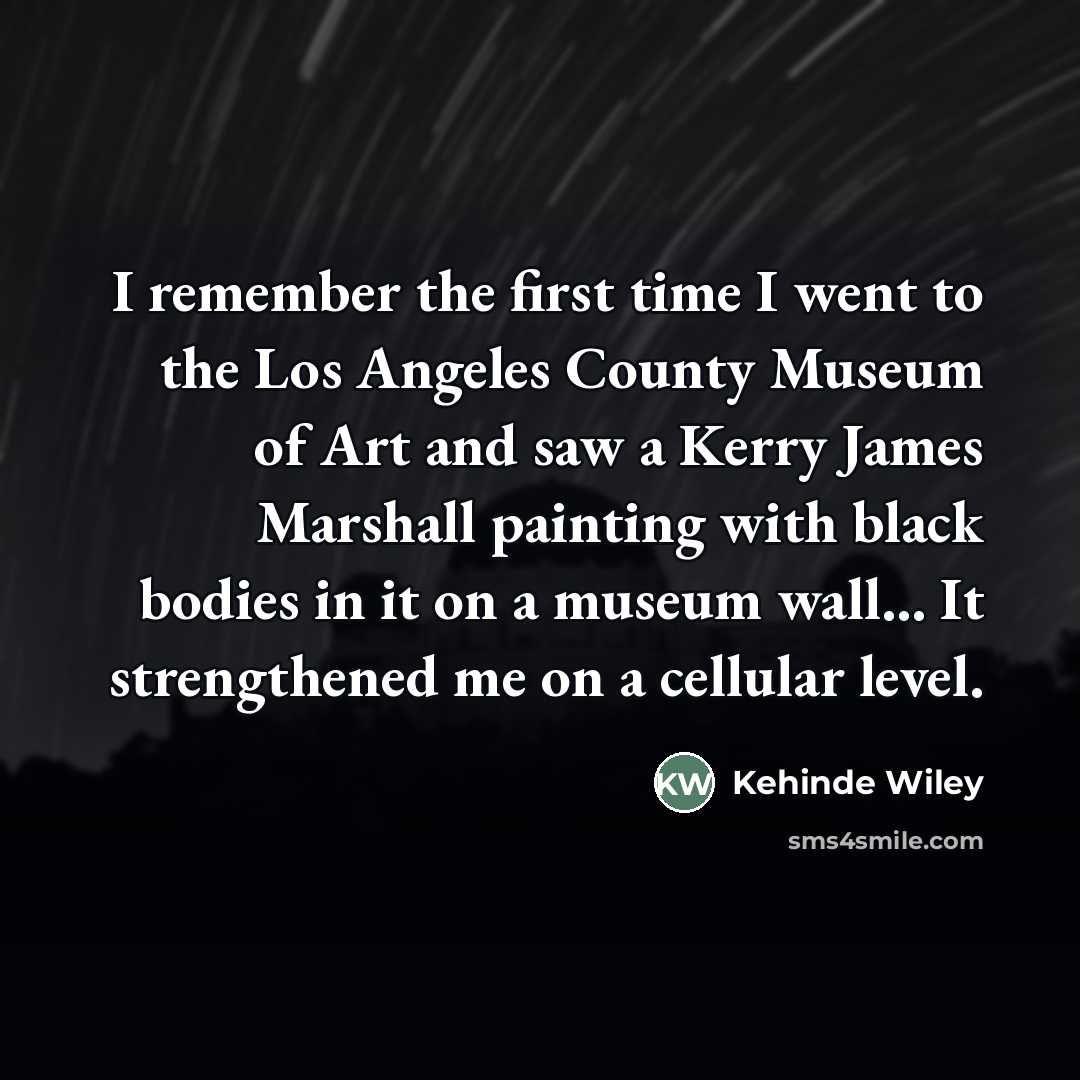
I remember the first time I went to the Los Angeles County Museum of Art and saw a Kerry James Marshall painting… — Kehinde Wiley Copy Share Image
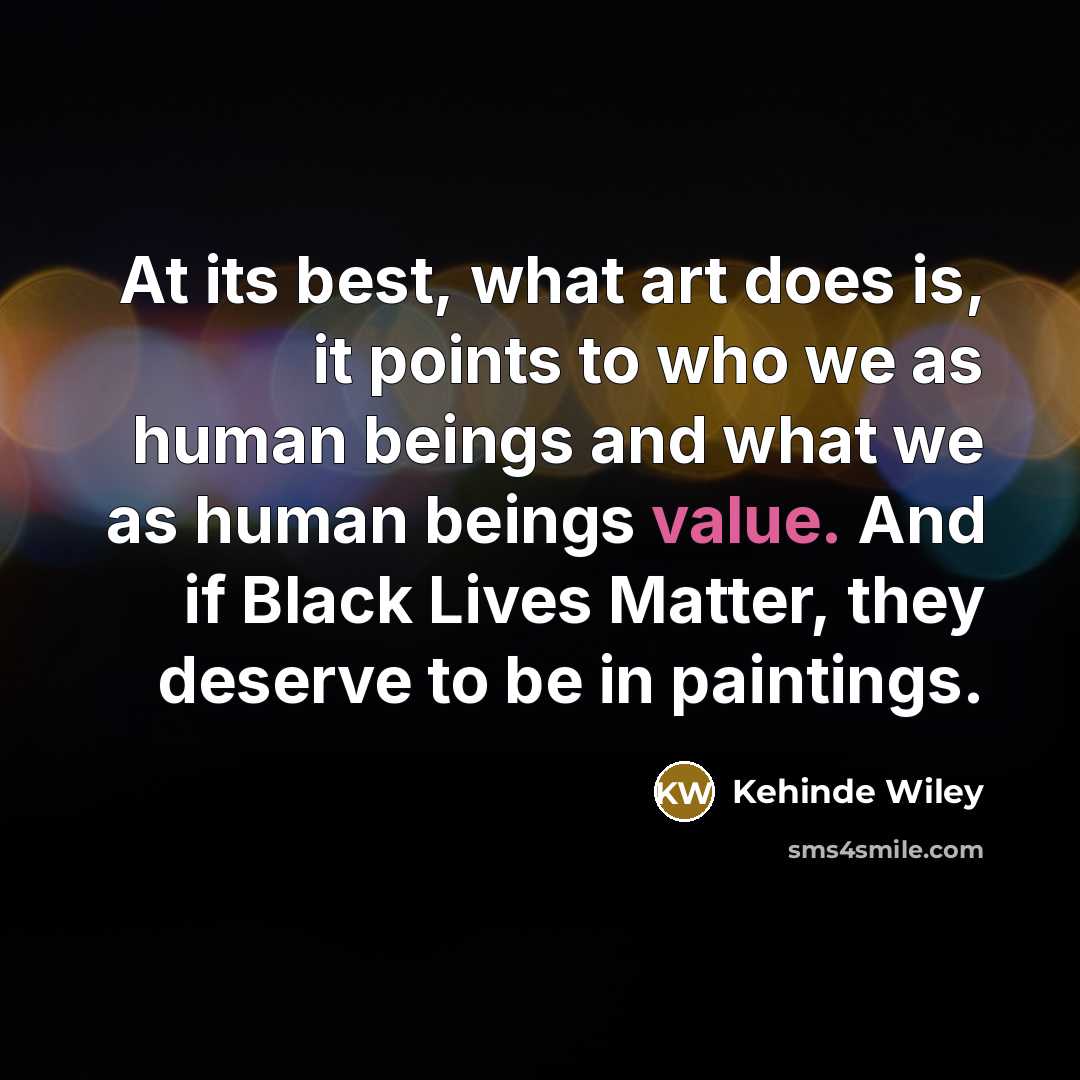
At its best, what art does is, it points to who we as human beings and what we as human beings value.… — Kehinde Wiley Copy Share Image
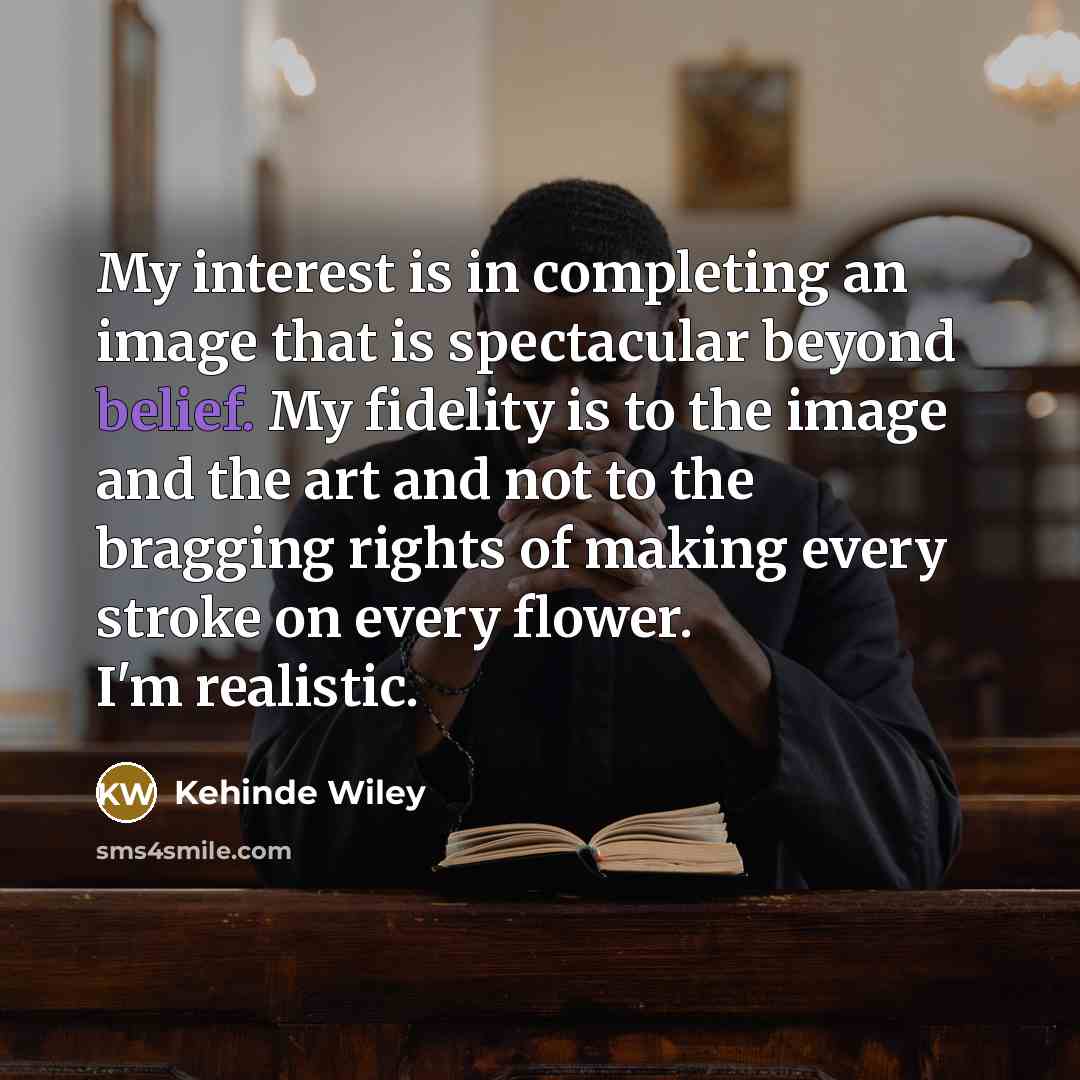
My interest is in completing an image that is spectacular beyond belief. My fidelity is to the image and the art and… — Kehinde Wiley Copy Share Image
I think my life has been transformed by the ability to take things that exist in the world and look at them… — Kehinde Wiley Copy Share Image
What I love in art is that it takes known combinations and reorders them in a way that sheds light on something… — Kehinde Wiley Copy Share Image
My mother sent me to art classes at the age of 11. I began to have kids around me say, 'Will you… — Kehinde Wiley Copy Share Image
I think it was a matter of, like, I'm not going to have my kids in these wild streets. Both my twin… — Kehinde Wiley Copy Share Image
Artists are those people who sit at the intersection between the known and unknown, the rational and irrational, coming to terms with… — Kehinde Wiley Copy Share Image
When I was growing up and going to art school and learning about African-American art, much of it was a type of… — Kehinde Wiley Copy Share Image
I think the pairing of your material practice with your subject is something that is the constant concern of every artist for… — Kehinde Wiley Copy Share Image
I went back to my mother's house recently and I saw some of my earlier works as a 15-year-old art student. And… — Kehinde Wiley Copy Share Image
There was no image of the other biological half of myself. And as an artists, as a - as an - as… — Kehinde Wiley Copy Share Image
He [Michael Jackson] would choose specific moments. They were art history books that I prefer. They were paintings that he prefers. It's… — Kehinde Wiley Copy Share Image
As a working artist, I became increasingly aware of the patterns we see in the street and in America, becoming globalized in… — Kehinde Wiley Copy Share Image
If art can be at the service of anything, it's about letting us see a state of grace for those people who… — Kehinde Wiley Copy Share Image
After high school I went to the San Francisco Art Institute, and I began a formalized art education where we went through… — Kehinde Wiley Copy Share Image
I think what we should concentrate on is what it feels like to be a working artist in the day to day.… — Kehinde Wiley Copy Share Image
I have a fondness for making paintings that go beyond just having a conversation about art for art's sake or having a… — Kehinde Wiley Copy Share Image
There's nothing shocking inherently about that, given that so much of the way that artists are taught is by copying old master… — Kehinde Wiley Copy Share Image
Artists should be able to thrive and allow their ideas to flourish as much as those in biotechnology or finance. — Kehinde Wiley Copy Share Image
Women are expected to identify gender as a starting point. Ethnicities are expected to identify that as a location. Is it ever… — Kehinde Wiley Copy Share Image
One of my most strong memories was studying with Mel Bochner, one of the, I think, high water marks of American conceptual… — Kehinde Wiley Copy Share Image
One of the weirdest things that happened to artists and art criticism was this moment when everyone got cynical and stopped believing… — Kehinde Wiley Copy Share Image
In the Studio Museum in Harlem, when I was dealing with that community and dealing with my peers in the streets, it… — Kehinde Wiley Copy Share Image
Much like teaching art to young art students age 10 to 15 or so on, you have to break it down into bite-sized pieces,… — Kehinde Wiley Copy Share Image
The erotic and the art historical imagination is something that gets very little play when people talk about my work, and when they rarely… — Kehinde Wiley Copy Share Image
One of the weirdest things that happened to artists and art criticism was this moment when everyone got cynical and stopped believing in the… — Kehinde Wiley Copy Share Image
At its best, what art does is, it points to who we as human beings and what we as human beings value. And if… — Kehinde Wiley Copy Share Image
My style is in the 21st century. If you look at the process, it goes from photography through Photoshop, where certain features are heightened,… — Kehinde Wiley Copy Share Image
I think the world that I grew up in was like being in this sort of magical artistic garden. — Kehinde Wiley Copy Share Image
It was something that came sort of matter-of-factually. Because there - it's like really - real honest engagement with the people around me and… — Kehinde Wiley Copy Share Image
We're wired to be empathetic and to care about the needs of others, but also to be curious about others. And I think that's… — Kehinde Wiley Copy Share Image
Painting is situational. And my particular situation exists within gender, race, class, sexuality, nation. — Kehinde Wiley Copy Share Image
There were certain expectations that were assumed of me as a young black American 20th-century - then 20th-century artist. — Kehinde Wiley Copy Share Image
I think, something that you might be able to locate in the work that I'm creating today: the ability to look at a black… — Kehinde Wiley Copy Share Image
I remember the first time I went to the Los Angeles County Museum of Art and saw a Kerry James Marshall painting with black… — Kehinde Wiley Copy Share Image
![“[My twin brother] he was the star artist of the family as we - as we were growing up. He eventually lost interest and went more towards literature and then medicine and then business and so on. But for me it became something that I did well. And it felt great being able to make something look like…” quote by Kehinde Wiley](https://sms4smile.com/quotes/img-quotes/221/kehinde-wiley-1194_able_my-twin-brother-he-was-the-star-artist-o_1330091.jpg)
![“He [Michael Jackson] would choose specific moments. They were art history books that I prefer. They were paintings that he prefers. It's this dance back and forth. We were halfway through the dance. He died.” quote by Kehinde Wiley](https://sms4smile.com/quotes/img-quotes/70b/kehinde-wiley-1194_art_he-michael-jackson-would-choose-specific_2414757.jpg)