Mental state Quote by tim wu
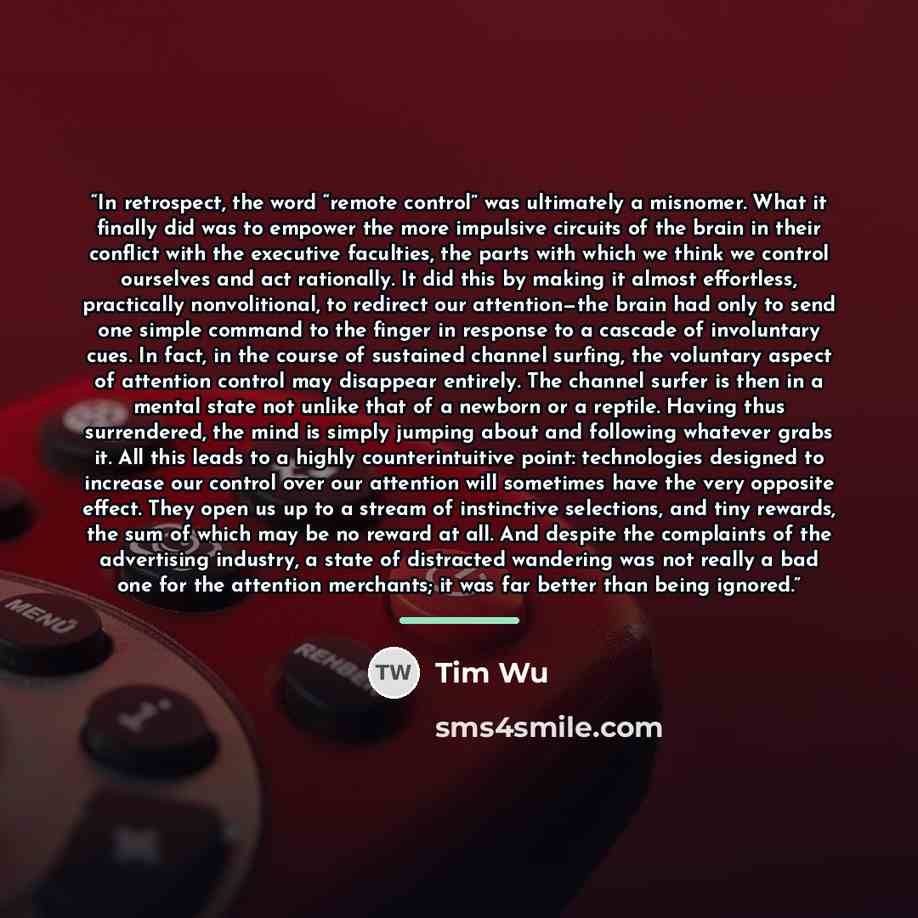
““In retrospect, the word “remote control” was ultimately a misnomer. What it finally did was to empower the more impulsive circuits of the brain in their conflict with the executive faculties, the parts with which we think we control ourselves and act rationally. It did this by making it almost effortless, practically nonvolitional, to redirect our attention—the brain had only to send one simple command to the finger in response to a cascade of involuntary cues. In fact, in the course of sustained channel surfing, the voluntary aspect of attention control may disappear entirely. The channel surfer is then in a mental state not unlike that of a newborn or a reptile. Having thus surrendered, the mind is simply jumping about and following whatever grabs it. All this leads to a highly counterintuitive point: technologies designed to increase our control over our attention will sometimes have the very opposite effect. They open us up to a stream of instinctive selections, and tiny rewards, the sum of which may be no reward at all. And despite the complaints of the advertising industry, a state of distracted wandering was not really a bad one for the attention merchants; it was far better than being ignored.””
About This Quote
Source Book: The Attention Merchants by Tim Wu, 2016
Technology that promises to give us focus can instead hijack our impulsive brain circuits, leading to mindless, reward‑driven behavior and loss of deliberate attention control.
In simple terms: Tech meant for focus can cause mindless distraction.
Key Takeaway
Beware tools that claim control over attention.
Themes
attention
technology
self‑control
behavior
media
Mood
critical
concerned
Type
analytical
cautionary
When to use this quote
- social media scrolling
- TV binge‑watching
- online gaming
- advertising exposure
Key Concepts
cognitive neuroscience
behavioral economics
media manipulation
Questions to Reflect On
- How does your device design influence your focus?
- Can you detect when you’re acting impulsively?
A Different Perspective
Even with awareness, habitual design can override conscious intent.