Different attitude Quote by Ronald Carter
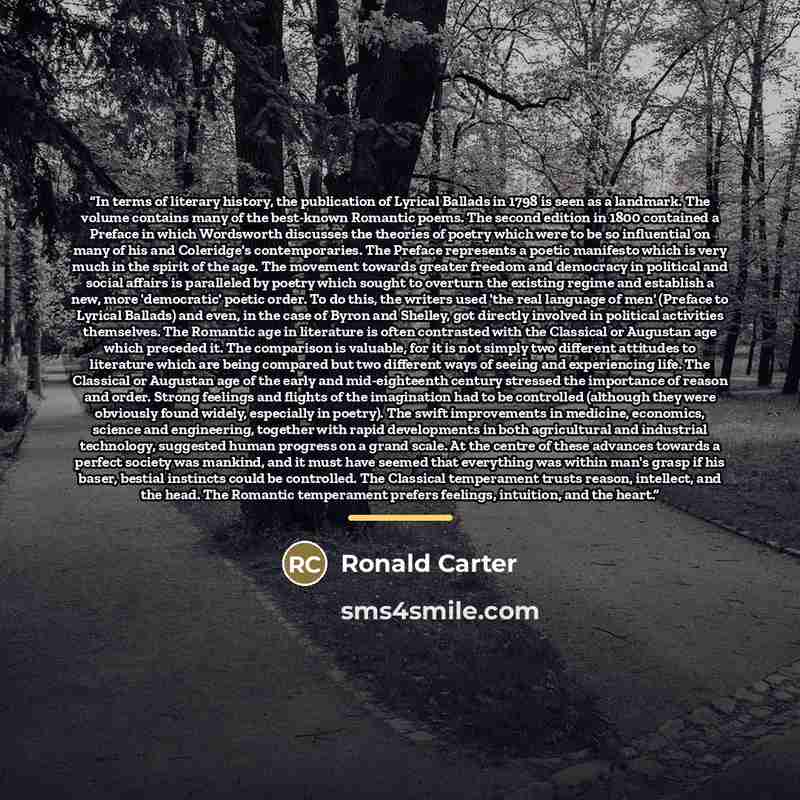
““In terms of literary history, the publication of Lyrical Ballads in 1798 is seen as a landmark. The volume contains many of the best-known Romantic poems. The second edition in 1800 contained a Preface in which Wordsworth discusses the theories of poetry which were to be so influential on many of his and Coleridge's contemporaries. The Preface represents a poetic manifesto which is very much in the spirit of the age. The movement towards greater freedom and democracy in political and social affairs is paralleled by poetry which sought to overturn the existing regime and establish a new, more 'democratic' poetic order. To do this, the writers used 'the real language of men' (Preface to Lyrical Ballads) and even, in the case of Byron and Shelley, got directly involved in political activities themselves. The Romantic age in literature is often contrasted with the Classical or Augustan age which preceded it. The comparison is valuable, for it is not simply two different attitudes to literature which are being compared but two different ways of seeing and experiencing life. The Classical or Augustan age of the early and mid-eighteenth century stressed the importance of reason and order. Strong feelings and flights of the imagination had to be controlled (although they were obviously found widely, especially in poetry). The swift improvements in medicine, economics, science and engineering, together with rapid developments in both agricultural and industrial technology, suggested human progress on a grand scale. At the centre of these advances towards a perfect society was mankind, and it must have seemed that everything was within man's grasp if his baser, bestial instincts could be controlled. The Classical temperament trusts reason, intellect, and the head. The Romantic temperament prefers feelings, intuition, and the heart.””
About This Quote
Source Literary History: Lyrical Ballads Preface, 1798‑1800, Romantic Era
Romantic poetry sought democratic expression, using everyday language and emotion to challenge classical rationalism.
In simple terms: Romanticism valued feeling over reason, using common speech.
Key Takeaway
Embrace authentic, heartfelt expression.
Themes
literature
history
philosophy
politics
art
Mood
inspired
thoughtful
Type
analytical
historical
When to use this quote
- teaching
- creative writing
- public speaking
- political activism
Key Concepts
democracy
individualism
emotional honesty
Questions to Reflect On
- How does everyday language empower poetry?
- What modern movements echo Romantic democratic spirit?
A Different Perspective
Romantic ideals can clash with modern rational demands.
![“Utopian fiction is really boring. I had to read a lot of it, and it's not that much fun. But they're fascinating to me as historical documents. Cabet [Icaria's founder and author of the utopian novel, Travels in Icaria], is writing in the 1830s, and his idea of the perfect society reveals a lot…” quote by Christine Jennings](https://sms4smile.com/quotes/img-quotes/ac0/christine-jennings-20527_book_utopian-fiction-is-really-boring-i-had-t_68118.jpg)