Communication Quote by Richard Hugo
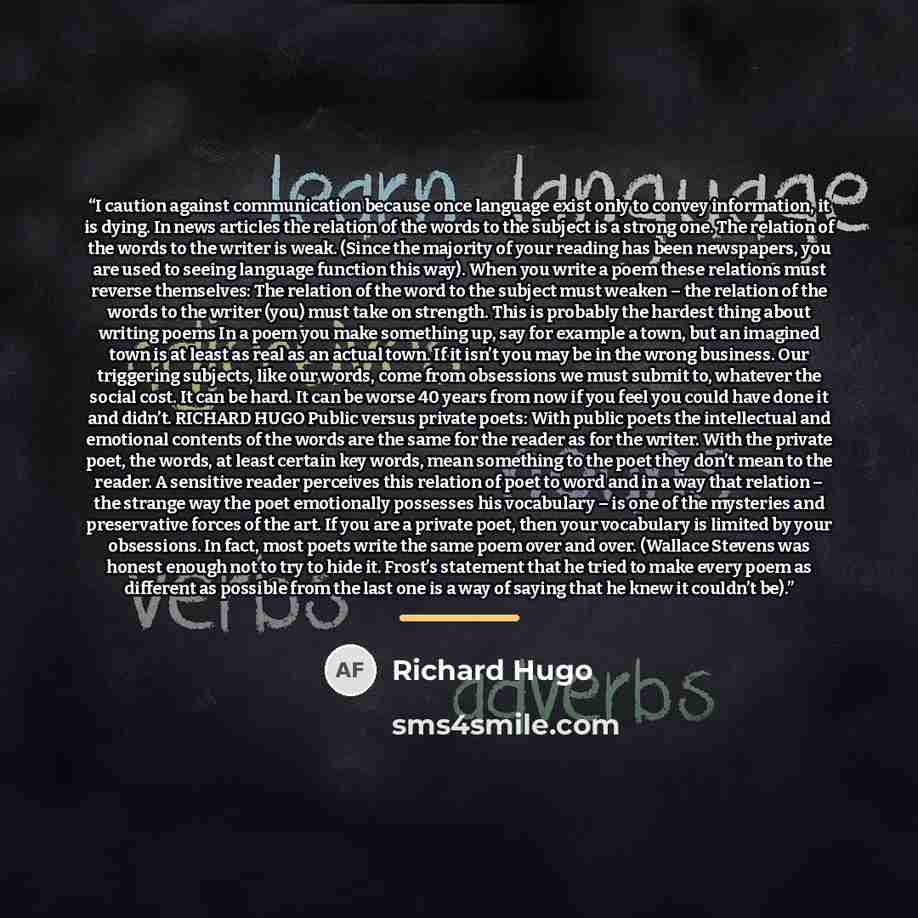
““I caution against communication because once language exist only to convey information, it is dying. In news articles the relation of the words to the subject is a strong one. The relation of the words to the writer is weak. (Since the majority of your reading has been newspapers, you are used to seeing language function this way). When you write a poem these relations must reverse themselves: The relation of the word to the subject must weaken – the relation of the words to the writer (you) must take on strength. This is probably the hardest thing about writing poems In a poem you make something up, say for example a town, but an imagined town is at least as real as an actual town. If it isn’t you may be in the wrong business. Our triggering subjects, like our words, come from obsessions we must submit to, whatever the social cost. It can be hard. It can be worse 40 years from now if you feel you could have done it and didn’t. RICHARD HUGO Public versus private poets: With public poets the intellectual and emotional contents of the words are the same for the reader as for the writer. With the private poet, the words, at least certain key words, mean something to the poet they don’t mean to the reader. A sensitive reader perceives this relation of poet to word and in a way that relation – the strange way the poet emotionally possesses his vocabulary – is one of the mysteries and preservative forces of the art. If you are a private poet, then your vocabulary is limited by your obsessions. In fact, most poets write the same poem over and over. (Wallace Stevens was honest enough not to try to hide it. Frost’s statement that he tried to make every poem as different as possible from the last one is a way of saying that he knew it couldn’t be).””
About This Quote
Source Essay: “On Poetry” by Richard Hugo, 1970s
Poetry demands that words shift from merely conveying facts to expressing the poet’s inner world, making the writer’s voice dominant over the subject.
In simple terms: Poetry flips language from factual to personal expression.
Key Takeaway
Let your voice shape the words, not just the facts.
Themes
creativity
expression
subjectivity
poetry
voice
Mood
introspective
challenging
inspirational
Type
literary
philosophical
reflective
When to use this quote
- writing poetry
- literary analysis
- creative workshops
- personal journaling
- teaching literature
Key Concepts
subjectivity
obsession
imagery
voice
relationship
Questions to Reflect On
- How can you balance personal intensity with reader accessibility?
- What obsessions drive your poetic language?
A Different Perspective
The emphasis on personal voice may alienate readers seeking clear narratives.