Abuse Quote by Michael Salter
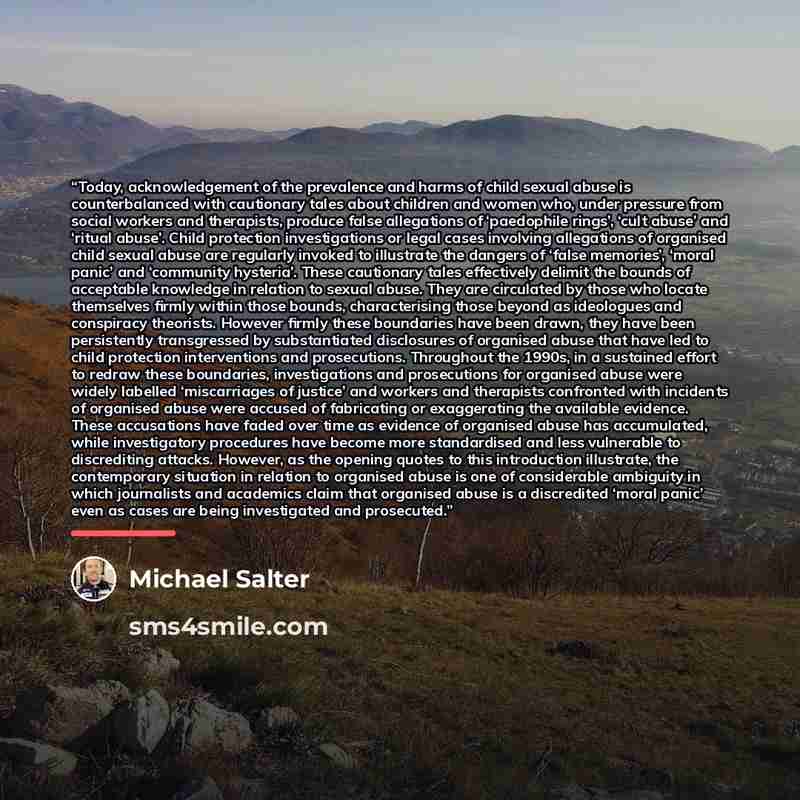
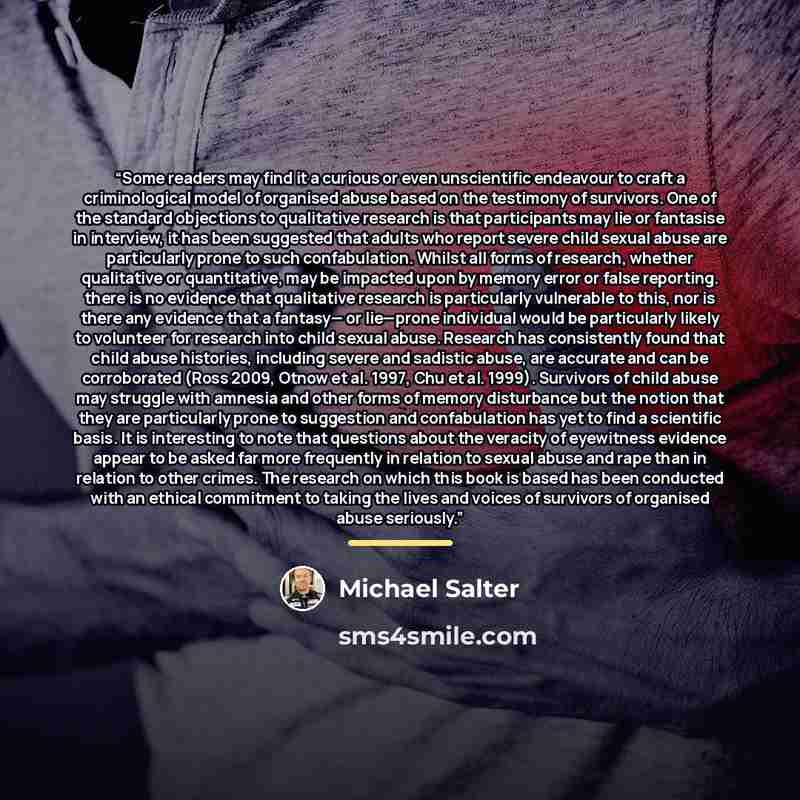
““In her book claiming that allegations of ritualistic abuse are mostly confabulations, La Fontaine’s (1998) comparison of social workers to ‘nazis’ shows the depth of feeling evident amongst many sceptics. However, this raises an important question: Why did academics and journalists feel so strongly about allegations of ritualistic abuse, to the point of pervasively misrepresenting the available evidence and treating women disclosing ritualistic abuse, and those workers who support them, with barely concealed contempt? It is of course true that there are fringe practitioners in the field of organised abuse, just as there are fringe practitioners in many other health-related fields. However, the contrast between the measured tone of the majority of therapists and social workers writing on ritualistic abuse, and the over-blown sensationalism of their critics, could not be starker. Indeed, Scott (2001) notes with irony that the writings of those who claimed that ‘satanic ritual abuse’ is a ‘moral panic’ had many of the features of a moral panic: scapegoating therapists, social workers and sexual abuse victims whilst warning of an impending social catastrophe brought on by an epidemic of false allegations of sexual abuse. It is perhaps unsurprising that social movements for people accused of sexual abuse would engage in such hyperbole, but why did this rhetoric find so many champions in academia and the media?””
About This Quote
Source Article: “Moral Panic and the Satanic Ritual Abuse Debate” by Michael Salter, 2005
The passage questions why scholars and journalists strongly opposed ritual abuse claims, often misrepresenting evidence and showing contempt toward victims and supporters, despite the phenomenon being largely debunked.
In simple terms: It asks why experts reacted so harshly to disputed abuse claims, treating victims and allies with hostility.
Key Takeaway
Examine bias in media and academia when confronting controversial topics.
Themes
bias
media influence
social panic
academic responsibility
victim treatment
Mood
critical
analytical
skeptical
Type
commentary
analytical
critical
When to use this quote
- research reviews
- policy debates
- court cases
- public health discussions
- media reporting
Key Concepts
moral panic
scapegoating
confirmation bias
social construction of reality
ethical journalism
Questions to Reflect On
- How does sensationalism affect public perception of abuse claims?
- What responsibilities do scholars have when addressing controversial topics?
A Different Perspective
The critique may overlook legitimate concerns about false accusations harming innocent people.
![“I find it disturbing that one anthropologist's readings of transcripts are being listened to more seriously than 40 senior health service clinicians. [Referring to Jean La Fontaine's 1994 research paper for the DOH]” quote by Valerie Sinason](https://sms4smile.com/quotes/img-quotes/ed4/valerie-sinason-38025_child-abuse-allegati_i-find-it-disturbing-that-one-anthropolo_1637950.jpg)

![“I think it was impossible not to come upon a lot of confabulation simply because any good scholarship that has been done since [Buckminster Fuller] death has really delved in that.” quote by Jonathon Keats](https://sms4smile.com/quotes/img-quotes/5c0/jonathon-keats-10822_buckminster-fuller_i-think-it-was-impossible-not-to-come-up_1655031.jpg)