Abuse Quote by Michael Salter
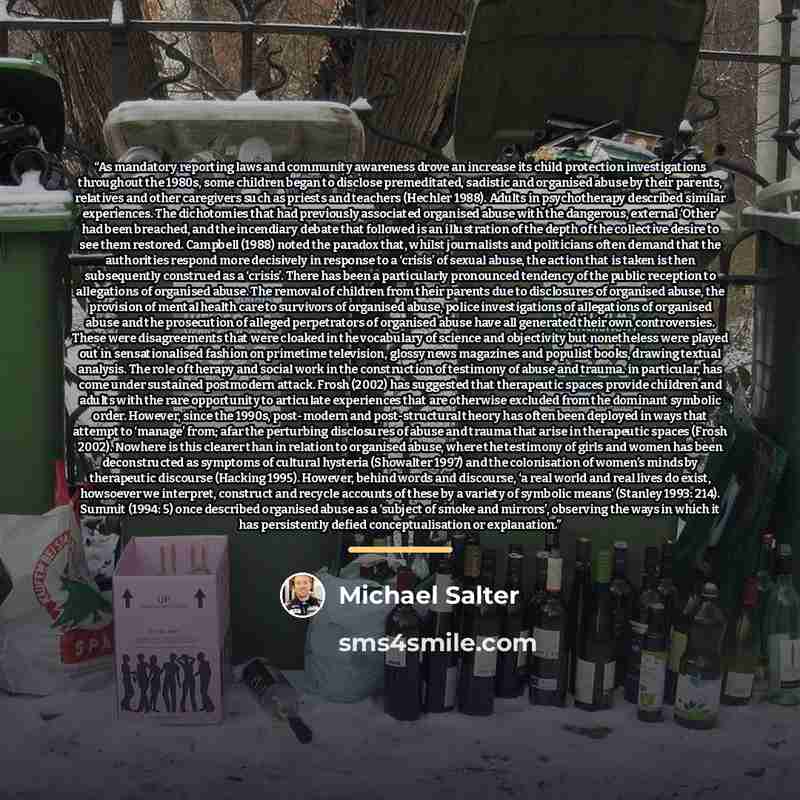
““As mandatory reporting laws and community awareness drove an increase its child protection investigations throughout the 1980s, some children began to disclose premeditated, sadistic and organised abuse by their parents, relatives and other caregivers such as priests and teachers (Hechler 1988). Adults in psychotherapy described similar experiences. The dichotomies that had previously associated organised abuse with the dangerous, external ‘Other’ had been breached, and the incendiary debate that followed is an illustration of the depth of the collective desire to see them restored. Campbell (1988) noted the paradox that, whilst journalists and politicians often demand that the authorities respond more decisively in response to a ‘crisis’ of sexual abuse, the action that is taken is then subsequently construed as a ‘crisis’. There has been a particularly pronounced tendency of the public reception to allegations of organised abuse. The removal of children from their parents due to disclosures of organised abuse, the provision of mental health care to survivors of organised abuse, police investigations of allegations of organised abuse and the prosecution of alleged perpetrators of organised abuse have all generated their own controversies. These were disagreements that were cloaked in the vocabulary of science and objectivity but nonetheless were played out in sensationalised fashion on primetime television, glossy news magazines and populist books, drawing textual analysis. The role of therapy and social work in the construction of testimony of abuse and trauma. in particular, has come under sustained postmodern attack. Frosh (2002) has suggested that therapeutic spaces provide children and adults with the rare opportunity to articulate experiences that are otherwise excluded from the dominant symbolic order. However, since the 1990s, post-modern and post-structural theory has often been deployed in ways that attempt to ‘manage’ from; afar the perturbing disclosures of abuse and trauma that arise in therapeutic spaces (Frosh 2002). Nowhere is this clearer than in relation to organised abuse, where the testimony of girls and women has been deconstructed as symptoms of cultural hysteria (Showalter 1997) and the colonisation of women’s minds by therapeutic discourse (Hacking 1995). However, behind words and discourse, ‘a real world and real lives do exist, howsoever we interpret, construct and recycle accounts of these by a variety of symbolic means’ (Stanley 1993: 214). Summit (1994: 5) once described organised abuse as a ‘subject of smoke and mirrors’, observing the ways in which it has persistently defied conceptualisation or explanation.””
About This Quote
The passage describes how mandatory reporting and public awareness in the 1980s revealed organized child abuse, challenging prior notions of abuse as an external threat and sparking media-fueled controversy over responses and therapeutic testimony.
In simple terms: Revealing systemic abuse reshapes public perception and policy.
Key Takeaway
Exposure of hidden abuse forces societal reckoning.
Themes
Power dynamics
Media influence
Therapeutic authority
Social stigma
Institutional accountability
Mood
Urgent
Reflective
Critical
Type
Analytical
Historical
Sociopolitical
When to use this quote
- Legal investigations
- Therapeutic disclosure
- Media coverage
- Public policy debates
- Survivor support
Key Concepts
Mandatory reporting
Organized abuse
Narrative construction
Postmodern critique
Practical Applications
- Developing trauma-informed legal frameworks
- Designing ethical therapeutic practices
Questions to Reflect On
- How does media framing affect public response to abuse scandals?
- What ethical responsibilities do therapists have when documenting trauma?