Abuse Quote by Michael Salter
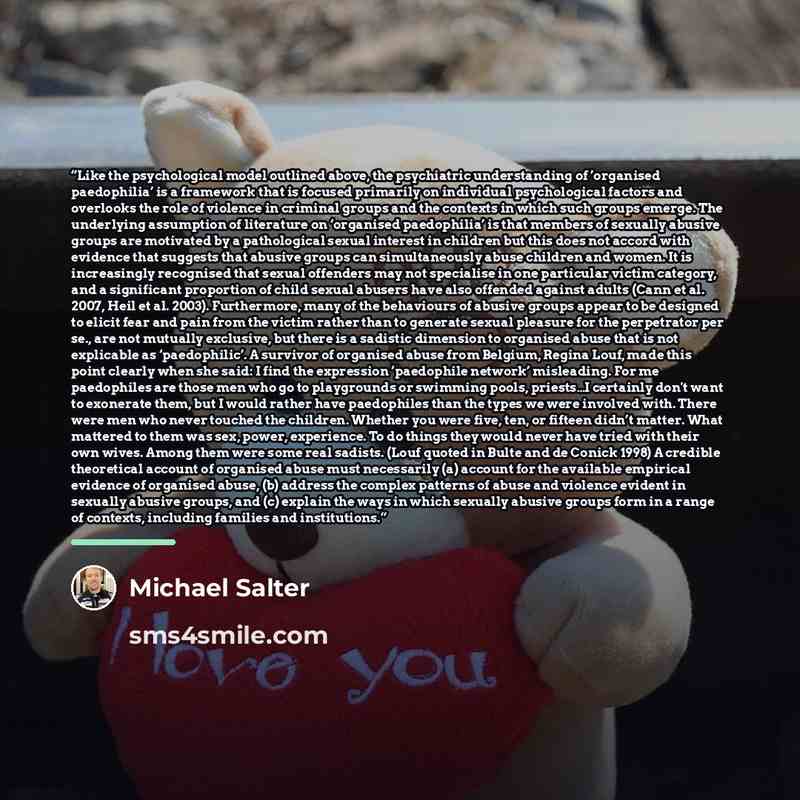
““Like the psychological model outlined above, the psychiatric understanding of ’organised paedophilia’ is a framework that is focused primarily on individual psychological factors and overlooks the role of violence in criminal groups and the contexts in which such groups emerge. The underlying assumption of literature on ‘organised paedophilia’ is that members of sexually abusive groups are motivated by a pathological sexual interest in children but this does not accord with evidence that suggests that abusive groups can simultaneously abuse children and women. It is increasingly recognised that sexual offenders may not specialise in one particular victim category, and a significant proportion of child sexual abusers have also offended against adults (Cann et al. 2007, Heil et al. 2003). Furthermore, many of the behaviours of abusive groups appear to be designed to elicit fear and pain from the victim rather than to generate sexual pleasure for the perpetrator per se., are not mutually exclusive, but there is a sadistic dimension to organised abuse that is not explicable as ‘paedophilic’. A survivor of organised abuse from Belgium, Regina Louf, made this point clearly when she said: I find the expression ‘paedophile network’ misleading. For me paedophiles are those men who go to playgrounds or swimming pools, priests…I certainly don't want to exonerate them, but I would rather have paedophiles than the types we were involved with. There were men who never touched the children. Whether you were five, ten, or fifteen didn’t matter. What mattered to them was sex, power, experience. To do things they would never have tried with their own wives. Among them were some real sadists. (Louf quoted in Bulte and de Conick 1998) A credible theoretical account of organised abuse must necessarily (a) account for the available empirical evidence of organised abuse, (b) address the complex patterns of abuse and violence evident in sexually abusive groups, and (c) explain the ways in which sexually abusive groups form in a range of contexts, including families and institutions.””
About This Quote
The quote argues that focusing only on individual psychology in organized child sexual abuse ignores group violence, power dynamics, and sadistic motives, calling for a broader framework that includes these factors.
In simple terms: It says we need to look beyond personal motives to understand group abuse.
Key Takeaway
Consider group dynamics and power in abuse analysis.
Themes
psychology
violence
group dynamics
sexual abuse
power
sadism
Mood
analytical
critical
serious
Type
theoretical
analytical
critical
When to use this quote
- law enforcement
- policy making
- clinical assessment
- research
- advocacy
Key Concepts
pathology
victimology
social structures
Questions to Reflect On
- How do power and fear shape abusive group behavior?
- What policies can address both individual and group factors?
A Different Perspective
Group behavior may be driven by factors other than sexual interest, complicating prevention.