Abuse Quote by Michael Salter
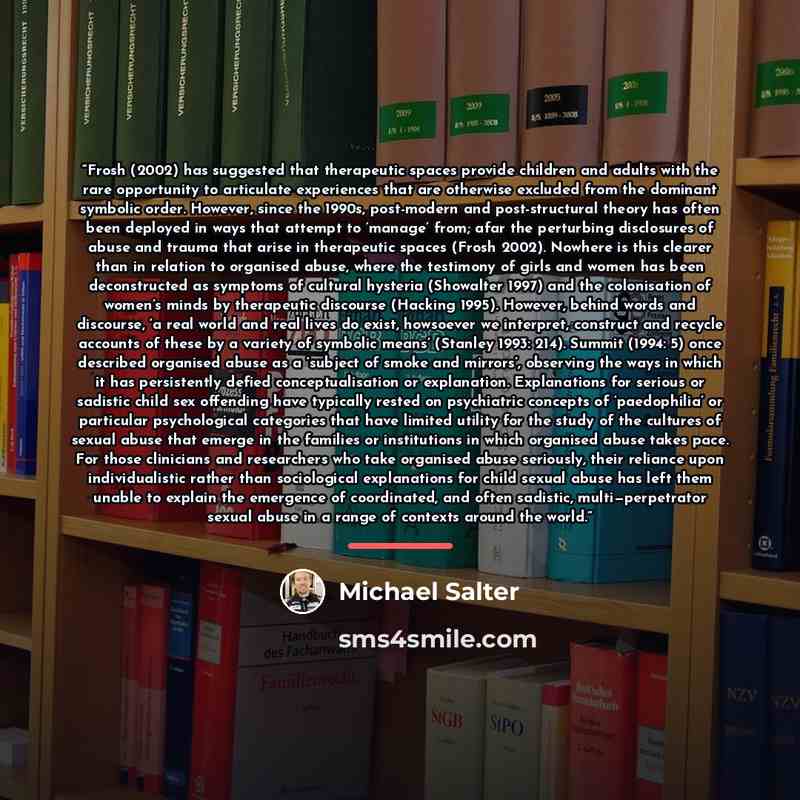
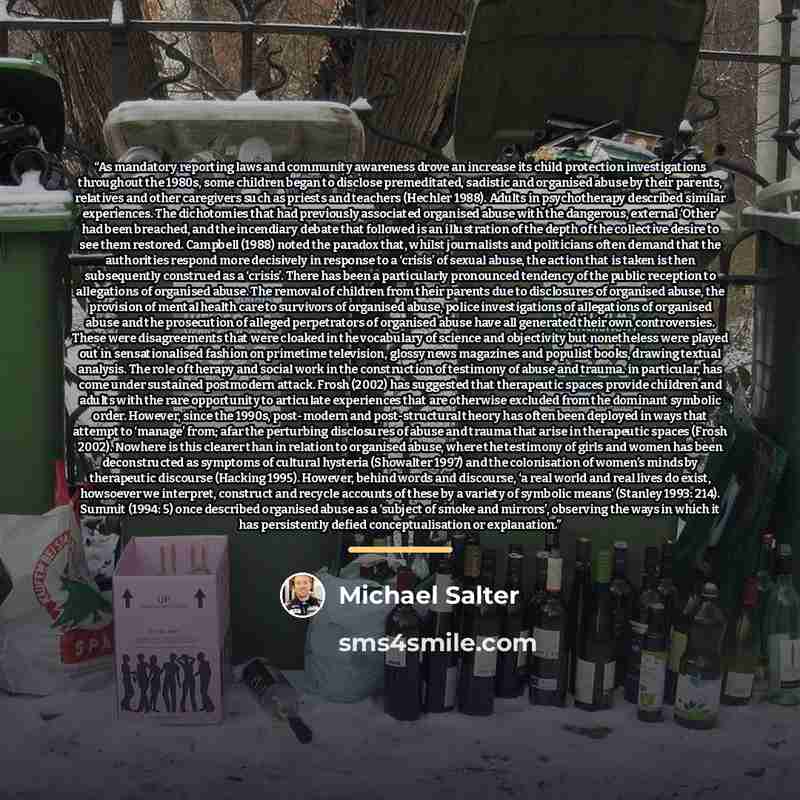
““Frosh (2002) has suggested that therapeutic spaces provide children and adults with the rare opportunity to articulate experiences that are otherwise excluded from the dominant symbolic order. However, since the 1990s, post-modern and post-structural theory has often been deployed in ways that attempt to ‘manage’ from; afar the perturbing disclosures of abuse and trauma that arise in therapeutic spaces (Frosh 2002). Nowhere is this clearer than in relation to organised abuse, where the testimony of girls and women has been deconstructed as symptoms of cultural hysteria (Showalter 1997) and the colonisation of women’s minds by therapeutic discourse (Hacking 1995). However, behind words and discourse, ‘a real world and real lives do exist, howsoever we interpret, construct and recycle accounts of these by a variety of symbolic means’ (Stanley 1993: 214). Summit (1994: 5) once described organised abuse as a ‘subject of smoke and mirrors’, observing the ways in which it has persistently defied conceptualisation or explanation. Explanations for serious or sadistic child sex offending have typically rested on psychiatric concepts of ‘paedophilia’ or particular psychological categories that have limited utility for the study of the cultures of sexual abuse that emerge in the families or institutions in which organised abuse takes pace. For those clinicians and researchers who take organised abuse seriously, their reliance upon individualistic rather than sociological explanations for child sexual abuse has left them unable to explain the emergence of coordinated, and often sadistic, multi—perpetrator sexual abuse in a range of contexts around the world.””
About This Quote
Source Article: The Politics of Organised Abuse, Michael Salter, 2020
Therapeutic spaces can reveal hidden trauma, but dominant discourses often suppress or reinterpret these disclosures, limiting understanding of systemic abuse.
In simple terms: Therapy can expose trauma, yet mainstream narratives may silence it.
Key Takeaway
Recognize and challenge dominant narratives that marginalize survivor testimony.
Themes
trauma
power
discourses
systemic abuse
psychiatry
Mood
critical
reflective
concerned
Type
analytical
advocacy
scholarly
When to use this quote
- clinical practice
- policy making
- education
- media reporting
- support groups
Key Concepts
post‑modern theory
post‑structuralism
symbolic order
cultural hysteria
psychiatric labeling
Questions to Reflect On
- How can we shift from individual to sociological explanations?
- What practices allow survivor voices to shape discourse?
A Different Perspective
Dominant frameworks may pathologize survivors instead of addressing structural causes.