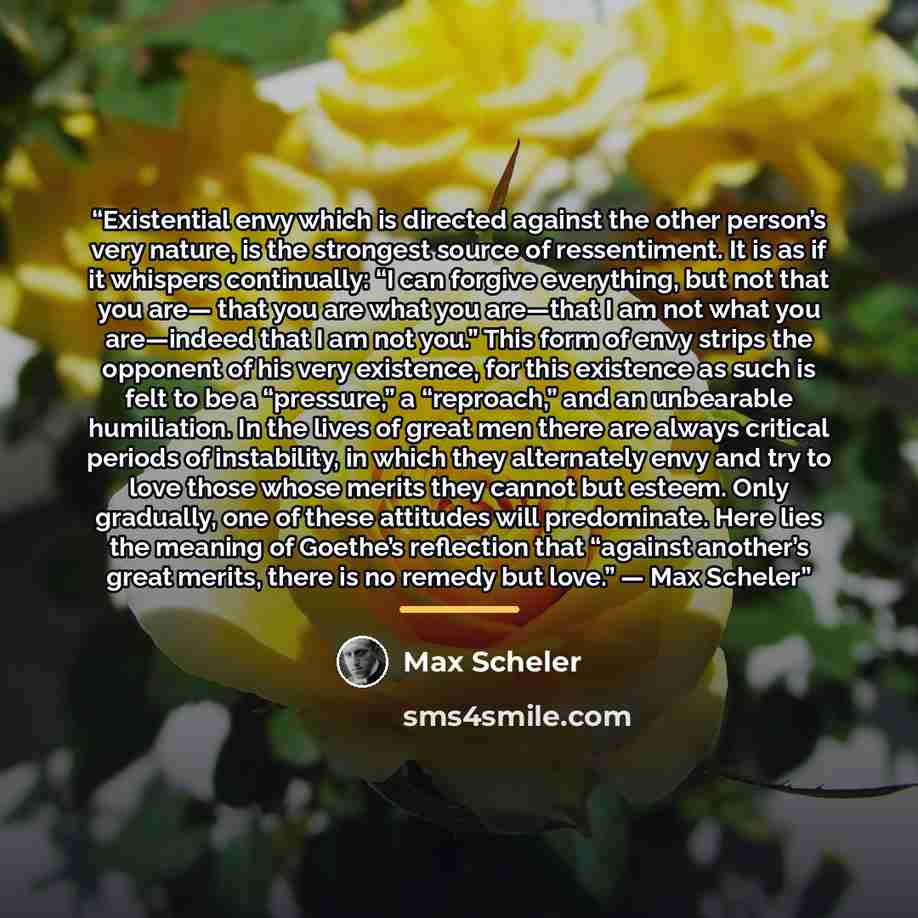
Hatred Quote by Max Scheler

““In ressentiment morality, love for the “small,” the “poor,” the “weak,” and the “oppressed” is really disguised hatred, repressed envy, an impulse to detract, etc., directed against the opposite phenomena: “wealth,” “strength,” “power,” “largesse.” When hatred does not dare to come out into the open, it can be easily expressed in the form of ostensible love—love for something which has features that are the opposite of those of the hated object. This can happen in such a way that the hatred remains secret. When we hear that falsely pious, unctuous tone (it is the tone of a certain “socially-minded” type of priest), sermonizing that love for the “small” is our first duty, love for the “humble” inspirit, since God gives “grace” to them, then it is often only hatred posing as Christian love.””
About This Quote
Source Essay: “The Ethics of Ressentiment” by Max Scheler, 1915
Moralizing love for the weak can mask hidden hostility toward the powerful, turning envy into feigned compassion.
In simple terms: Pretending to love the humble may hide envy of the strong.
Key Takeaway
Examine motives behind proclaimed altruism.
Themes
morality
envy
hypocrisy
power dynamics
Mood
critical
thoughtful
Type
philosophical
analytical
When to use this quote
- political discourse
- charitable work
- personal relationships
- media analysis
Key Concepts
psychology
ethics
social critique
Questions to Reflect On
- What evidence shows true compassion versus hidden resentment?
- How can societies encourage authentic solidarity?
A Different Perspective
Such critiques can oversimplify complex motivations, ignoring genuine empathy.







![“Love loves and in loving always looks beyond what it has in hand and possesses. The driving impulse [*Triebimpuls*] which arouses may tire out; love itself does not tire. This *sursum corda* which is the essence of love may take on fundamentally different forms at different elevations in the…” quote by Max Scheler](https://sms4smile.com/quotes/img-quotes/cc4/max-scheler-21013_axiology_love-loves-and-in-loving-always-looks-be_248149.jpg)
![“Only after the concept of knowledge has been based on an ontological relation [*Seinsverhältnis*] can we work out the particular kind of being from which the principle of immanence-to-consciousness (the starting point of Idealism and Critical Realism) mistakenly proceeds as though from a primary…” quote by Max Scheler](https://sms4smile.com/quotes/img-quotes/65c/max-scheler-21013_epistemology_only-after-the-concept-of-knowledge-has_492525.jpg)



![“All that is worthy of love [*die Liebenswürdigkeiten*], from the viewpoint of God's comprehensive love, might have been stamped and created by this act of love; man's love does not so stamp or create its objects. Man's love is restricted to recognizing the objective demand these objects make and…” quote by Max Scheler](https://sms4smile.com/quotes/img-quotes/ece/max-scheler-21013_ability-to-love_all-that-is-worthy-of-love-die-liebensw_1325365.jpg)