Epistemology Quote by Max Scheler
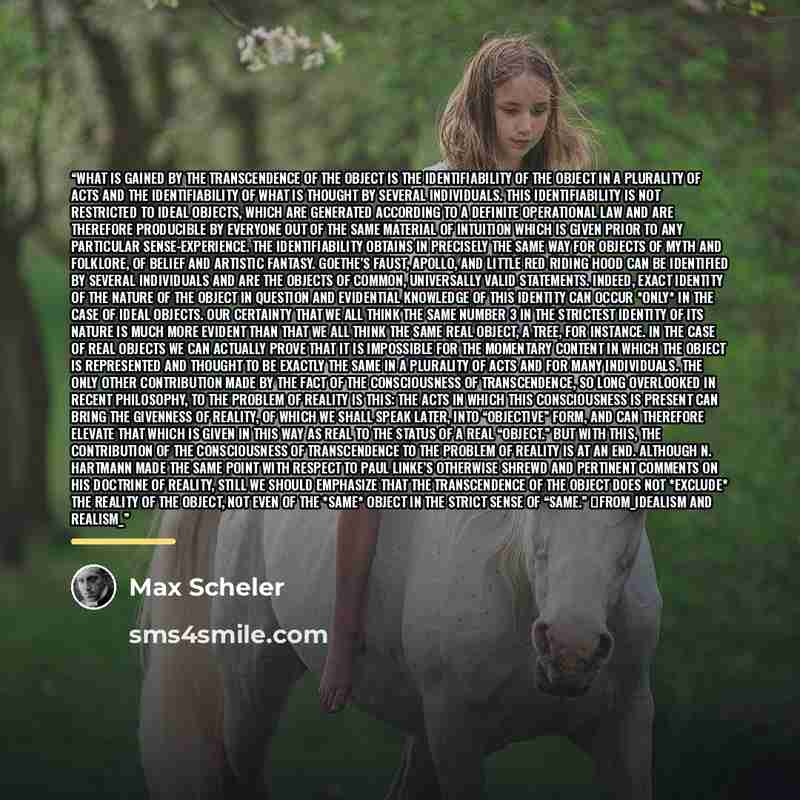
““What is gained by the transcendence of the object is the identifiability of the object in a plurality of acts and the identifiability of what is thought by several individuals. This identifiability is not restricted to ideal objects, which are generated according to a definite operational law and are therefore producible by everyone out of the same material of intuition which is given prior to any particular sense-experience. The identifiability obtains in precisely the same way for objects of myth and folklore, of belief and artistic fantasy. Goethe’s Faust, Apollo, and Little Red Riding Hood can be identified by several individuals and are the objects of common, universally valid statements. Indeed, exact identity of the nature of the object in question and evidential knowledge of this identity can occur *only* in the case of ideal objects. Our certainty that we all think the same number 3 in the strictest identity of its nature is much more evident than that we all think the same real object, a tree, for instance. In the case of real objects we can actually prove that it is impossible for the momentary content in which the object is represented and thought to be exactly the same in a plurality of acts and for many individuals. The only other contribution made by the fact of the consciousness of transcendence, so long overlooked in recent philosophy, to the problem of reality is this: the acts in which this consciousness is present can bring the givenness of reality, of which we shall speak later, into “objective” form, and can therefore elevate that which is given in this way as real to the status of a real “object.” But with this, the contribution of the consciousness of transcendence to the problem of reality is at an end. Although N. Hartmann made the same point with respect to Paul Linke’s otherwise shrewd and pertinent comments on his doctrine of reality, still we should emphasize that the transcendence of the object does not *exclude* the reality of the object, not even of the *same* object in the strict sense of “same.” ―from_Idealism and Realism_””
About This Quote
Source Book: Philosophy of Values, Max Scheler, 1916
He argues that ideal objects can be identically recognized by many, while concrete objects cannot be perfectly shared in thought.
In simple terms: Ideal ideas are universally identifiable; real things are not.
Key Takeaway
Recognize the limits of shared perception.
Themes
philosophy
epistemology
ontology
language
perception
Mood
analytical
reflective
critical
Type
philosophical
theoretical
academic
When to use this quote
- academic discussion
- teaching philosophy
- cross‑cultural analysis
Key Concepts
transcendence
identifiability
ideal vs. real objects
Questions to Reflect On
- How do we communicate about concrete objects reliably?
- Can we ever achieve true consensus on reality?
A Different Perspective
Shared exact identity is only possible for abstract concepts, not for concrete particulars.





![“[She wished] that once, just once, the fairy tale fantasy would come true. Not the prince in shining armor . . . But the other one . . . in which innocent little Red Riding Hood meets the Big Bad Wolf.” quote by Sierra Dafoe](https://sms4smile.com/quotes/img-quotes/b69/sierra-dafoe-278293_dark-fantasy_she-wished-that-once-just-once-the-fairy_812022.jpg)





![“Love loves and in loving always looks beyond what it has in hand and possesses. The driving impulse [*Triebimpuls*] which arouses may tire out; love itself does not tire. This *sursum corda* which is the essence of love may take on fundamentally different forms at different elevations in the…” quote by Max Scheler](https://sms4smile.com/quotes/img-quotes/cc4/max-scheler-21013_axiology_love-loves-and-in-loving-always-looks-be_248149.jpg)
![“Only after the concept of knowledge has been based on an ontological relation [*Seinsverhältnis*] can we work out the particular kind of being from which the principle of immanence-to-consciousness (the starting point of Idealism and Critical Realism) mistakenly proceeds as though from a primary…” quote by Max Scheler](https://sms4smile.com/quotes/img-quotes/65c/max-scheler-21013_epistemology_only-after-the-concept-of-knowledge-has_492525.jpg)



![“All that is worthy of love [*die Liebenswürdigkeiten*], from the viewpoint of God's comprehensive love, might have been stamped and created by this act of love; man's love does not so stamp or create its objects. Man's love is restricted to recognizing the objective demand these objects make and…” quote by Max Scheler](https://sms4smile.com/quotes/img-quotes/ece/max-scheler-21013_ability-to-love_all-that-is-worthy-of-love-die-liebensw_1325365.jpg)