Data Quote by Leonard Mlodinow
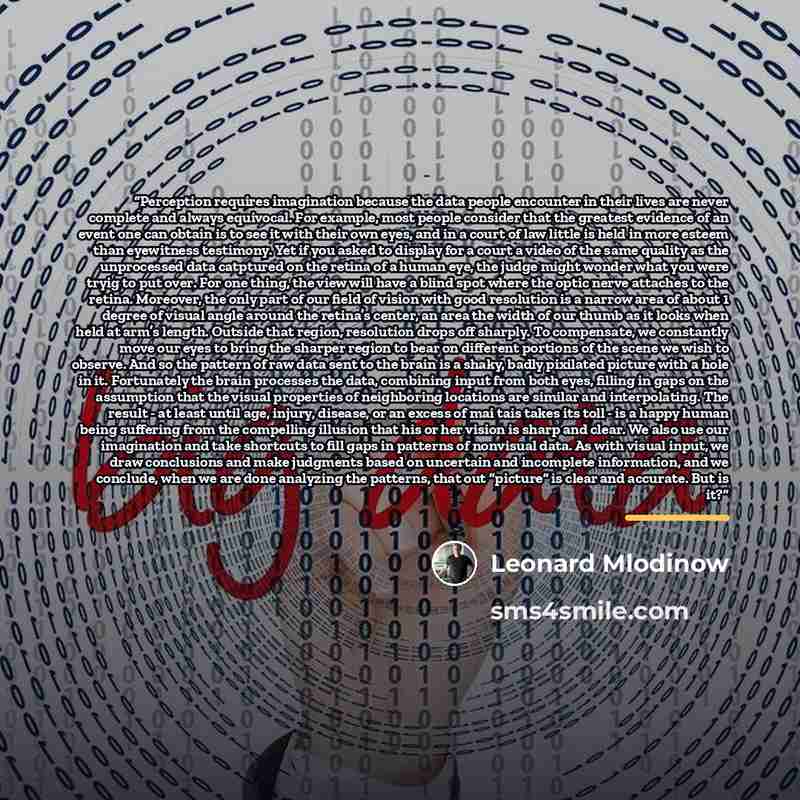
““Perception requires imagination because the data people encounter in their lives are never complete and always equivocal. For example, most people consider that the greatest evidence of an event one can obtain is to see it with their own eyes, and in a court of law little is held in more esteem than eyewitness testimony. Yet if you asked to display for a court a video of the same quality as the unprocessed data catptured on the retina of a human eye, the judge might wonder what you were tryig to put over. For one thing, the view will have a blind spot where the optic nerve attaches to the retina. Moreover, the only part of our field of vision with good resolution is a narrow area of about 1 degree of visual angle around the retina’s center, an area the width of our thumb as it looks when held at arm’s length. Outside that region, resolution drops off sharply. To compensate, we constantly move our eyes to bring the sharper region to bear on different portions of the scene we wish to observe. And so the pattern of raw data sent to the brain is a shaky, badly pixilated picture with a hole in it. Fortunately the brain processes the data, combining input from both eyes, filling in gaps on the assumption that the visual properties of neighboring locations are similar and interpolating. The result - at least until age, injury, disease, or an excess of mai tais takes its toll - is a happy human being suffering from the compelling illusion that his or her vision is sharp and clear. We also use our imagination and take shortcuts to fill gaps in patterns of nonvisual data. As with visual input, we draw conclusions and make judgments based on uncertain and incomplete information, and we conclude, when we are done analyzing the patterns, that out “picture” is clear and accurate. But is it?””
About This Quote
Source Book: The Art of Thinking Clearly, Leonard Mlodinow, 2013
Perception fills gaps with imagination, creating a coherent picture from incomplete, blurry data, but this can mislead us about reality.
In simple terms: Our brains complete missing visual and non‑visual information, often giving a false sense of clarity.
Key Takeaway
Question assumptions and seek fuller data.
Themes
perception
imagination
cognitive bias
Mood
skeptical
analytical
Type
educational
philosophical
When to use this quote
- court testimony
- medical diagnosis
- news consumption
- personal decision making
Key Concepts
visual processing
heuristics
confirmation bias
Questions to Reflect On
- What evidence do you rely on?
- How might your mind be filling in gaps?
A Different Perspective
Our brain’s shortcuts can produce systematic errors, especially under pressure.







![“[Brazil] went to the UN and said, "We need new standards for this." We need to take a look at what they're calling "data sovereignty."” quote by Edward Snowden](https://sms4smile.com/quotes/img-quotes/af7/edward-snowden-555_brazil_brazil-went-to-the-un-and-said-we-need-n_14906.jpg)