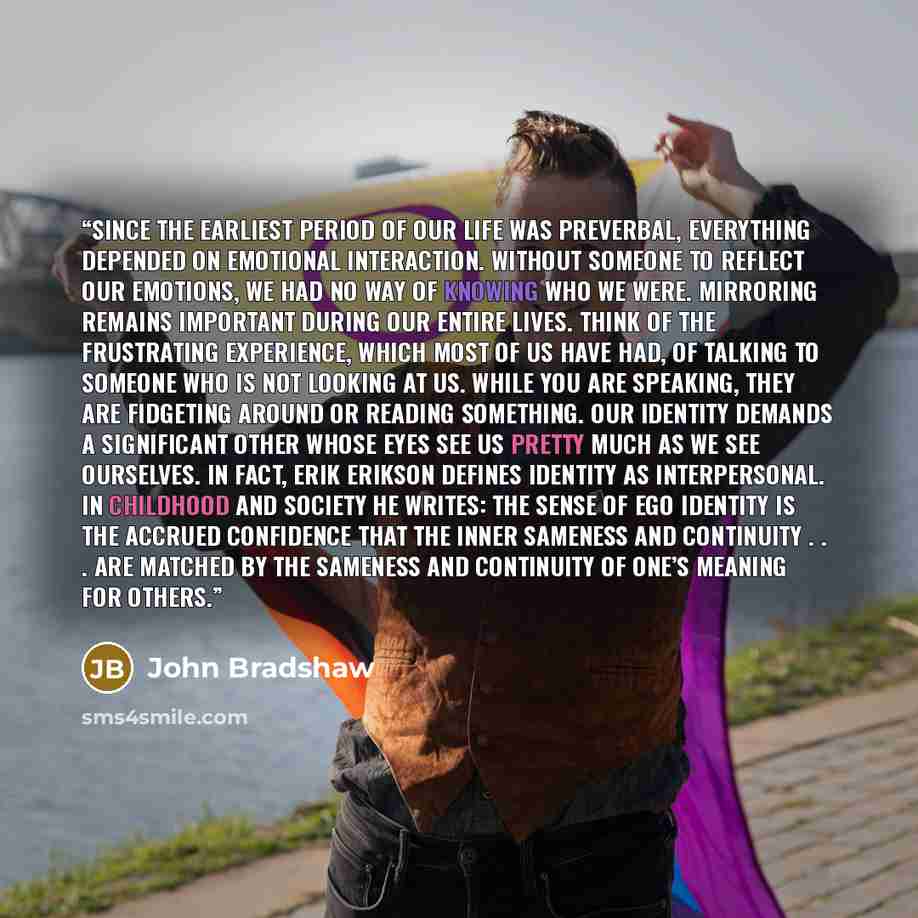
““Since the earliest period of our life was preverbal, everything depended on emotional interaction. Without someone to reflect our emotions, we had no way of knowing who we were. Mirroring remains important during our entire lives. Think of the frustrating experience, which most of us have had, of talking to someone who is not looking at us. While you are speaking, they are fidgeting around or reading something. Our identity demands a significant other whose eyes see us pretty much as we see ourselves. In fact, Erik Erikson defines identity as interpersonal. In Childhood and Society he writes: The sense of ego identity is the accrued confidence that the inner sameness and continuity . . . are matched by the sameness and continuity of one’s meaning for others.””
![“Our personal identities are socially situated. We are where we live, eat, work, and make love. [...] Our sense of identity is in large measure conferred on us by others in the ways they treat or mistreat us, recognize or ignore us, praise us or punish us. Some people make us timid and shy; others…” quote by Philip G. Zimbardo](https://sms4smile.com/quotes/img-quotes/130/philip-g-zimbardo-46937_identity_our-personal-identities-are-socially-sit_2665083.jpg)












![“In the worldly life, due to maadakta (intoxication of the ego of ‘I am Chandubhai’), one has completely lost awareness of everything about one’s self. Everything in the worldly life is nothing but intoxication. The food is intoxicating, the senses are intoxicating. [Therefore] Go to the one, who…” quote by Dada Bhagwan](https://sms4smile.com/quotes/img-quotes/2b3/dada-bhagwan-31_absolute_in-the-worldly-life-due-to-maadakta-into_3662.jpg)