North america Quote by Daniel Ellsberg
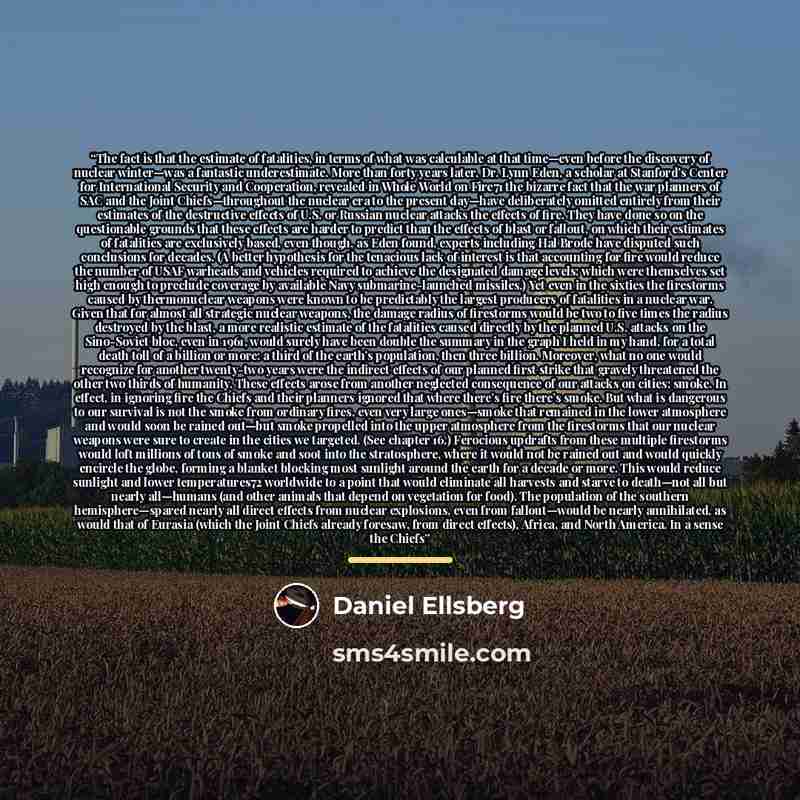
““The fact is that the estimate of fatalities, in terms of what was calculable at that time—even before the discovery of nuclear winter—was a fantastic underestimate. More than forty years later, Dr. Lynn Eden, a scholar at Stanford’s Center for International Security and Cooperation, revealed in Whole World on Fire71 the bizarre fact that the war planners of SAC and the Joint Chiefs—throughout the nuclear era to the present day—have deliberately omitted entirely from their estimates of the destructive effects of U.S. or Russian nuclear attacks the effects of fire. They have done so on the questionable grounds that these effects are harder to predict than the effects of blast or fallout, on which their estimates of fatalities are exclusively based, even though, as Eden found, experts including Hal Brode have disputed such conclusions for decades. (A better hypothesis for the tenacious lack of interest is that accounting for fire would reduce the number of USAF warheads and vehicles required to achieve the designated damage levels: which were themselves set high enough to preclude coverage by available Navy submarine-launched missiles.) Yet even in the sixties the firestorms caused by thermonuclear weapons were known to be predictably the largest producers of fatalities in a nuclear war. Given that for almost all strategic nuclear weapons, the damage radius of firestorms would be two to five times the radius destroyed by the blast, a more realistic estimate of the fatalities caused directly by the planned U.S. attacks on the Sino-Soviet bloc, even in 1961, would surely have been double the summary in the graph I held in my hand, for a total death toll of a billion or more: a third of the earth’s population, then three billion. Moreover, what no one would recognize for another twenty-two years were the indirect effects of our planned first strike that gravely threatened the other two thirds of humanity. These effects arose from another neglected consequence of our attacks on cities: smoke. In effect, in ignoring fire the Chiefs and their planners ignored that where there’s fire there’s smoke. But what is dangerous to our survival is not the smoke from ordinary fires, even very large ones—smoke that remained in the lower atmosphere and would soon be rained out—but smoke propelled into the upper atmosphere from the firestorms that our nuclear weapons were sure to create in the cities we targeted. (See chapter 16.) Ferocious updrafts from these multiple firestorms would loft millions of tons of smoke and soot into the stratosphere, where it would not be rained out and would quickly encircle the globe, forming a blanket blocking most sunlight around the earth for a decade or more. This would reduce sunlight and lower temperatures72 worldwide to a point that would eliminate all harvests and starve to death—not all but nearly all—humans (and other animals that depend on vegetation for food). The population of the southern hemisphere—spared nearly all direct effects from nuclear explosions, even from fallout—would be nearly annihilated, as would that of Eurasia (which the Joint Chiefs already foresaw, from direct effects), Africa, and North America. In a sense the Chiefs””
About This Quote
Strategic nuclear assessments have historically ignored firestorm effects, vastly underestimating potential casualties and broader humanitarian impact.
In simple terms: Nuclear war death estimates ignore fire, undercounting deaths.
Key Takeaway
Fire effects dramatically raise nuclear war casualties.
Themes
nuclear strategy
risk assessment
humanitarian impact
policy
Mood
critical
concerned
Type
analytical
political
When to use this quote
- defense planning meetings
- academic seminars on security
- policy briefings
Key Concepts
strategic miscalculation
ethical responsibility
Practical Applications
- integrate fire modeling into war‑game simulations
- public education on nuclear risks
Questions to Reflect On
- What ethical duties do planners have when data is incomplete?
- How might acknowledging fire effects change deterrence doctrine?
A Different Perspective
Quantifying fire effects is complex; models may still be uncertain.