Absorbing Quote by Paul J. Crutzen
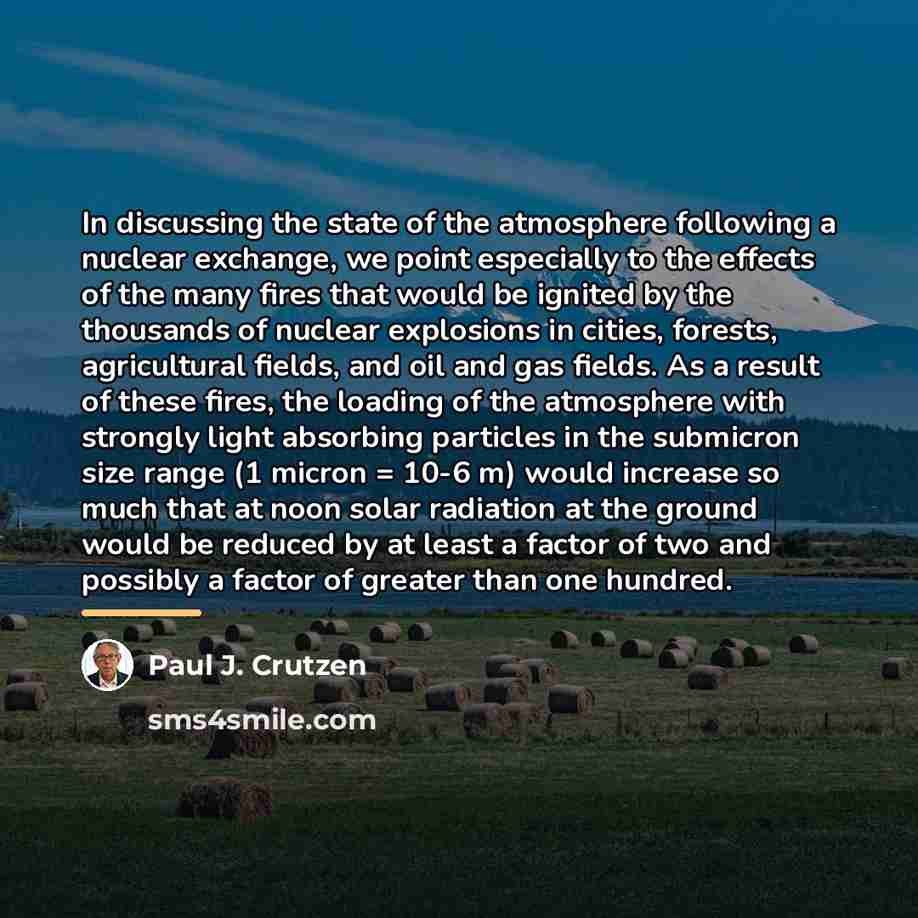
“In discussing the state of the atmosphere following a nuclear exchange, we point especially to the effects of the many fires that would be ignited by the thousands of nuclear explosions in cities, forests, agricultural fields, and oil and gas fields. As a result of these fires, the loading of the atmosphere with strongly light absorbing particles in the submicron size range (1 micron = 10-6 m) would increase so much that at noon solar radiation at the ground would be reduced by at least a factor of two and possibly a factor of greater than one hundred.”
About This Quote
Source Report: Nuclear Winter Study, 1980s
Massive fires from nuclear detonations would fill the sky with tiny, light‑blocking particles, cutting sunlight at the surface by half or more, potentially to a hundred‑fold reduction.
In simple terms: Nuclear fires would darken the world, cutting sunlight drastically.
Key Takeaway
Recognize climate risk of nuclear war.
Themes
environment
climate
war
science
risk
Mood
anxious
serious
Type
scientific
warning
When to use this quote
- policy planning
- civil defense
- public health
- environmental advocacy
Key Concepts
radiative forcing
aerosol physics
global cooling
Questions to Reflect On
- How would societies adapt to near‑darkness?
- What policies can prevent such catastrophic climate effects?
A Different Perspective
Mitigation depends on preventing nuclear conflict, not just atmospheric science.




![“It's hard to pick. I mean, I think the one that is most emblematic of the collaboration that occurred is "We Know The Way." That's the first song we wrote for the movie [Moana]. We actually got it written that weekend in New Zealand, so we're all in New Zealand, we're all absorbing this culture…” quote by Lin-Manuel Miranda](https://sms4smile.com/quotes/img-quotes/2ae/lin-manuel-miranda-2352_absorbing_it-s-hard-to-pick-i-mean-i-think-the-one_119053.jpg)
![“I know "accessibility" is a term that's kind of thrown around wantonly today, especially with talking about visual media. But I think that the strength of comics [is how they] really allow you to transcend those last barriers between a reader absorbing the information of an experience, and a…” quote by Nate Powell](https://sms4smile.com/quotes/img-quotes/d87/nate-powell-42191_able_i-know-accessibility-is-a-term-that-s-ki_173002.jpg)