Business Quote by Charlotte Brontë

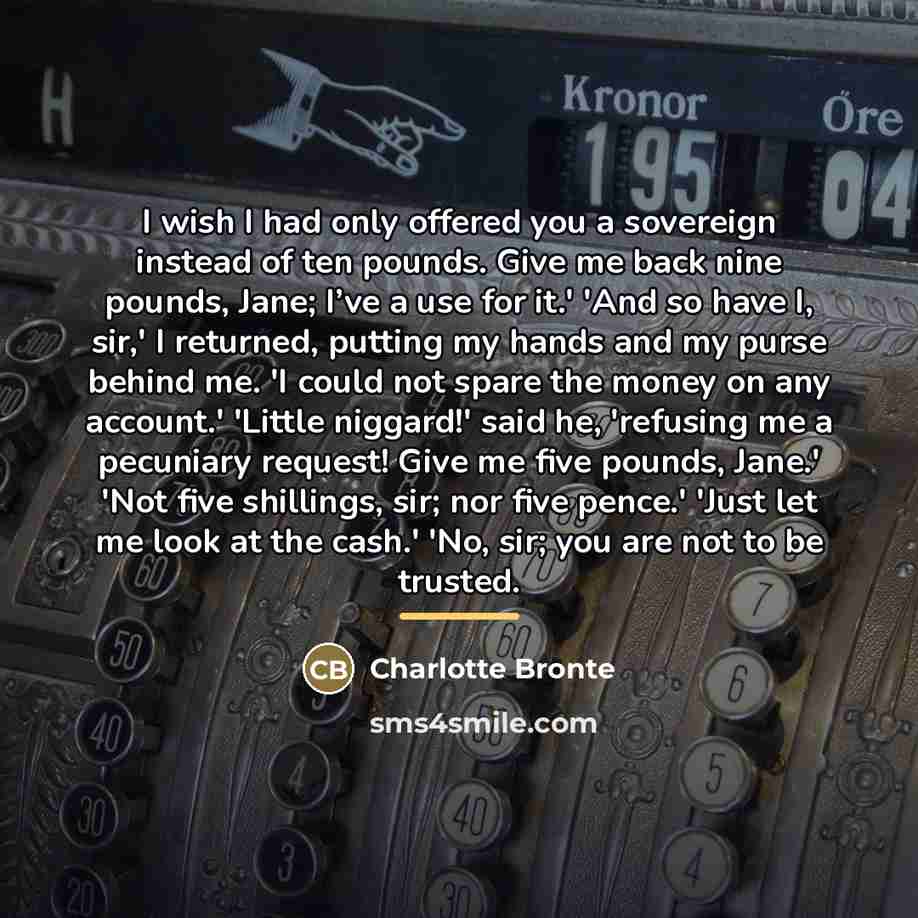
““When do you wish to go?” “Early to-morrow morning, sir.” “Well, you must have some money; you can’t travel without money, and I daresay you have not much: I have given you no salary yet. How much have you in the world, Jane?” he asked, smiling. I drew out my purse; a meagre thing it was. “Five shillings, sir.” He took the purse, poured the hoard into his palm, and chuckled over it as if its scantiness amused him. Soon he produced his pocket-book: “Here,” said he, offering me a note; it was fifty pounds, and he owed me but fifteen. I told him I had no change. “I don’t want change; you know that. Take your wages.” I declined accepting more than was my due. He scowled at first; then, as if recollecting something, he said— “Right, right! Better not give you all now: you would, perhaps, stay away three months if you had fifty pounds. There are ten; is it not plenty?” “Yes, sir, but now you owe me five.” “Come back for it, then; I am your banker for forty pounds.” “Mr. Rochester, I may as well mention another matter of business to you while I have the opportunity.” “Matter of business? I am curious to hear it.” “You have as good as informed me, sir, that you are going shortly to be married?” “Yes; what then?” “In that case, sir, Adèle ought to go to school: I am sure you will perceive the necessity of it.” “To get her out of my bride’s way, who might otherwise walk over her rather too emphatically? There’s sense in the suggestion; not a doubt of it. Adèle, as you say, must go to school; and you, of course, must march straight to—the devil?” “I hope not, sir; but I must seek another situation somewhere.” “In course!” he exclaimed, with a twang of voice and a distortion of features equally fantastic and ludicrous. He looked at me some minutes. “And old Madam Reed, or the Misses, her daughters, will be solicited by you to seek a place, I suppose?” “No, sir; I am not on such terms with my relatives as would justify me in asking favours of them—but I shall advertise.””
About This Quote
Source Novel: Jane Eyre by Charlotte Brontë, 1847
A servant negotiates wages and future plans, revealing power dynamics and social expectations of Victorian England.
In simple terms: A servant talks about money and marriage plans, showing class and gender issues.
Key Takeaway
Recognize and question unfair power structures.
Themes
class
gender
economics
authority
negotiation
Mood
tense
reflective
Type
literary
dialogue
When to use this quote
- employment negotiations
- marriage arrangements
- family obligations
- financial dependence
Key Concepts
social hierarchy
dependency
morality
Questions to Reflect On
- How do economic dependencies shape personal choices?
- What alternatives exist for those in subordinate positions?
A Different Perspective
Power imbalances can limit genuine consent and agency.
























![“[S]ometimes, when you are a food person, the possible irrelevance of what you are doing doesn’t cross your mind until it’s too late. (Once, for example, when I was just starting out in the food business, I was hired by the caper people to develop a lot of recipes using capers, and it was weeks of…” quote by Nora Ephron](https://sms4smile.com/quotes/img-quotes/d79/nora-ephron-1217_business_s-ometimes-when-you-are-a-food-person-th_980.jpg)


![“If the State does not acquire supremacy over [vast private] enterprises, it becomes their puppet, and they become the real State.” quote by Bertrand Russell](https://sms4smile.com/quotes/img-quotes/bad/bertrand-russell-69_acquire_if-the-state-does-not-acquire-supremacy_1379.jpg)