Lack of knowledge Quote by Arthur Schopenhauer
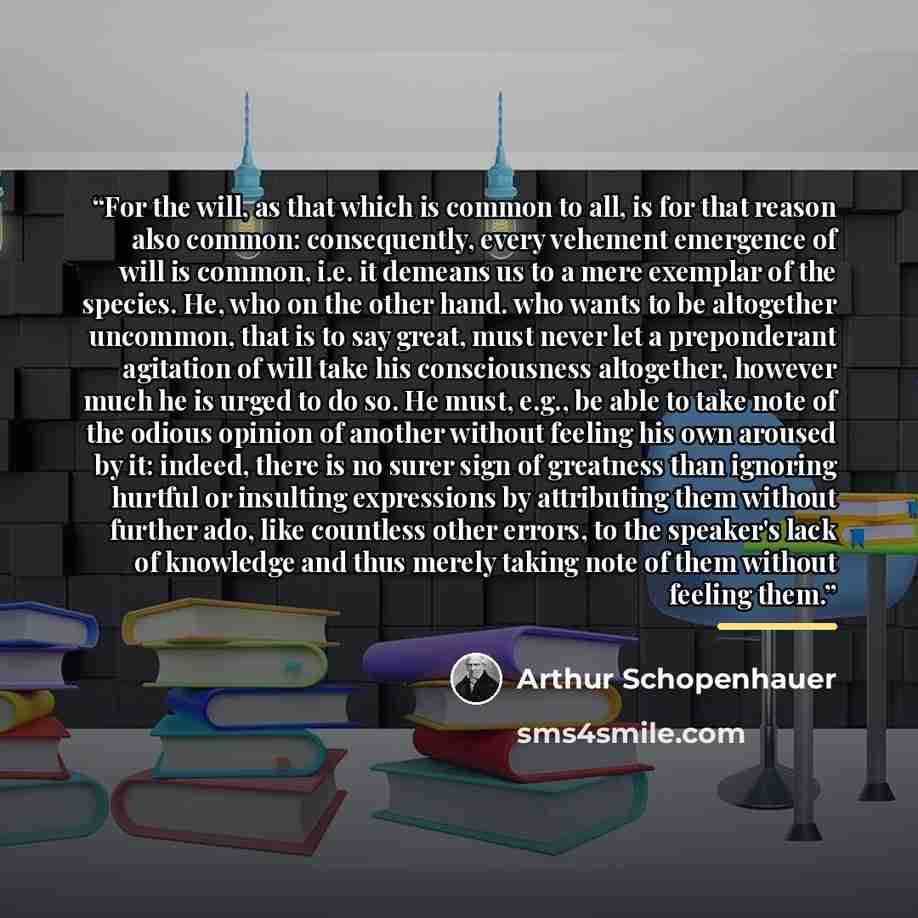
““For the will, as that which is common to all, is for that reason also common: consequently, every vehement emergence of will is common, i.e. it demeans us to a mere exemplar of the species. He, who on the other hand. who wants to be altogether uncommon, that is to say great, must never let a preponderant agitation of will take his consciousness altogether, however much he is urged to do so. He must, e.g., be able to take note of the odious opinion of another without feeling his own aroused by it: indeed, there is no surer sign of greatness than ignoring hurtful or insulting expressions by attributing them without further ado, like countless other errors, to the speaker's lack of knowledge and thus merely taking note of them without feeling them.””
About This Quote
Greatness requires detachment from the impulsive will that drives ordinary people, allowing one to ignore insults and view them as ignorance rather than personal offense.
In simple terms: Detachment from willful impulse
Key Takeaway
Ignore insults to preserve greatness
Themes
individualism
self-control
philosophy of will
greatness
perception
Mood
resolute
reflective
Type
philosophical
advice
When to use this quote
- public criticism
- personal attack
- social pressure
- conflict
Key Concepts
will
greatness
insult
ignorance
Practical Applications
- leadership development
- personal resilience
Questions to Reflect On
- How does ignoring insults affect personal growth?
- Can detachment from will be sustainable?




![“[T]he appropriate form of address between man and man ought to be, not monsieur, sir, but fellow sufferer, compagnon de miseres.” quote by Arthur Schopenhauer](https://sms4smile.com/quotes/img-quotes/be6/arthur-schopenhauer-226_addresses_t-he-appropriate-form-of-address-between_32897.jpg)
![“[Materialism] seeks the primary and most simple state of matter, and then tries to develop all the others from it; ascending from mere mechanism, to chemism, to polarity, to the vegetable and to the animal kingdom. And if we suppose this to have been done, the last link in the chain would be…” quote by Arthur Schopenhauer](https://sms4smile.com/quotes/img-quotes/88c/arthur-schopenhauer-226_animal-kingdom_materialism-seeks-the-primary-and-most-s_50402.jpg)