Truth Quote by Aristotle
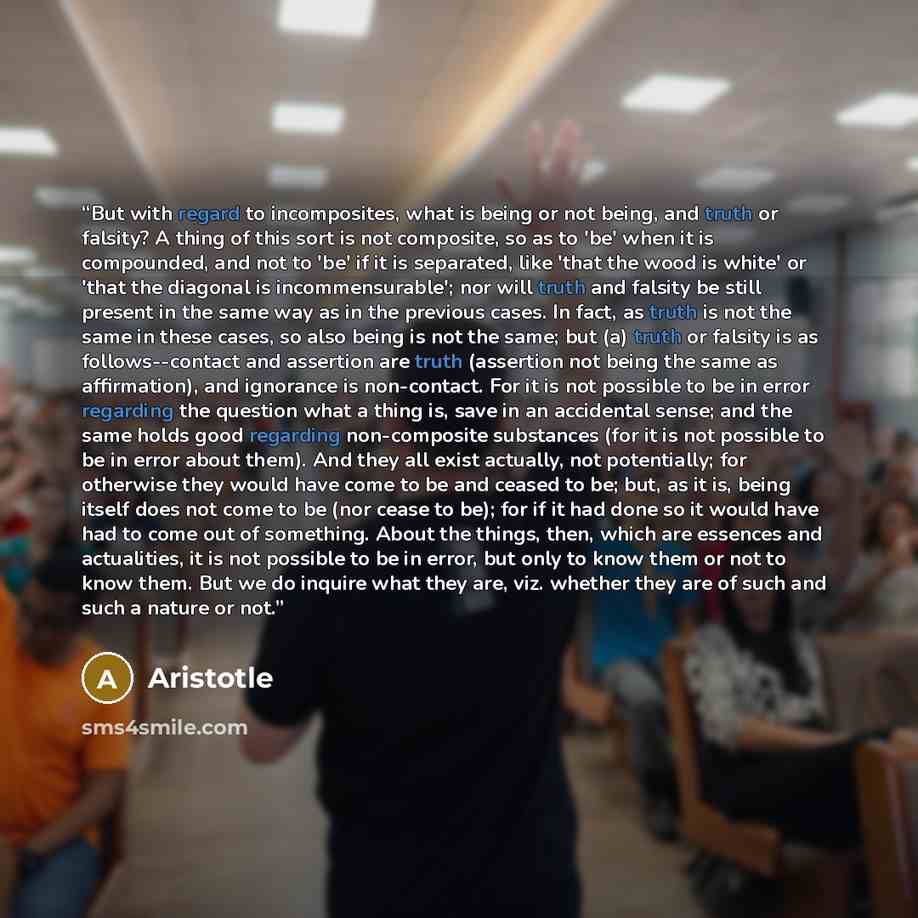
““But with regard to incomposites, what is being or not being, and truth or falsity? A thing of this sort is not composite, so as to 'be' when it is compounded, and not to 'be' if it is separated, like 'that the wood is white' or 'that the diagonal is incommensurable'; nor will truth and falsity be still present in the same way as in the previous cases. In fact, as truth is not the same in these cases, so also being is not the same; but (a) truth or falsity is as follows--contact and assertion are truth (assertion not being the same as affirmation), and ignorance is non-contact. For it is not possible to be in error regarding the question what a thing is, save in an accidental sense; and the same holds good regarding non-composite substances (for it is not possible to be in error about them). And they all exist actually, not potentially; for otherwise they would have come to be and ceased to be; but, as it is, being itself does not come to be (nor cease to be); for if it had done so it would have had to come out of something. About the things, then, which are essences and actualities, it is not possible to be in error, but only to know them or not to know them. But we do inquire what they are, viz. whether they are of such and such a nature or not.””
About This Quote
Source Treat: Metaphysics by Aristotle, 4th century BC
Being and truth differ for composite versus simple entities; truth arises from contact and assertion, while ignorance is non‑contact.
In simple terms: Truth depends on interaction, not just existence.
Key Takeaway
Seek direct experience to understand truth.
Themes
philosophy
ontology
epistemology
logic
truth
Mood
inquisitive
analytical
serious
Type
philosophical
academic
reflective
When to use this quote
- scientific research
- critical analysis
- education
- debate
- personal inquiry
Key Concepts
substance theory
non‑composite
assertion
ignorance
Questions to Reflect On
- How does direct contact shape our understanding of truth?
- What role does assertion play in distinguishing knowledge from ignorance?
A Different Perspective
The dense language may limit accessibility for non‑specialists.