The good citizen need not of necessity possess the virtue which makes a good man. — Aristotle Copy Share Image
A man's happiness consists in the free exercise of his highest faculties. — Aristotle Copy Share Image
The high-minded man must care more for the truth than for what people think. — Aristotle Copy Share Image
Comedy aims at representing men as worse, Tragedy as better than in actual life. — Aristotle Copy Share Image
If you see a man approaching with the obvious intent of doing you good, run for your life. Consider pleasures as they… — Aristotle Copy Share Image
Men are divided between those who are as thrifty as if they would live forever, and those who are as extravagant as… — Aristotle Copy Share Image
But what is happiness? If we consider what the function of man is, we find that happiness is a virtuous activity of… — Aristotle Copy Share Image
The truly good and wise man will bear all kinds of fortune in a seemly way, and will always act in the… — Aristotle Copy Share Image
No man of high and generous spirit is ever willing to indulge in flattery; the good may feel affection for others, but… — Aristotle Copy Share Image
The high-minded man does not bear grudges, for it is not the mark of a great soul to remember injuries, but to… — Aristotle Copy Share Image
The vigorous are no better than the lazy during one half of life, for all men are alike when asleep. — Aristotle Copy Share Image
Man perfected by society is the best of all animals; he is the most terrible of all when he lives without law,… — Aristotle Copy Share Image
Human good turns out to be activity of soul exhibiting excellence, and if there is more than one sort of excellence, in… — Aristotle Copy Share Image
Young men have strong passions and tend to gratify them indiscriminately. Of the bodily desires, it is the sexual by which they… — Aristotle Copy Share Image
There is a cropping-time in the races of men, as in the fruits of the field; and sometimes, if the stock be… — Aristotle Copy Share Image
“We must not listen to those who advise us "being men to think human thoughts, and being mortal to think mortal thoughts,"… — Aristotle Copy Share Image
Happiness is a thing honored and perfect. This seems to be borne out by the fact that it is a first principle… — Aristotle Copy Share Image
So virtue is a purposive disposition, lying in a mean that is relative to us and determined by a rational principle, and… — Aristotle Copy Share Image
The society that loses its grip on the past is in danger, for it produces men who know nothing but the present,… — Aristotle Copy Share Image
It is absurd to hold that a man should be ashamed of an inability to defend himself with his limbs, but not… — Aristotle Copy Share Image
The same ideas, one must believe, recur in men's minds not once or twice but again and again. — Aristotle Copy Share Image
Why is it that all men who are outstanding in philosophy, poetry or the arts are melancholic? — Aristotle Copy Share Image
Women should marry when they are about eighteen years of age, and men at seven and thirty; then they are in the… — Aristotle Copy Share Image
Man is the metre of all things, the hand is the instrument of instruments, and the mind is the form of forms. — Aristotle Copy Share Image
Those who excel in virtue have the best right of all to rebel, but then they are of all men the least… — Aristotle Copy Share Image
If men think that a ruler is religious and has a reverence for the Gods, they are less afraid of suffering injustice… — Aristotle Copy Share Image
Indeed, we may go further and assert that anyone who does not delight in fine actions is not even a good man. — Aristotle Copy Share Image
For it is owing to their wonder that men both now begin and at first began to philosophize... They were pursuing science… — Aristotle Copy Share Image
A good man may make the best even of poverty and disease, and the other ills of life; but he can only… — Aristotle Copy Share Image
Give a man a fish, you feed him for a day. Give a man a poisoned fish, you feed him for the… — Aristotle Copy Share Image
Character is that which reveals moral purpose, exposing the class of things a man chooses and avoids. — Aristotle Copy Share Image
The knowledge of the soul admittedly contributes greatly to the advance of truth in general, and, above all, to our understanding of Nature, for… — Aristotle Copy Share Image
Young men have strong passions and tend to gratify them indiscriminately. Of the bodily desires, it is the sexual by which they are most… — Aristotle Copy Share Image
The body is at its best between the ages of thirty and thirty-five; the mind is at its best about the age of forty-nine. — Aristotle Copy Share Image
The ensouled is distinguished from the unsouled by its being alive. Now since being alive is spoken of in many ways, even if only… — Aristotle Copy Share Image
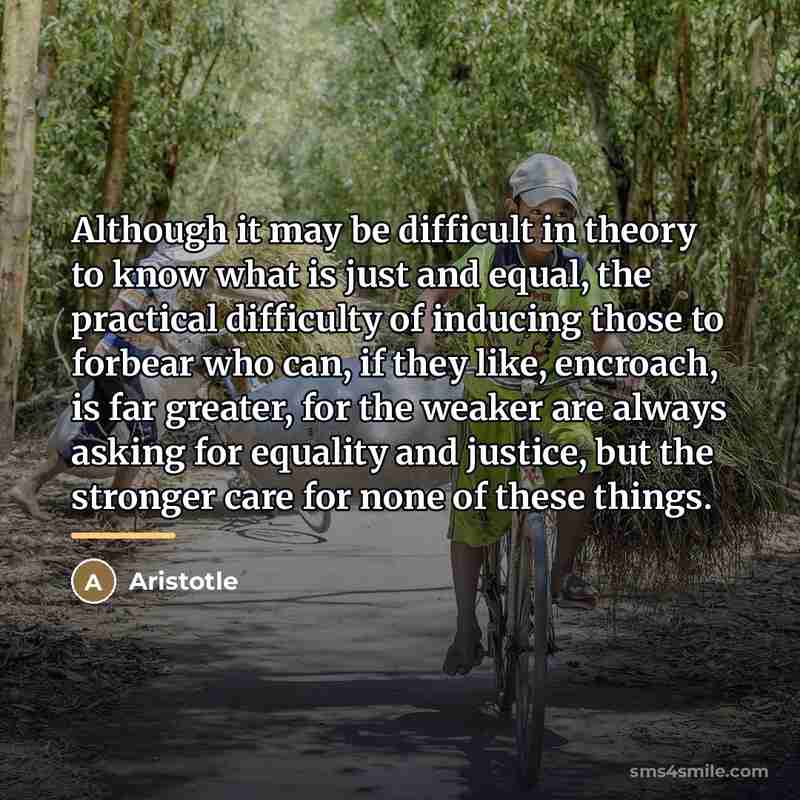
Although it may be difficult in theory to know what is just and equal, the practical difficulty of inducing those to forbear who can,… — Aristotle Copy Share Image
The true forms of government, therefore, are those in which the one, or the few, or the many, govern with a view to the… — Aristotle Copy Share Image
All persons ought to endeavor to follow what is right, and not what is established. — Aristotle Copy Share Image
Give a man a fish, you feed him for a day. Give a man a poisoned fish, you feed him for the rest of… — Aristotle Copy Share Image
The man who confers a favour would rather not be repaid in the same coin. — Aristotle Copy Share Image
Obstinate people can be divided into the opinionated, the ignorant, and the boorish. — Aristotle Copy Share Image
Happiness does not consist in pastimes and amusements but in virtuous activities. — Aristotle Copy Share Image
To learn is a natural pleasure, not confined to philosophers, but common to all men. — Aristotle Copy Share Image