“The next generation of quiet kids can and should be raised to know their own strengths.” — Susan Cain Copy Share Image
“We should all look out for cobblers who might have been great generals. Which means focusing on introverted children, whose talents are… — Susan Cain Copy Share Image
“By 1950, the slogan of he Mid-Century White House Conference on Children and Youth was "A healthy personality for every child.” — Susan Cain Copy Share Image
“[P]arents need to step back from their own preferences and see what the world looks like to their quiet children.” — Susan Cain Copy Share Image
As a parent, if give yourself what you need, your children will watch you doing that and will give themselves what they… — Susan Cain Copy Share Image
“High-reactive kids also tend to think and feel deeply about what they’ve noticed, and to bring an extra degree of nuance to… — Susan Cain Copy Share Image
“If a high-reactive toddler breaks another child's toy by mistake, studies show, she often experiences a more intense mix of guilt and… — Susan Cain Copy Share Image
“You can also teach your child simple social strategies to get him through uncomfortable moments. Encourage him to look confident even if… — Susan Cain Copy Share Image
“Conversely, high-reactive children may be more likely to develop into artists and writers and scientists and thinkers because their aversion to novelty… — Susan Cain Copy Share Image
It's important for a parent to learn to take delight in a child whose behavior might seem mystifying. In the case of… — Susan Cain Copy Share Image
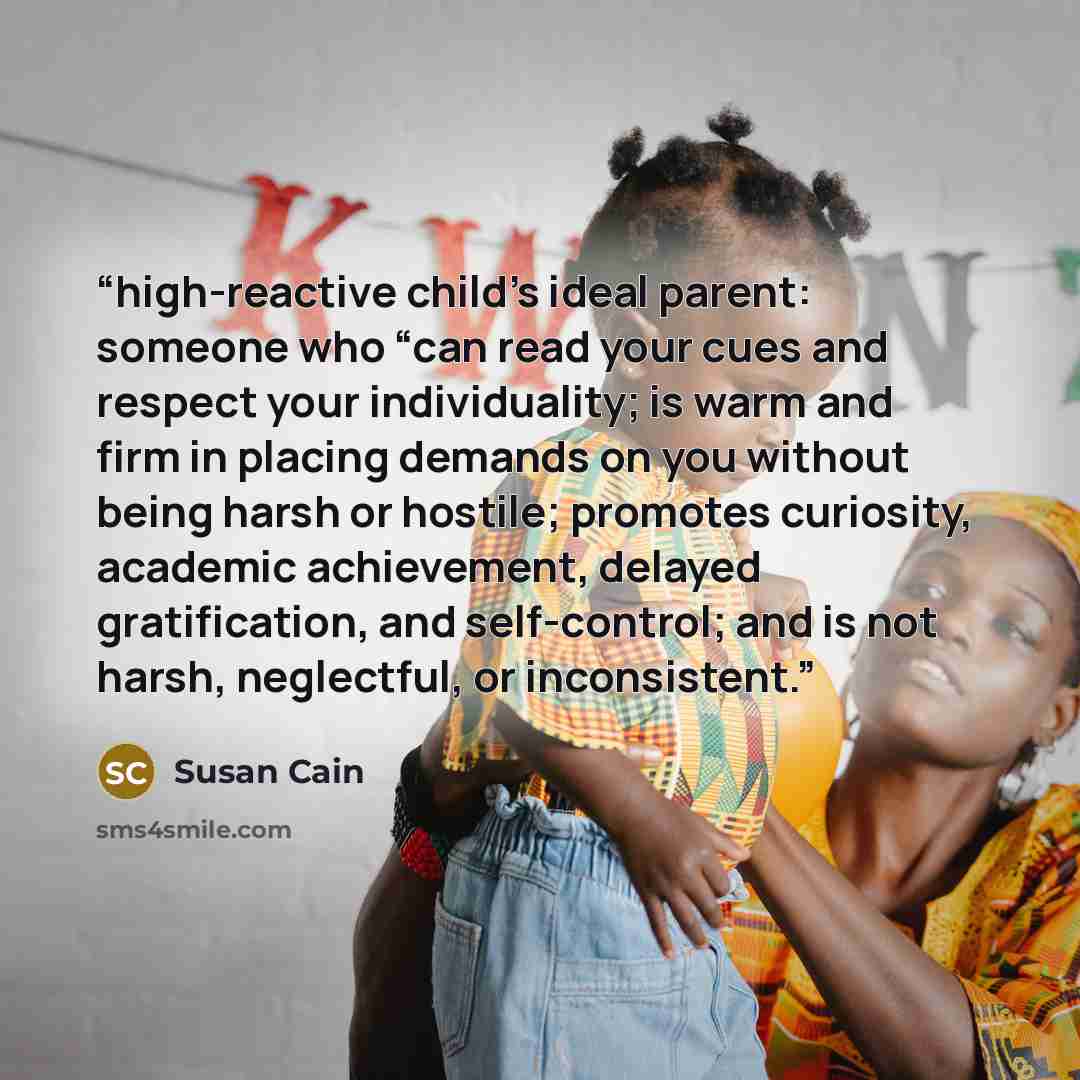
“high-reactive child’s ideal parent: someone who “can read your cues and respect your individuality; is warm and firm in placing demands on… — Susan Cain Copy Share Image
We know from myths and fairy tales that there are many different kinds of powers in this world. One child is given… — Susan Cain Copy Share Image
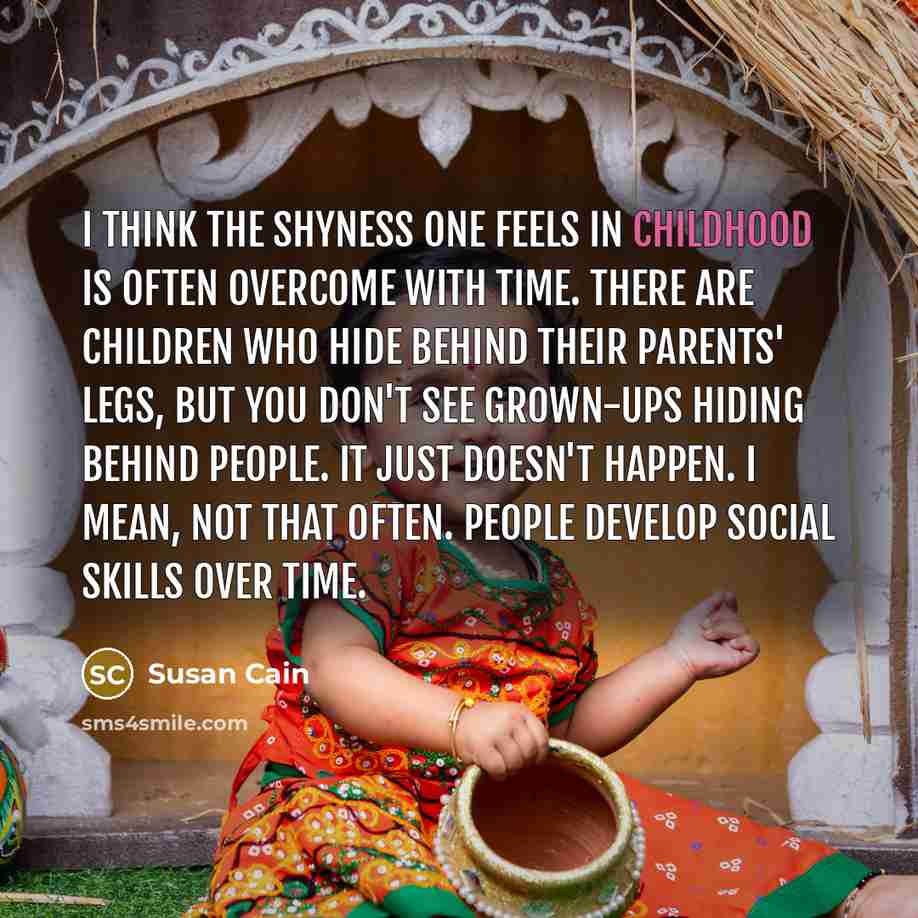
I think the shyness one feels in childhood is often overcome with time. There are children who hide behind their parents' legs,… — Susan Cain Copy Share Image
“High-reactive children pay what one psychologist calls “alert attention” to people and things. They literally use more eye movements than others to… — Susan Cain Copy Share Image
“Many introver- ted kids grow up to have excellent so- cial skills, although they tend to join groups in their own way—waiting… — Susan Cain Copy Share Image
Ask your child for information in a gentle, nonjudgmental way, with specific, clear questions. Instead of “How was your day?” try “What… — Susan Cain Copy Share Image
“Why do we accept this one-size-fits-all situation as a given when we know perfectly well that adults don’t organize themselves this way?… — Susan Cain Copy Share Image
“Joyce has also come to appreciate Isabel’s sensitive ways. “Isabel is an old soul,” she says. “You forget that she’s only a… — Susan Cain Copy Share Image
“The same goes for new situations. Imagine a child who’s more afraid of the ocean than are other kids the same age.… — Susan Cain Copy Share Image
“Public speaking phobia has many causes, including early childhood setbacks, that have to do with our unique personal histories, not inborn temperament.… — Susan Cain Copy Share Image
We often marvel at how introverted, geeky, kid 'blossom' into secure and happy adults. We liken it to a metamorphosis. However, maybe… — Susan Cain Copy Share Image
Remember that introverts react not only to new people, but also to new places and events. So don’t mistake a child’s caution… — Susan Cain Copy Share Image
Theodor Geisel (otherwise known as Dr. Seuss) spent his workdays ensconced in his private studio, the walls lined with sketches and drawings,… — Susan Cain Copy Share Image
“According to Jay Belsky, a leading proponent of this view and a psychology professor and child care expert at the University of… — Susan Cain Copy Share Image
“Proverbs from the East: The wind howls, but the mountain remains still. Even though I make no special attempt to observe the discipline of… — Susan Cain Copy Share Image
“where we fall on the introvert-extrovert spectrum. Our place on this continuum influences our choice of friends and mates, and how we make conversation,… — Susan Cain Copy Share Image
“I worry that there are people who are put in positions of authority because they’re good talkers, but they don’t have good ideas,” he… — Susan Cain Copy Share Image
“He believes, as most of us do, that venting anger lets off steam. The “catharsis hypothesis”—that aggression builds up inside us until it’s healthily… — Susan Cain Copy Share Image
“Soft power is not limited to moral exemplars like Mahatma Gandhi. Consider, for example, the much-ballyhooed excellence of Asians in fields like math and… — Susan Cain Copy Share Image
“Events like this don't give me the sense of oneness others seem to enjoy; it's always been private occasions that make me feel connected… — Susan Cain Copy Share Image
“Social anxiety disorder”—which essentially means pathological shyness—is now thought to afflict nearly one in five of us. The most recent version of the Diagnostic… — Susan Cain Copy Share Image
“So when introverts assume the observer role, as when they write novels, or contemplate unified field theory- or fall quiet at dinner parties- they’re… — Susan Cain Copy Share Image
“Osborn’s theory had great impact, and company leaders took up brainstorming with enthusiasm. To this day, it’s common for anyone who spends time in… — Susan Cain Copy Share Image
Extroversion is an enormously appealing personality style, but we've turned it into an oppressive standard to which most of us feel we must conform. — Susan Cain Copy Share Image
“But as the word satyagraha implies, Gandhi’s passivity was not weakness at all. It meant focusing on an ultimate goal and refusing to divert… — Susan Cain Copy Share Image
![“[P]arents need to step back from their own preferences and see what the world looks like to their quiet children.” quote by Susan Cain](https://sms4smile.com/quotes/img-quotes/fc7/susan-cain-647_children_p-arents-need-to-step-back-from-their-ow_1241690.jpg)