Children Quote by Susan Cain
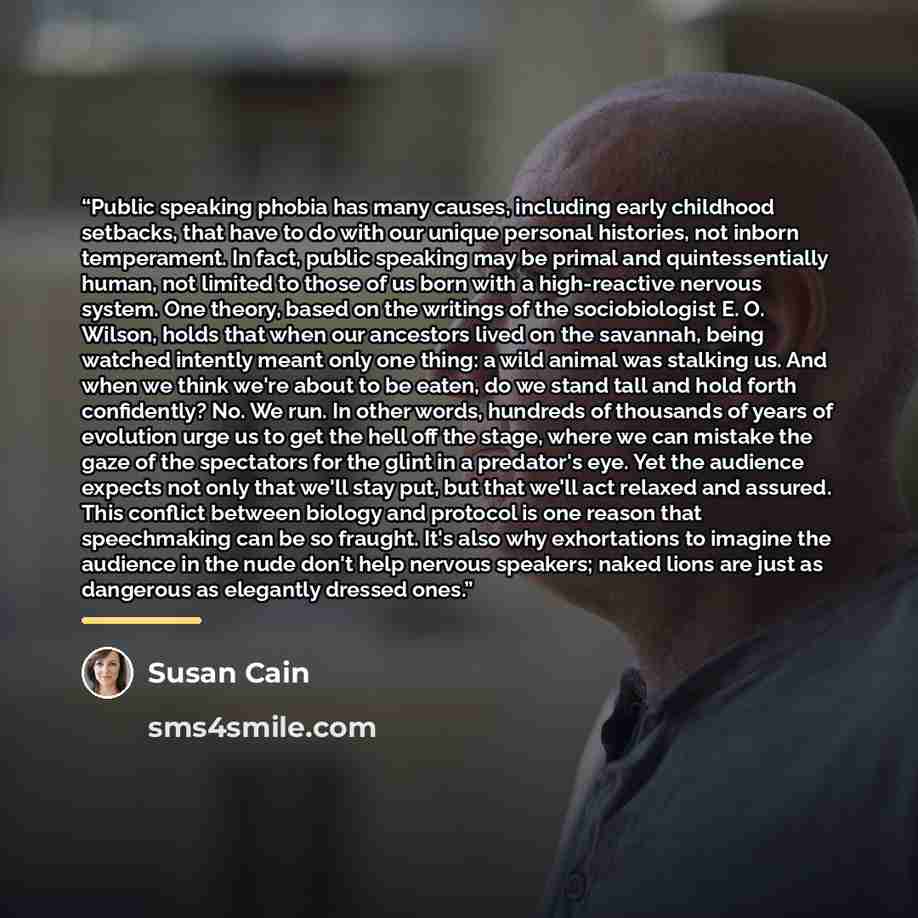
““Public speaking phobia has many causes, including early childhood setbacks, that have to do with our unique personal histories, not inborn temperament. In fact, public speaking may be primal and quintessentially human, not limited to those of us born with a high-reactive nervous system. One theory, based on the writings of the sociobiologist E. O. Wilson, holds that when our ancestors lived on the savannah, being watched intently meant only one thing: a wild animal was stalking us. And when we think we're about to be eaten, do we stand tall and hold forth confidently? No. We run. In other words, hundreds of thousands of years of evolution urge us to get the hell off the stage, where we can mistake the gaze of the spectators for the glint in a predator's eye. Yet the audience expects not only that we'll stay put, but that we'll act relaxed and assured. This conflict between biology and protocol is one reason that speechmaking can be so fraught. It's also why exhortations to imagine the audience in the nude don't help nervous speakers; naked lions are just as dangerous as elegantly dressed ones.””
About This Quote
Source Book: Quiet: The Power of Introverts in a World That Can't Stop Talking, Susan Cain, 2012
Public speaking triggers ancient survival instincts, making stage anxiety feel like a predator threat, conflicting with social expectations of calm confidence.
In simple terms: Our brain treats audience gaze like a predator, causing fear.
Key Takeaway
Recognize the instinct, then reframe the audience as non‑threatening.
Themes
anxiety
evolution
communication
confidence
social pressure
Mood
nervous
reflective
motivational
Type
advice
psychology
inspirational
When to use this quote
- job presentations
- classroom teaching
- weddings
- political speeches
- team meetings
Key Concepts
fight or flight
social cognition
performance psychology
Questions to Reflect On
- How can you transform the feeling of being watched into a sense of connection?
- What practical steps help you feel safe on stage?
A Different Perspective
The metaphor may oversimplify modern anxiety, which also stems from learned self‑criticism and cultural factors.