Black swan Quote by Walter Isaacson
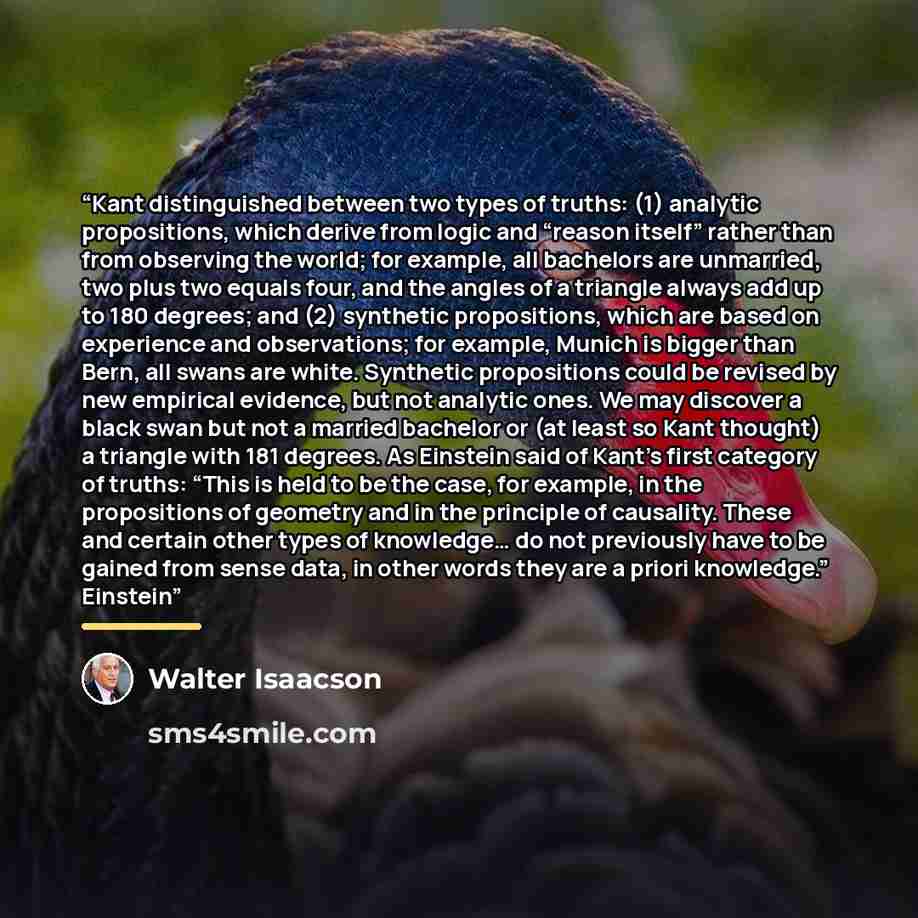
““Kant distinguished between two types of truths: (1) analytic propositions, which derive from logic and “reason itself” rather than from observing the world; for example, all bachelors are unmarried, two plus two equals four, and the angles of a triangle always add up to 180 degrees; and (2) synthetic propositions, which are based on experience and observations; for example, Munich is bigger than Bern, all swans are white. Synthetic propositions could be revised by new empirical evidence, but not analytic ones. We may discover a black swan but not a married bachelor or (at least so Kant thought) a triangle with 181 degrees. As Einstein said of Kant’s first category of truths: “This is held to be the case, for example, in the propositions of geometry and in the principle of causality. These and certain other types of knowledge… do not previously have to be gained from sense data, in other words they are a priori knowledge.” Einstein””
About This Quote
Source Biography: Einstein, 2007
Kant’s analytic truths are logical and unchanging, while synthetic truths depend on empirical observation and can be revised.
In simple terms: Logical truths are fixed; empirical truths can change.
Key Takeaway
Recognize which knowledge type you’re using.
Themes
philosophy
epistemology
knowledge classification
Mood
reflective
analytical
Type
educational
philosophical
When to use this quote
- academic study
- scientific research
- everyday reasoning
Key Concepts
a priori knowledge
empirical evidence
Questions to Reflect On
- When should you question a so belief?
- How do you balance theory and evidence?
A Different Perspective
Overreliance on logic may ignore new data.