Consciousness Quote by Arthur Schopenhauer
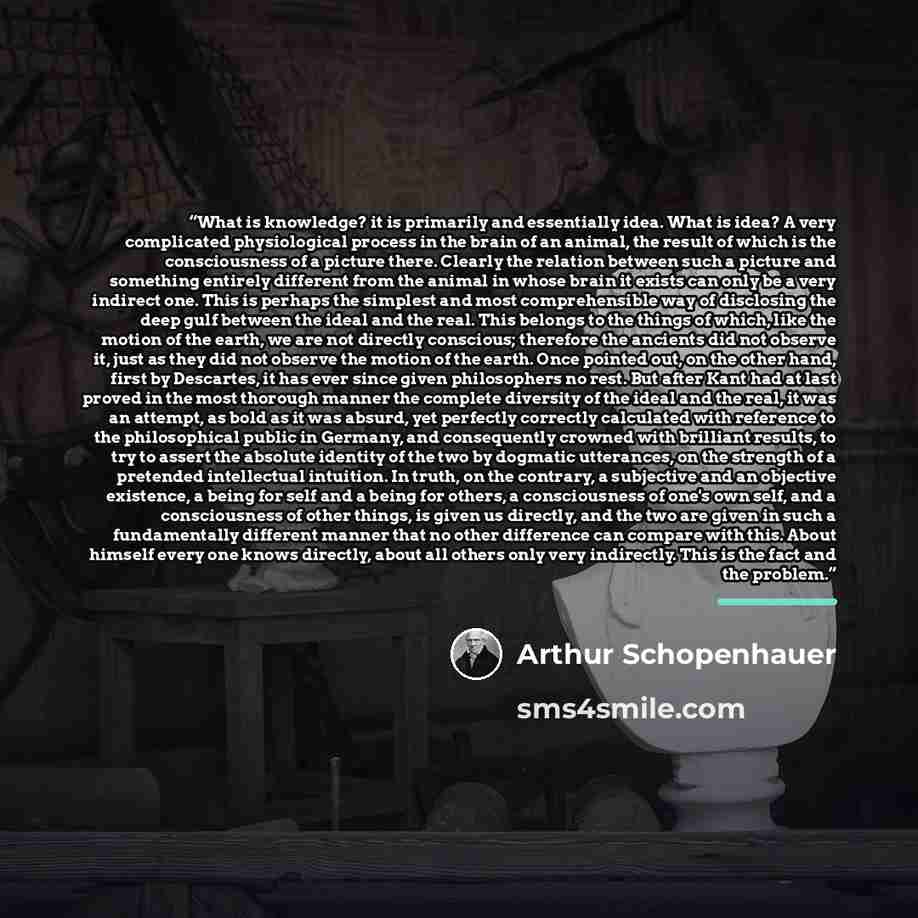
““What is knowledge? it is primarily and essentially idea. What is idea? A very complicated physiological process in the brain of an animal, the result of which is the consciousness of a picture there. Clearly the relation between such a picture and something entirely different from the animal in whose brain it exists can only be a very indirect one. This is perhaps the simplest and most comprehensible way of disclosing the deep gulf between the ideal and the real. This belongs to the things of which, like the motion of the earth, we are not directly conscious; therefore the ancients did not observe it, just as they did not observe the motion of the earth. Once pointed out, on the other hand, first by Descartes, it has ever since given philosophers no rest. But after Kant had at last proved in the most thorough manner the complete diversity of the ideal and the real, it was an attempt, as bold as it was absurd, yet perfectly correctly calculated with reference to the philosophical public in Germany, and consequently crowned with brilliant results, to try to assert the absolute identity of the two by dogmatic utterances, on the strength of a pretended intellectual intuition. In truth, on the contrary, a subjective and an objective existence, a being for self and a being for others, a consciousness of one's own self, and a consciousness of other things, is given us directly, and the two are given in such a fundamentally different manner that no other difference can compare with this. About himself every one knows directly, about all others only very indirectly. This is the fact and the problem.””
About This Quote
Source Book: The World as Will and Representation, 1818
The quote argues that knowledge is an idea formed by complex brain processes, creating a picture whose relation to external reality is indirect, highlighting the gulf between ideal and real.
In simple terms: Knowledge is brain‑generated ideas, indirectly linked to reality.
Key Takeaway
Recognize the limits of our perception.
Themes
philosophy
epistemology
mind
reality
knowledge
Mood
thoughtful
critical
Type
philosophical
analytical
When to use this quote
- academic debate
- personal introspection
- teaching philosophy
- writing essays
Key Concepts
Idealism
subject‑object dualism
consciousness
representation
Questions to Reflect On
- How do we know what is real?
- Can we ever truly grasp the external world?
A Different Perspective
It may overstate the separation, ignoring how language and science bridge mind and world.
![“Only after the concept of knowledge has been based on an ontological relation [*Seinsverhältnis*] can we work out the particular kind of being from which the principle of immanence-to-consciousness (the starting point of Idealism and Critical Realism) mistakenly proceeds as though from a primary…” quote by Max Scheler](https://sms4smile.com/quotes/img-quotes/65c/max-scheler-21013_epistemology_only-after-the-concept-of-knowledge-has_492525.jpg)
![“[T]he appropriate form of address between man and man ought to be, not monsieur, sir, but fellow sufferer, compagnon de miseres.” quote by Arthur Schopenhauer](https://sms4smile.com/quotes/img-quotes/be6/arthur-schopenhauer-226_addresses_t-he-appropriate-form-of-address-between_32897.jpg)
![“[Materialism] seeks the primary and most simple state of matter, and then tries to develop all the others from it; ascending from mere mechanism, to chemism, to polarity, to the vegetable and to the animal kingdom. And if we suppose this to have been done, the last link in the chain would be…” quote by Arthur Schopenhauer](https://sms4smile.com/quotes/img-quotes/88c/arthur-schopenhauer-226_animal-kingdom_materialism-seeks-the-primary-and-most-s_50402.jpg)