Conscious mind Quote by Tom Robbins
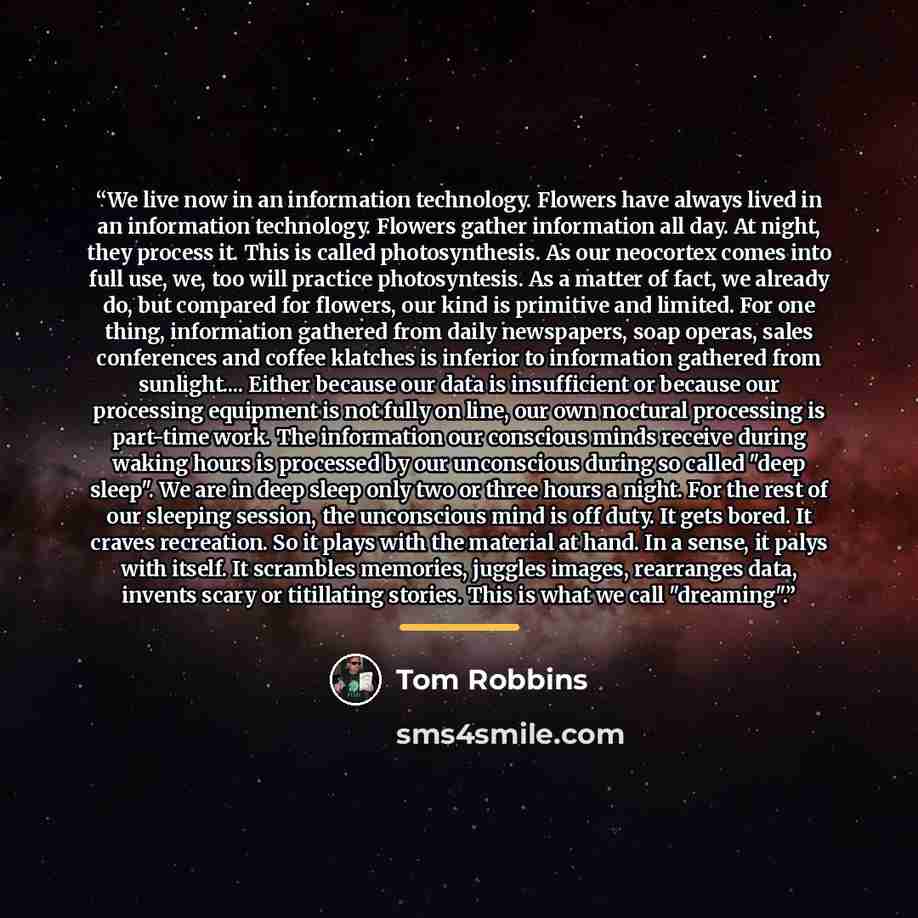
““We live now in an information technology. Flowers have always lived in an information technology. Flowers gather information all day. At night, they process it. This is called photosynthesis. As our neocortex comes into full use, we, too will practice photosyntesis. As a matter of fact, we already do, but compared for flowers, our kind is primitive and limited. For one thing, information gathered from daily newspapers, soap operas, sales conferences and coffee klatches is inferior to information gathered from sunlight… Either because our data is insufficient or because our processing equipment is not fully on line, our own noctural processing is part-time work. The information our conscious minds receive during waking hours is processed by our unconscious during so called "deep sleep". We are in deep sleep only two or three hours a night. For the rest of our sleeping session, the unconscious mind is off duty. It gets bored. It craves recreation. So it plays with the material at hand. In a sense, it palys with itself. It scrambles memories, juggles images, rearranges data, invents scary or titillating stories. This is what we call "dreaming".””
About This Quote
Source Book: Still Life with Woodpecker by Tom Robbins, 1980
Human consciousness processes daily information like plants use sunlight, but our mental 'sleep' is limited, making dreaming a fragmented, creative remix of memories.
In simple terms: Our minds work like photosynthesis but are less efficient, leading to fragmented dreaming.
Key Takeaway
Recognize the limits of conscious processing and value dreaming as creative work.
Themes
cognition
dreams
information processing
creativity
biology
Mood
curious
reflective
inquisitive
Type
philosophical
inspirational
analytical
When to use this quote
- creative problem solving
- artistic inspiration
- personal reflection
- mental health
- sleep hygiene
Key Concepts
photosynthesis metaphor
neuroscience
unconscious mind
dream theory
Questions to Reflect On
- How can we harness dream content for real‑world creativity?
- What does limited deep sleep imply for learning?
A Different Perspective
Dreaming may be chaotic and less purposeful than intended, offering limited practical insight.
![“...Bliss is not something to be got. On the other hand you are always Bliss. This desire [for Bliss] is born of the sense of incompleteness. To whom is this sense of incompleteness? Enquire. In deep sleep you were blissful. Now you are not so. What has interposed between that Bliss and this…” quote by Ramana Maharshi](https://sms4smile.com/quotes/img-quotes/e10/ramana-maharshi-915_bliss_bliss-is-not-something-to-be-got-on-the_565847.jpg)