Human condition Quote by Roger Scruton
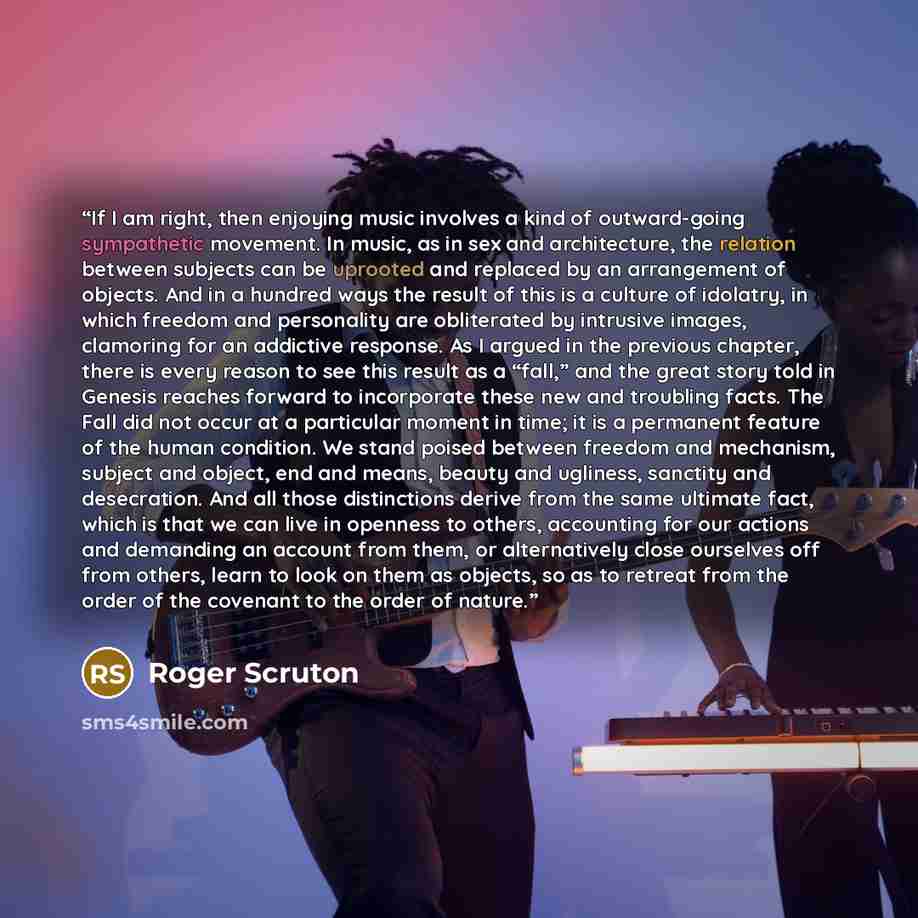
““If I am right, then enjoying music involves a kind of outward-going sympathetic movement. In music, as in sex and architecture, the relation between subjects can be uprooted and replaced by an arrangement of objects. And in a hundred ways the result of this is a culture of idolatry, in which freedom and personality are obliterated by intrusive images, clamoring for an addictive response. As I argued in the previous chapter, there is every reason to see this result as a “fall,” and the great story told in Genesis reaches forward to incorporate these new and troubling facts. The Fall did not occur at a particular moment in time; it is a permanent feature of the human condition. We stand poised between freedom and mechanism, subject and object, end and means, beauty and ugliness, sanctity and desecration. And all those distinctions derive from the same ultimate fact, which is that we can live in openness to others, accounting for our actions and demanding an account from them, or alternatively close ourselves off from others, learn to look on them as objects, so as to retreat from the order of the covenant to the order of nature.””
About This Quote
Source Book: The Aesthetics of Music, Roger Scruton, 2009
Human experience oscillates between openness and objectification, shaping culture and personal freedom.
In simple terms: We shift between seeing others as subjects or objects, affecting freedom and identity.
Key Takeaway
Recognize and choose openness over objectification.
Themes
freedom
objectification
culture
identity
ethics
Mood
reflective
critical
Type
philosophical
analytical
When to use this quote
- personal relationships
- art criticism
- social media interaction
- political discourse
Key Concepts
aesthetics
human condition
subject‑object relation
Questions to Reflect On
- How do you balance openness with self‑preservation?
- When do you treat others as objects?
A Different Perspective
Objectification can be entrenched by societal pressures, limiting true freedom.