Literature Apocalypse Quote by Richard Bauckham
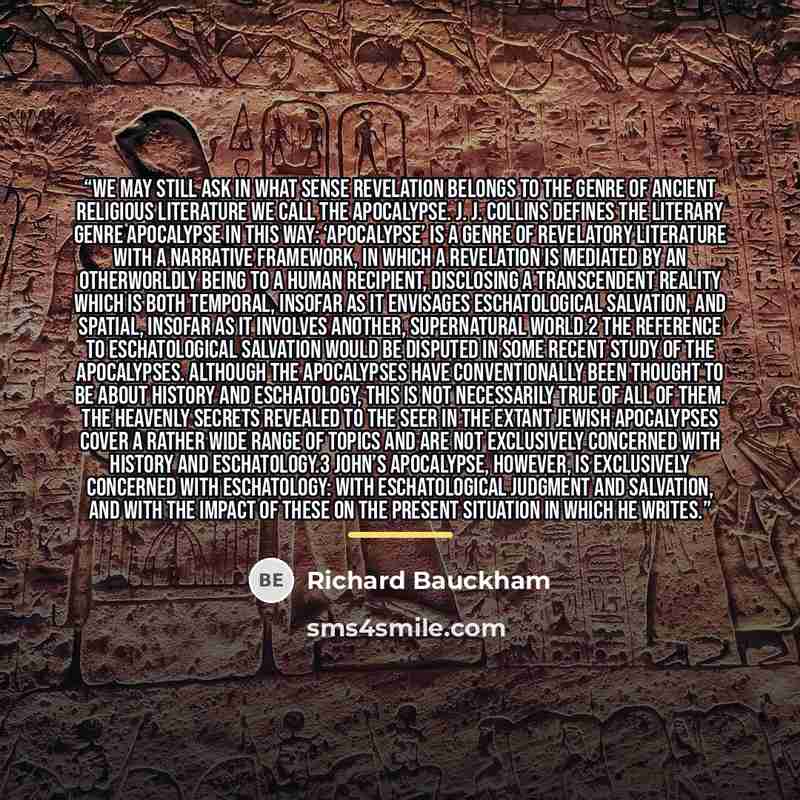
““We may still ask in what sense Revelation belongs to the genre of ancient religious literature we call the apocalypse. J. J. Collins defines the literary genre apocalypse in this way: ‘Apocalypse’ is a genre of revelatory literature with a narrative framework, in which a revelation is mediated by an otherworldly being to a human recipient, disclosing a transcendent reality which is both temporal, insofar as it envisages eschatological salvation, and spatial, insofar as it involves another, supernatural world.2 The reference to eschatological salvation would be disputed in some recent study of the apocalypses. Although the apocalypses have conventionally been thought to be about history and eschatology, this is not necessarily true of all of them. The heavenly secrets revealed to the seer in the extant Jewish apocalypses cover a rather wide range of topics and are not exclusively concerned with history and eschatology.3 John’s apocalypse, however, is exclusively concerned with eschatology: with eschatological judgment and salvation, and with the impact of these on the present situation in which he writes.””
About This Quote
Source Academic article: Revelation and Apocalyptic Literature, 2020
The passage defines apocalypse as a genre where divine revelation is delivered by a supernatural being, emphasizing its dual focus on temporal history and transcendent salvation, while noting variations across texts.
In simple terms: Apocalypse involves divine messages about both present history and future salvation.
Key Takeaway
Consider both historical and spiritual layers in apocalyptic texts.
Themes
theology
literature
revelation
Mood
analytical
thoughtful
Type
scholarly
explanatory
When to use this quote
- biblical studies
- literary analysis
- religious education
- interpretive frameworks
Key Concepts
esoteric
eschatology
genre theory
Questions to Reflect On
- What modern contexts reshape apocalyptic narratives?
- How do different cultures interpret divine revelation?
A Different Perspective
The definition may oversimplify diverse apocalyptic traditions.

![“[Jesus'] resurrection is therefore God's promise of new creation for the whole of the godforsaken reality which the crucified Jesus represents. It is therefore an event of dialectical promise: it opens up a qualitatively new future, which negates all the negatives of present experience. It opens…” quote by Richard Bauckham](https://sms4smile.com/quotes/img-quotes/dc1/richard-bauckham-18561_hope_jesus-resurrection-is-therefore-god-s-pr_566748.jpg)