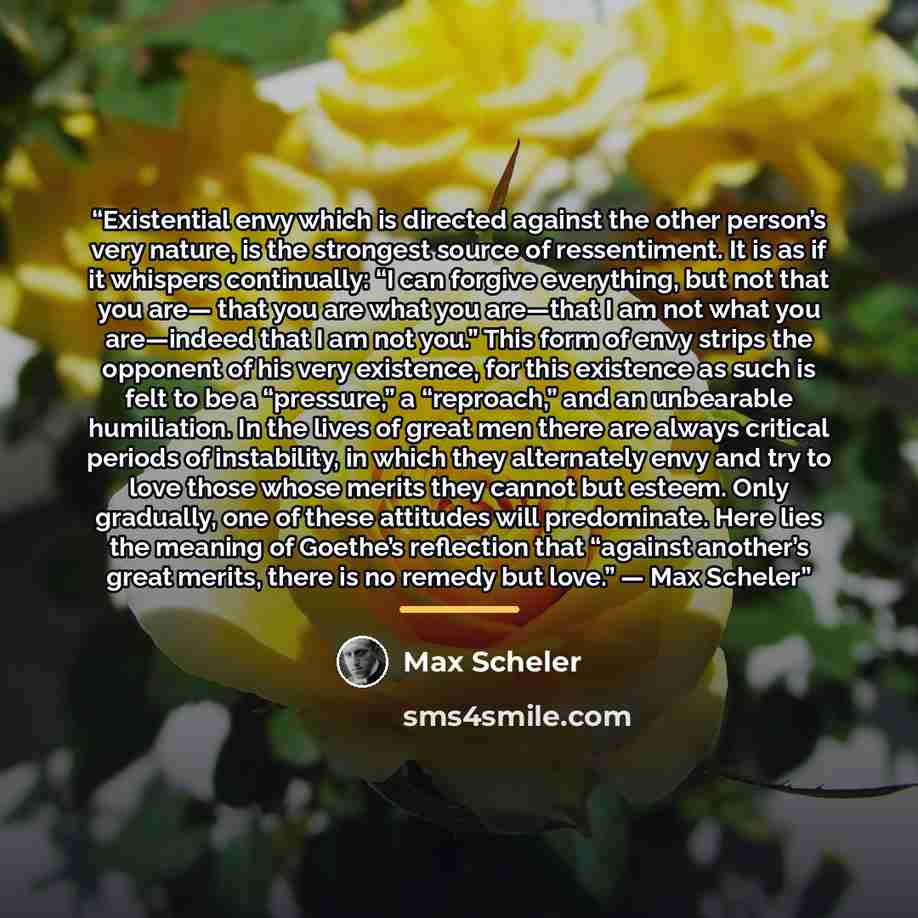
Character Quote by Max Scheler
““The “noble” person has a completely naïve and non-reflective awareness of his own value and of his fullness of being, an obscure conviction which enriches every conscious moment of his existence, as if he were autonomously rooted in the universe. This should not be mistaken for “pride.” Quite on the contrary, pride results from an experienced diminution of this “naive” self-confidence. It is a way of “holding on” to one’s value, of seizing and “preserving” it deliberately. The noble man’s naive self-confidence, which is as natural to him as tension is to the muscles, permits him calmly to assimilate the merits of others in all the fullness of their substance and configuration. He never “grudges” them their merits. On the contrary: he rejoices in their virtues and feels that they make the world more worthy of love. His naive self-confidence is by no means “compounded” of a series of positive valuations based on specific qualities, talents, and virtues: it is originally directed at his very essence and being. Therefore he can afford to admit that another person has certain “qualities” superior to his own or is more “gifted” in some respects—indeed in all respects. Such a conclusion does not diminish his naïve awareness of his own value, which needs no justification or proof by achievements or abilities. Achievements merely serve to confirm it. On the other hand, the “common” man (in the exact acceptation of the term) can only experience his value and that of another if he relates the two, and he clearly perceives only those qualities which constitute possible differences. The noble man experiences value prior to any comparison, the common man in and through a comparison. For the latter, the relation is the selective precondition for apprehending any value. Every value is a relative thing, “higher” or “lower,” “more” or “less” than his own. He arrives at value judgments by comparing himself to others and others to himself””
About This Quote
Source Book: Formalism in Ethics and Non‑Formal Ethics of Values, 1916
The noble person possesses a natural, unexamined confidence in their inherent worth, allowing them to appreciate others without comparison, unlike the common person who defines value through comparison.
In simple terms: Noble confidence is innate, not comparative.
Key Takeaway
Cultivate self‑worth without measuring against others.
Themes
philosophy
self‑esteem
humility
value
comparison
Mood
inspirational
contemplative
Type
philosophical
motivational
When to use this quote
- personal development
- leadership training
- conflict resolution
- mentoring
Key Concepts
Existentialism
Ethics of Value
Questions to Reflect On
- How can you recognize intrinsic worth?
- What practices foster genuine appreciation of others?
A Different Perspective
Overcoming societal emphasis on comparison can be difficult.






![“Love loves and in loving always looks beyond what it has in hand and possesses. The driving impulse [*Triebimpuls*] which arouses may tire out; love itself does not tire. This *sursum corda* which is the essence of love may take on fundamentally different forms at different elevations in the…” quote by Max Scheler](https://sms4smile.com/quotes/img-quotes/cc4/max-scheler-21013_axiology_love-loves-and-in-loving-always-looks-be_248149.jpg)
![“Only after the concept of knowledge has been based on an ontological relation [*Seinsverhältnis*] can we work out the particular kind of being from which the principle of immanence-to-consciousness (the starting point of Idealism and Critical Realism) mistakenly proceeds as though from a primary…” quote by Max Scheler](https://sms4smile.com/quotes/img-quotes/65c/max-scheler-21013_epistemology_only-after-the-concept-of-knowledge-has_492525.jpg)



![“All that is worthy of love [*die Liebenswürdigkeiten*], from the viewpoint of God's comprehensive love, might have been stamped and created by this act of love; man's love does not so stamp or create its objects. Man's love is restricted to recognizing the objective demand these objects make and…” quote by Max Scheler](https://sms4smile.com/quotes/img-quotes/ece/max-scheler-21013_ability-to-love_all-that-is-worthy-of-love-die-liebensw_1325365.jpg)