Psychology Quote by Karl Brunnholzl
![“If the mere nonexistence of attention and mental engagement is taken to be "nonattention" and "mental nonengagement," it is to be analyzed in what way these two [attention and mental engagement] are nonexistent. [Some utter] nonexistence is not suitable as a cause [for anything], so how could…” quote by Karl Brunnholzl](https://sms4smile.com/quotes/img-quotes/d01/karl-brunnholzl-4600_psychology_if-the-mere-nonexistence-of-attention-an_400862.jpg)
““If the mere nonexistence of attention and mental engagement is taken to be "nonattention" and "mental nonengagement," it is to be analyzed in what way these two [attention and mental engagement] are nonexistent. [Some utter] nonexistence is not suitable as a cause [for anything], so how could [plain] signlessness and [mere] nonexistence of mental engagement become the state of nonconceptuality? If just this [nonexistence of attention and mental engagement] were sufficient to be [true] nonconceptuality, this state of nonconceptuality could be entered even through fainting, since it is [a state] without attention and mental engagement. Without perfect discrimination, there are no other means in any other way to bring about nonattention and mental nonengagement. And if there is [nothing but] nonattention and mental nonengagement, without perfect discrimination, how could one engage in the lack of nature of all phenomena? Of course, the only way that phenomena actually are is that they are empty of nature. However, without discrimination and [just] through the [lack of attention and mental engagement], one will not realize this emptiness. Without the realization of emptiness, the obscurations will not be relinquished. Otherwise, everybody would always be self-liberated…””
About This Quote
Source Book: The Heart of the Buddha’s Teaching, 2005
True insight into emptiness requires discriminative awareness; mere lack of attention does not lead to liberation.
In simple terms: Understanding emptiness needs focused awareness, not just absence of thought.
Key Takeaway
Develop discriminative mindfulness to realize emptiness.
Themes
mindfulness
emptiness
discrimination
Buddhist philosophy
meditation
Mood
calm
inquisitive
Type
spiritual
educational
When to use this quote
- meditation practice
- academic study
- psychological therapy
- spiritual retreats
Key Concepts
Awareness
non‑attachment
cognitive clarity
Questions to Reflect On
- How can you cultivate sharper discriminative awareness?
- What practices help differentiate true emptiness from mental blankness?
A Different Perspective
Achieving deep discrimination can be challenging for beginners.
![“Its meaning is to rest one-pointedly on the focal object [of meditation], without being distracted by other thoughts. If this [one-pointed resting] were stopped, all meditative concentrations would stop. Therefore, in general, "mental nonengagement" has the meaning of not mentally engaging in any…” quote by Karl Brunnholzl](https://sms4smile.com/quotes/img-quotes/604/karl-brunnholzl-4600_focus_its-meaning-is-to-rest-one-pointedly-on_1635099.jpg)
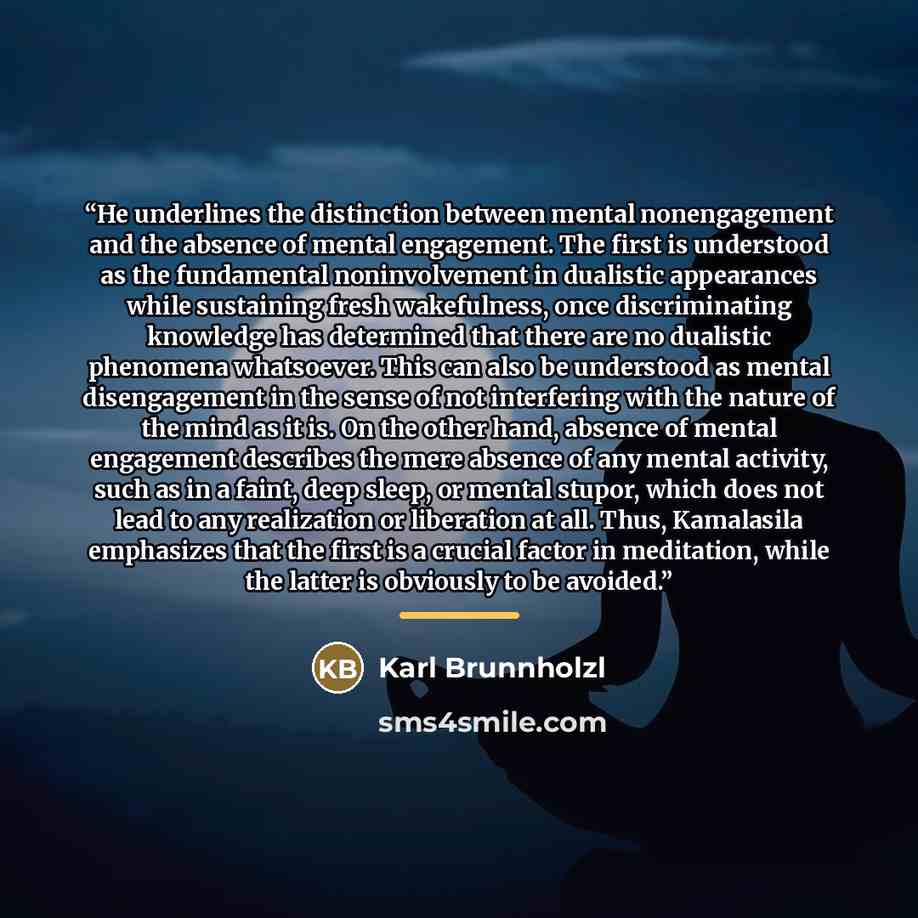





![“Hence, [emptiness] is also not an object of [something like the] cognition of Buddhas, because they do not have [such a thing as] cognition.” quote by Karl Brunnholzl](https://sms4smile.com/quotes/img-quotes/c69/karl-brunnholzl-4600_emptiness_hence-emptiness-is-also-not-an-object-of_55069.jpg)
![“Here, master Bhavya states [this as] the main argument, and then he formulates four autonomous reasons as the means to prove the subject property. The venerable and fearless Candrakirti presents this by labeling the mere refutation of arising from the four extremes a "position." He teaches the…” quote by Karl Brunnholzl](https://sms4smile.com/quotes/img-quotes/cb7/karl-brunnholzl-4600_logic_here-master-bhavya-states-this-as-the-ma_140001.jpg)
![“Therefore, everything is the illusory magical display of one's own mind. It is appearing yet delusive, and delusive while appearing. Thus, all of it is contained in the body, and the [body] is again contained in the mind. As for the mind, it has no color and no shape. It is natural luminosity that…” quote by Karl Brunnholzl](https://sms4smile.com/quotes/img-quotes/8f8/karl-brunnholzl-4600_psychology_therefore-everything-is-the-illusory-mag_189022.jpg)
![“Not only can nobody deny the appearance of mere consciousness whose nature is other-dependent and not affected by the flaw of conceptions of a body with form and so on, but those who make any such [denial] only invalidate themselves by perception and such.” quote by Karl Brunnholzl](https://sms4smile.com/quotes/img-quotes/52d/karl-brunnholzl-4600_consciousness_not-only-can-nobody-deny-the-appearance_199293.jpg)