Christ Quote by Karim El Koussa
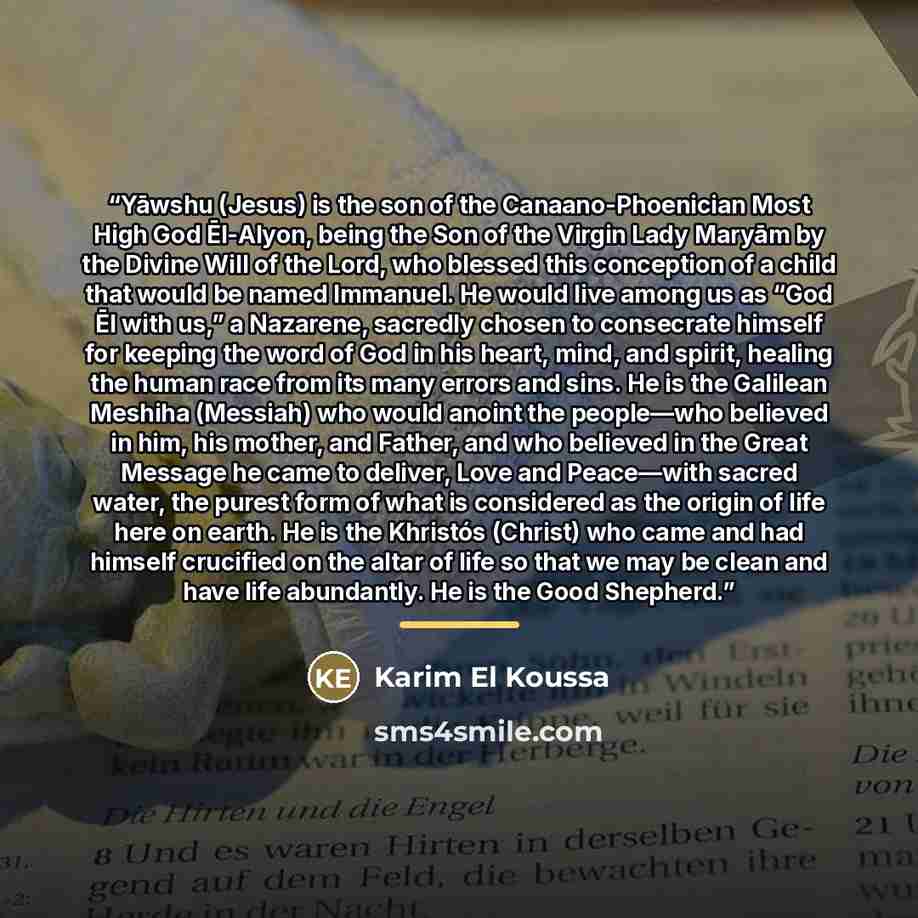
““Yāwshu (Jesus) is the son of the Canaano-Phoenician Most High God Ēl-Alyon, being the Son of the Virgin Lady Maryām by the Divine Will of the Lord, who blessed this conception of a child that would be named Immanuel. He would live among us as “God Ēl with us,” a Nazarene, sacredly chosen to consecrate himself for keeping the word of God in his heart, mind, and spirit, healing the human race from its many errors and sins. He is the Galilean Meshiha (Messiah) who would anoint the people—who believed in him, his mother, and Father, and who believed in the Great Message he came to deliver, Love and Peace—with sacred water, the purest form of what is considered as the origin of life here on earth. He is the Khristós (Christ) who came and had himself crucified on the altar of life so that we may be clean and have life abundantly. He is the Good Shepherd.””
About This Quote
Source Religious text: Unspecified theological commentary, 2020
The passage describes Jesus as divine, a messianic figure, and a shepherd, emphasizing his role in salvation and love.
In simple terms: Jesus is portrayed as a divine shepherd who brings love and salvation.
Key Takeaway
Recognize the spiritual symbolism of shepherding in faith.
Themes
faith
divinity
salvation
Mood
reflective
contemplative
Type
theological
inspirational
When to use this quote
- Sermon delivery
- theological study
- interfaith dialogue
Key Concepts
Messianic prophecy
spiritual leadership
Questions to Reflect On
- What does the shepherd metaphor convey about leadership?
- How does this view of Jesus compare to other traditions?
A Different Perspective
Interpretations vary across religions, challenging universal acceptance.



![“T]he church is not a place. It's not a building. It's not a preaching point. It's not a spiritual service provider. It's a people - the new covenant, blood-bought people of God. That's why Paul said, 'Christ loved the church and gave himself up for her' (Eph. 5:25). He didn't give himself up for a…” quote by Mark Dever](https://sms4smile.com/quotes/img-quotes/7a4/mark-dever-3175_blood_t-he-church-is-not-a-place-it-s-not-a-bu_3297.jpg)