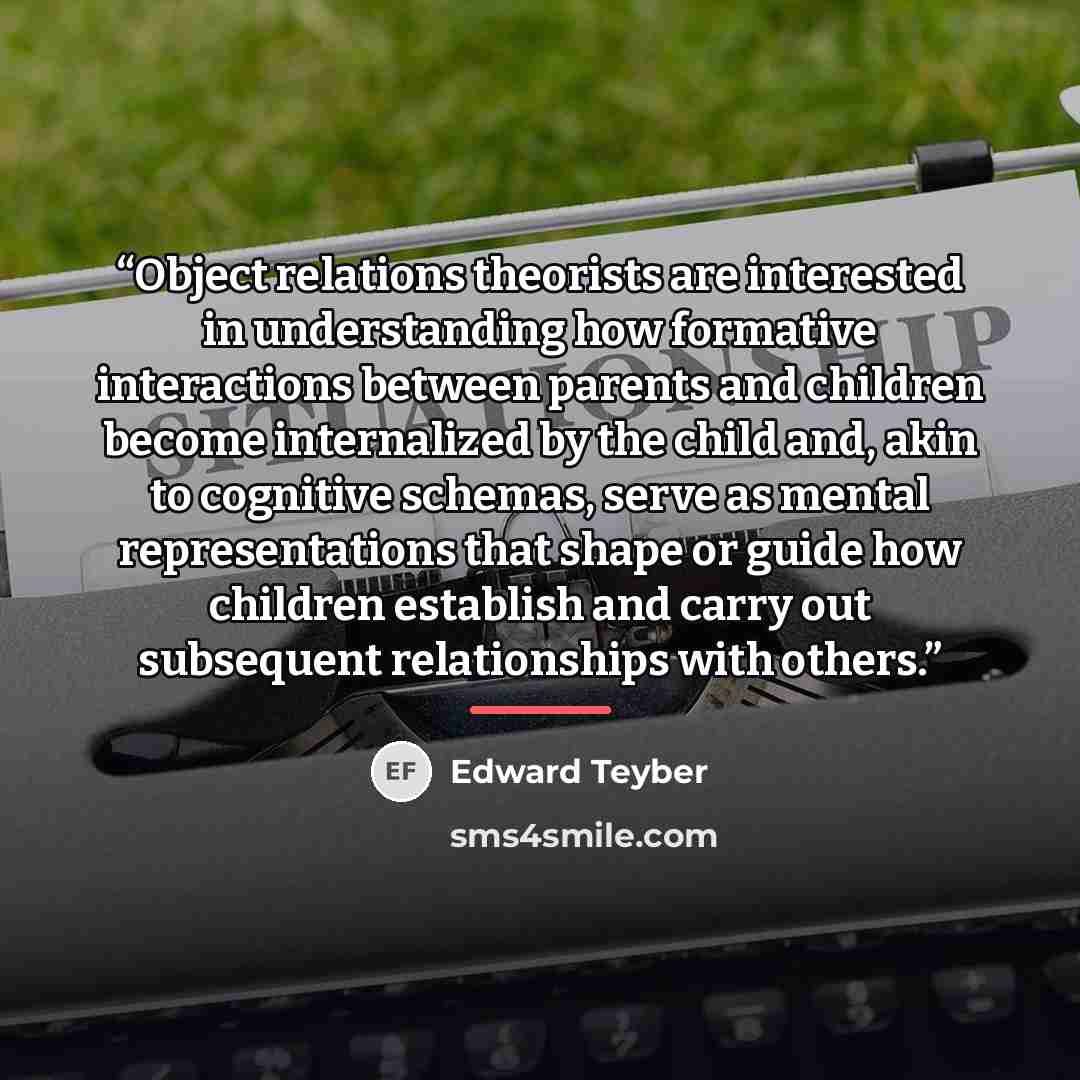
Relationships Quote by Edward Teyber

““Following Strupp (1980), clients change when they live through emotionally painful and long-ingrained relational experiences with the therapist, and the therapeutic relationship gives rise to new and better outcomes that are different from those anticipated and feared. That is, when the client re-experiences important aspects of her primary problem with the therapist, and the therapist’s response does not fit the old schemas or expectations, the client has the real-life experience that relationships can be another way. When clients experience this new or reparative response, a response that differs from previous relationships and that does not fit the client’s negative expectations or cognitive schemas, it is a powerful type of experiential re-learning that readily can be generalized to other relationships (Bandura, 1997).””
About This Quote
Source Article: Psychotherapy Research, 1990, “Therapeutic Change and Experiential Relearning”
Clients change when therapy provides novel, corrective relational experiences that contradict old negative schemas, enabling new learning that generalizes to other relationships.
In simple terms: Therapy can reshape expectations by offering different relational responses.
Key Takeaway
Seek therapeutic relationships that challenge old patterns.
Themes
therapyapeutic change
relational learning
schema revision
experiential learning
Mood
hopeful
reflective
Type
clinical
educational
When to use this quote
- Couples therapy
- trauma counseling
- long‑term psychotherapy
- relationship coaching
Key Concepts
Attachment theory
cognitive restructuring
Bandura social learning
Questions to Reflect On
- How can therapists recognize when they are repeating a client’s negative expectations?
- What signs indicate a client is internalizing new relational patterns?
A Different Perspective
If the therapist unintentionally reinforces old schemas, change may not occur.