Depressed person Quote by Chuck Klosterman
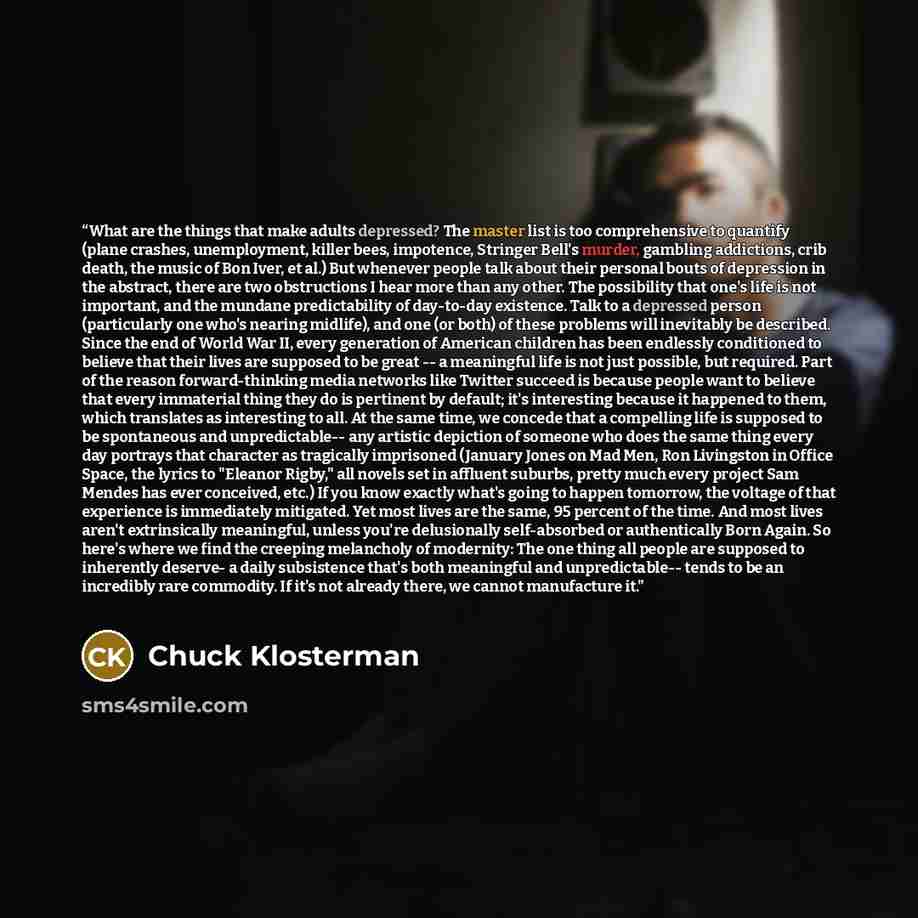
““What are the things that make adults depressed? The master list is too comprehensive to quantify (plane crashes, unemployment, killer bees, impotence, Stringer Bell's murder, gambling addictions, crib death, the music of Bon Iver, et al.) But whenever people talk about their personal bouts of depression in the abstract, there are two obstructions I hear more than any other. The possibility that one's life is not important, and the mundane predictability of day-to-day existence. Talk to a depressed person (particularly one who's nearing midlife), and one (or both) of these problems will inevitably be described. Since the end of World War II, every generation of American children has been endlessly conditioned to believe that their lives are supposed to be great -- a meaningful life is not just possible, but required. Part of the reason forward-thinking media networks like Twitter succeed is because people want to believe that every immaterial thing they do is pertinent by default; it's interesting because it happened to them, which translates as interesting to all. At the same time, we concede that a compelling life is supposed to be spontaneous and unpredictable-- any artistic depiction of someone who does the same thing every day portrays that character as tragically imprisoned (January Jones on Mad Men, Ron Livingston in Office Space, the lyrics to "Eleanor Rigby," all novels set in affluent suburbs, pretty much every project Sam Mendes has ever conceived, etc.) If you know exactly what's going to happen tomorrow, the voltage of that experience is immediately mitigated. Yet most lives are the same, 95 percent of the time. And most lives aren't extrinsically meaningful, unless you're delusionally self-absorbed or authentically Born Again. So here's where we find the creeping melancholy of modernity: The one thing all people are supposed to inherently deserve- a daily subsistence that's both meaningful and unpredictable-- tends to be an incredibly rare commodity. If it's not already there, we cannot manufacture it.””
About This Quote
Source Essay: "The End of the World as We Know It", The New York Times Magazine, 2015
The quote argues that modern depression stems from feeling life lacks importance and from the monotony of predictable daily routines, intensified by cultural expectations of a meaningful, unpredictable existence.
In simple terms: Depression linked to meaninglessness and routine.
Key Takeaway
Seek purpose and embrace uncertainty.
Themes
meaninglessness
routine
modernity
expectations
mental health
Mood
reflective
somber
analytical
Type
observational
critical
philosophical
When to use this quote
- career counseling
- therapy
- creative projects
- mindfulness practices
- community engagement
Key Concepts
existentialism
psychology
social conditioning
Questions to Reflect On
- How can you create meaning in everyday tasks?
- What small changes can break predictability?
A Different Perspective
Not everyone experiences depression from these sources; some find meaning in routine.