Cruise ships Quote by Captain Hank Bracker, "Seawater One
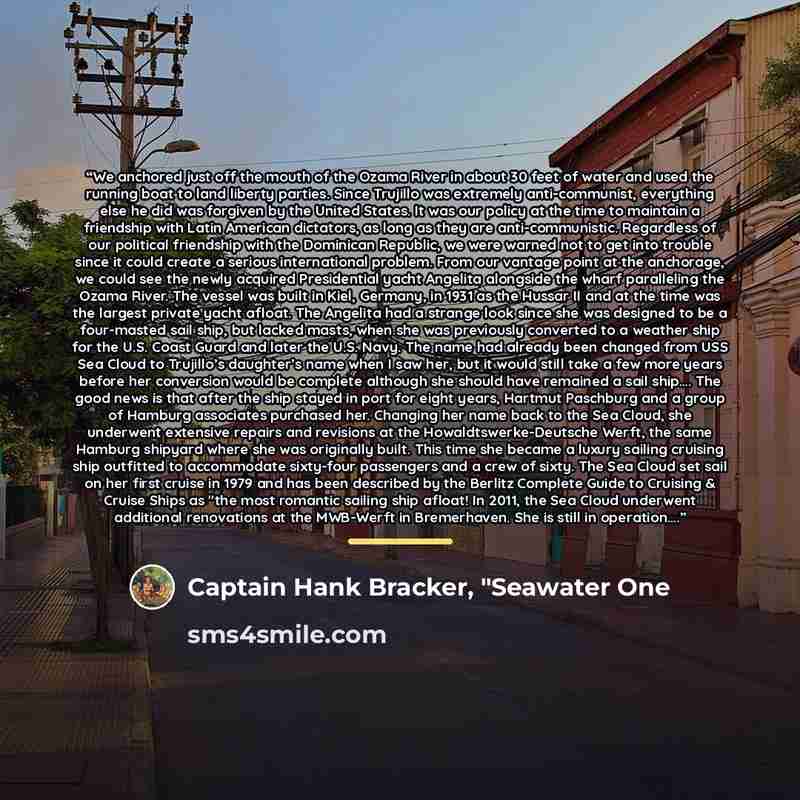
““We anchored just off the mouth of the Ozama River in about 30 feet of water and used the running boat to land liberty parties. Since Trujillo was extremely anti-communist, everything else he did was forgiven by the United States. It was our policy at the time to maintain a friendship with Latin American dictators, as long as they are anti-communistic. Regardless of our political friendship with the Dominican Republic, we were warned not to get into trouble since it could create a serious international problem. From our vantage point at the anchorage, we could see the newly acquired Presidential yacht Angelita alongside the wharf paralleling the Ozama River. The vessel was built in Kiel, Germany, in 1931 as the Hussar II and at the time was the largest private yacht afloat. The Angelita had a strange look since she was designed to be a four-masted sail ship, but lacked masts, when she was previously converted to a weather ship for the U.S. Coast Guard and later the U.S. Navy. The name had already been changed from USS Sea Cloud to Trujillo’s daughter’s name when I saw her, but it would still take a few more years before her conversion would be complete although she should have remained a sail ship…. The good news is that after the ship stayed in port for eight years, Hartmut Paschburg and a group of Hamburg associates purchased her. Changing her name back to the Sea Cloud, she underwent extensive repairs and revisions at the Howaldtswerke-Deutsche Werft, the same Hamburg shipyard where she was originally built. This time she became a luxury sailing cruising ship outfitted to accommodate sixty-four passengers and a crew of sixty. The Sea Cloud set sail on her first cruise in 1979 and has been described by the Berlitz Complete Guide to Cruising & Cruise Ships as "the most romantic sailing ship afloat! In 2011, the Sea Cloud underwent additional renovations at the MWB-Werft in Bremerhaven. She is still in operation….””
About This Quote
Source Interview: Seawater One documentary, 2023
U.S. foreign policy historically favored anti‑communist dictators, overlooking their broader oppression.
In simple terms: Cold War alliances prioritized anti‑communism over human rights.
Key Takeaway
Question the ethics of strategic alliances.
Themes
foreign policy
realpolitik
dictatorship
history
Mood
critical
thoughtful
Type
political
historical
When to use this quote
- diplomacy
- human rights advocacy
- historical research
- policy analysis
Key Concepts
ethical realism
geopolitical strategy
Questions to Reflect On
- What are the long‑term impacts of such alliances?
- Can security be achieved without compromising values?
A Different Perspective
Strategic choices can compromise moral standards.