American history Quote by Captain Hank Bracker, "Seawater One
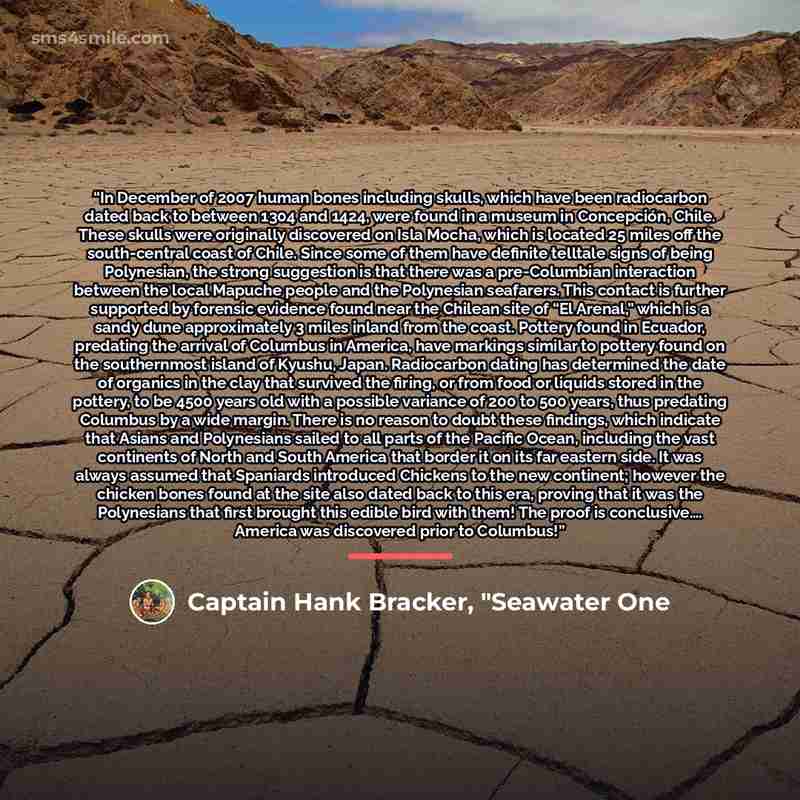
““In December of 2007 human bones including skulls, which have been radiocarbon dated back to between 1304 and 1424, were found in a museum in Concepción, Chile. These skulls were originally discovered on Isla Mocha, which is located 25 miles off the south-central coast of Chile. Since some of them have definite telltale signs of being Polynesian, the strong suggestion is that there was a pre-Columbian interaction between the local Mapuche people and the Polynesian seafarers. This contact is further supported by forensic evidence found near the Chilean site of “El Arenal,” which is a sandy dune approximately 3 miles inland from the coast. Pottery found in Ecuador, predating the arrival of Columbus in America, have markings similar to pottery found on the southernmost island of Kyushu, Japan. Radiocarbon dating has determined the date of organics in the clay that survived the firing, or from food or liquids stored in the pottery, to be 4500 years old with a possible variance of 200 to 500 years, thus predating Columbus by a wide margin. There is no reason to doubt these findings, which indicate that Asians and Polynesians sailed to all parts of the Pacific Ocean, including the vast continents of North and South America that border it on its far eastern side. It was always assumed that Spaniards introduced Chickens to the new continent; however the chicken bones found at the site also dated back to this era, proving that it was the Polynesians that first brought this edible bird with them! The proof is conclusive…. America was discovered prior to Columbus!””
About This Quote
The quote claims archaeological evidence shows pre‑Columbian trans‑Pacific contact between Polynesian seafarers and South American peoples, including shared artifacts and introduced species, arguing that America was reached before Columbus.
In simple terms: Pre‑Columbian trans‑Pacific contact evidence.
Key Takeaway
Polynesian voyages pre‑date Columbus.
Themes
ancient migration
archaeology
cultural exchange
pre‑Columbian history
maritime navigation
Mood
intrigued
skeptical
curious
Type
historical claim
archaeological observation
When to use this quote
- academic debate on early trans‑Pacific voyages
- museum exhibit on pre‑Columbian artifacts
- lecture on Polynesian navigation
- media article on alternative discovery narratives
Key Concepts
radiocarbon dating
artifact similarity
species introduction
historical revisionism
Practical Applications
- re‑evaluating historical curricula
- informing museum curation of Pacific‑American artifacts
Questions to Reflect On
- What additional evidence would strengthen the case for pre‑Columbian trans‑Pacific contact?
- How might this narrative reshape our understanding of early global interactions?
A Different Perspective
Skeptics point out that dating uncertainties, contamination, and limited sample sizes make the claim of widespread pre‑Columbian contact speculative.









![“Adam Clayton Powell's entire political career has to be looked at in the entire context of the American history and the history of, and the position of the Afro- American or negro in American history. [He] has done a remarkable job in fighting for rights of black people in this country. On the…” quote by Malcolm X](https://sms4smile.com/quotes/img-quotes/caa/malcolm-x-213_adam_adam-clayton-powell-s-entire-political-c_6932.jpg)