Failure Quote by Arthur Schopenhauer
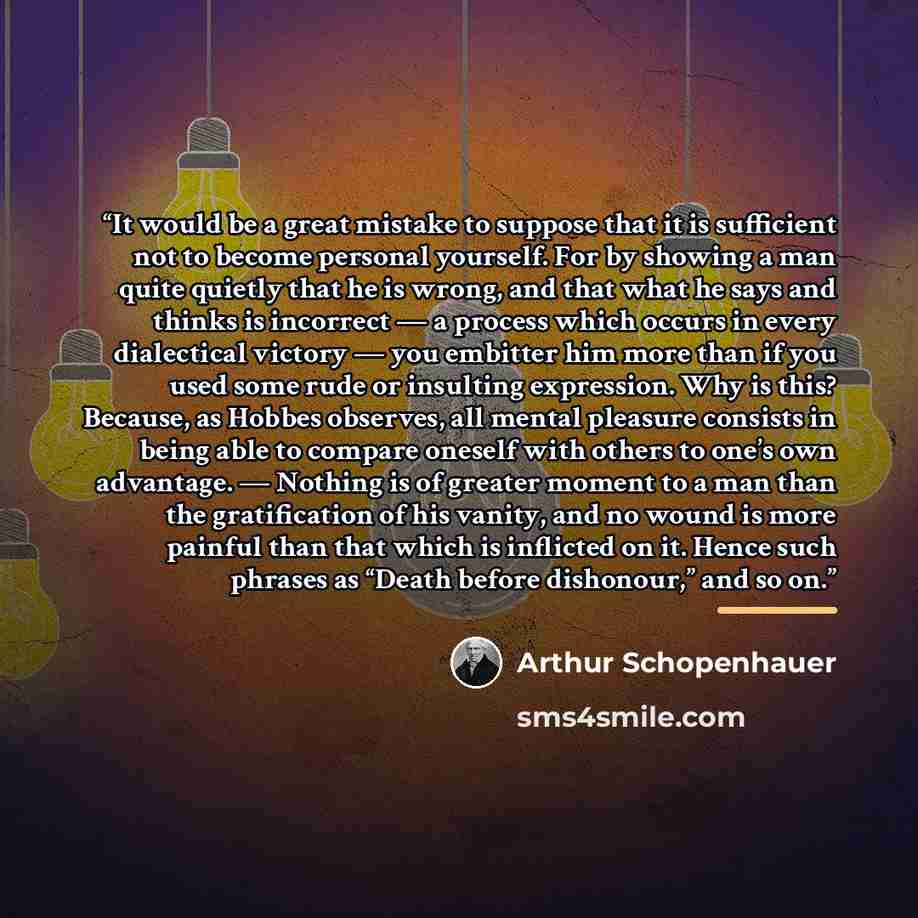
““It would be a great mistake to suppose that it is sufficient not to become personal yourself. For by showing a man quite quietly that he is wrong, and that what he says and thinks is incorrect — a process which occurs in every dialectical victory — you embitter him more than if you used some rude or insulting expression. Why is this? Because, as Hobbes observes, all mental pleasure consists in being able to compare oneself with others to one’s own advantage. — Nothing is of greater moment to a man than the gratification of his vanity, and no wound is more painful than that which is inflicted on it. Hence such phrases as “Death before dishonour,” and so on.””
About This Quote
Source Book: The World as Will and Representation, Arthur Schopenhauer, 1818
Criticizing personal attacks, the quote argues that subtle correction wounds pride more than overt insults because vanity seeks comparison and advantage.
In simple terms: Gentle correction hurts pride more than rude insults.
Key Takeaway
Avoid humiliating others; use respectful dialogue.
Themes
humility
communication
pride
psychology
Mood
reflective
cautious
Type
philosophical
ethical
When to use this quote
- workplace feedback
- academic debate
- personal relationships
- conflict resolution
Key Concepts
dialectics
ego
social dynamics
Questions to Reflect On
- How can you correct someone without bruising their ego?
- When is direct confrontation preferable?
A Different Perspective
Subtle criticism can backfire if it threatens self‑image.










![“[T]he appropriate form of address between man and man ought to be, not monsieur, sir, but fellow sufferer, compagnon de miseres.” quote by Arthur Schopenhauer](https://sms4smile.com/quotes/img-quotes/be6/arthur-schopenhauer-226_addresses_t-he-appropriate-form-of-address-between_32897.jpg)

![“[Materialism] seeks the primary and most simple state of matter, and then tries to develop all the others from it; ascending from mere mechanism, to chemism, to polarity, to the vegetable and to the animal kingdom. And if we suppose this to have been done, the last link in the chain would be…” quote by Arthur Schopenhauer](https://sms4smile.com/quotes/img-quotes/88c/arthur-schopenhauer-226_animal-kingdom_materialism-seeks-the-primary-and-most-s_50402.jpg)